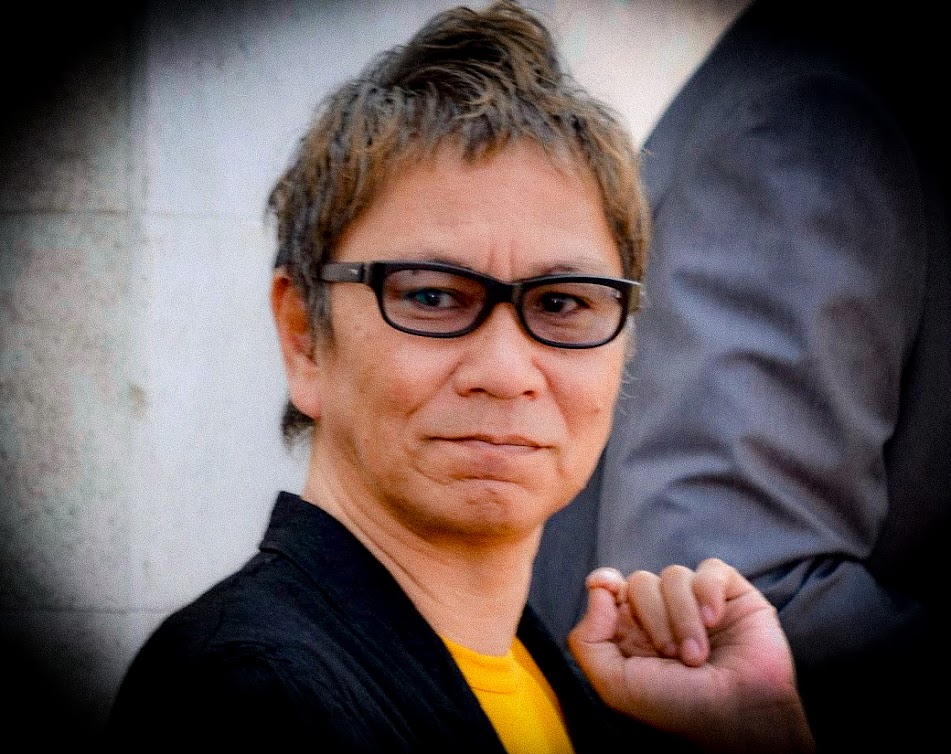
The cinematic trajectory of Takashi Miike represents one of the most significant and enigmatic case studies in the history of contemporary global film. Since his emergence in the early 1990s, Miike has defied the traditional constraints of authorship, moving fluidly between the marginalized realms of direct-to-video "V-Cinema" and the prestigious competition stages of the Cannes and Venice Film Festivals. His filmography, which exceeds one hundred directorial credits, serves as a dense tapestry of genre subversion, ranging from the graphic ultraviolence of Ichi the Killer to the delicate psychological horror of Audition, the surrealist musical comedy of The Happiness of the Katakuris, and the high-prestige samurai epics of his later career. This analysis provides an exhaustive exploration of Miike’s work, examining the socio-economic origins of his career, his idiosyncratic production philosophy, his influence on international cinema, and his ongoing evolution as he enters a new era of cross-cultural collaboration in the mid-2020s.
Socio-Economic Origins and the Imamura Legacy
The foundations of Takashi Miike’s creative identity are inextricably linked to the industrial and cultural landscape of post-war Japan. Born on August 24, 1960, in Yao, Osaka Prefecture, Miike was raised in a working-class environment that deeply influenced his thematic interest in characters living at the periphery of society. His father was a welder and his mother a seamstress, a background of manual labor that likely contributed to his later view of filmmaking as a form of "simple work" or industrial production. His family history was marked by the complexities of Japan’s mid-century expansion and displacement; his paternal grandfather was stationed in China and Korea during World War II, and his father was born in Seoul. This ancestral connection to the "foreign" or the "outsider" manifests in Miike’s recurring focus on the Zainichi Korean community and other displaced populations in Japan.
During his formative years, Miike showed little interest in academic pursuits, finding passion instead in motorcycle culture and professional racing. This early obsession with speed and kinetic energy can be traced through the visual language of his films, which often prioritize momentum and visceral impact over traditional narrative structure. His decision to enroll in the Yokohama Vocational School of Broadcast and Film at the age of 18 was, by his own admission, a pragmatic attempt to find a career path rather than a sudden artistic awakening. The school, founded by the legendary filmmaker Shohei Imamura, provided Miike with a professional framework that prioritized the "humanist" exploration of the lower depths of society.
While Miike frequently claims he rarely attended classes, his natural aptitude for the logistical demands of television production led Imamura to nominate him for an unpaid internship. This initial foray into the industry as an assistant director allowed Miike to master the mechanics of production under high-pressure conditions. His reflections on his time as Imamura’s assistant highlight a critical realization: that a filmmaker can only create work that is a reflection of their own character and life experience. While Imamura’s own work was deeply researched and meticulously planned, Miike adopted a more spontaneous and prolific approach, viewing the film set as a space for "play" rather than rigid intellectual inquiry.
The V-Cinema Crucible and the Black Society Trilogy
The early 1990s in Japan saw the emergence of "V-Cinema" (direct-to-video), a medium that would serve as the crucible for Miike’s early experimentation. This period of economic expansion allowed for a high volume of low-budget releases that were subject to significantly less stringent censorship than theatrical films. For Miike, V-Cinema was not a stepping stone but a vital space of creative freedom where he could hone his skill for "off-color and risky content". Between 1991 and 1995, he directed nearly a dozen direct-to-video projects, including Eyecatch Junction, Lady Hunter: Prelude to Murder, and the Bodyguard Kiba series.
This high-speed production cycle allowed Miike to develop a unique directorial shorthand and a comfort with transgressive imagery. His theatrical debut, The Third Gangster (1995), marked his transition to larger screens, but it was Shinjuku Triad Society (1995) that first garnered significant critical and public attention. This film initiated the "Black Society" (or "Black Triad") trilogy, an exploration of the violent intersections between the Japanese yakuza and Chinese triads in the Shinjuku district. The trilogy—completed by Rainy Dog (1997) and Ley Lines (1999)—remains a cornerstone of his early career, showcasing his ability to blend nihilistic violence with a contemplative, often noir-infused character study.
Rainy Dog, in particular, demonstrated a more minimalist and emotionally resonant side of Miike’s work, focusing on a Japanese hitman living in exile in Taiwan who forms a bond with his mute son. This willingness to pivot between extreme violence and quiet character studies became a hallmark of his career, confusing critics who sought to pigeonhole him as a mere purveyor of shock. The Black Society films established Miike as a director deeply concerned with the "outsider" in Japan—characters who exist between cultures, languages, and moral systems.
International Breakthrough: Audition and the Aesthetic of Dread
The turn of the millennium marked Takashi Miike’s ascension to global cult icon status, a shift driven largely by the 1999 release of Audition. Adapted from a novel by Ryu Murakami, Audition was produced by the Omega Project, the same company behind Hideo Nakata’s Ring. However, while Ring focused on supernatural horror, Audition was designed to be something different—a film that began as a delicate romance before descending into psychological and physical nightmare.
The film follows a widower who, encouraged by his son, stages a fake film audition to find a new wife. He becomes infatuated with the seemingly fragile Asami, played by model-turned-actress Eihi Shiina. Miike’s brilliance in Audition lies in his manipulation of pacing; the film spends the majority of its runtime as a slow-burn melodrama, which only makes the explosive violence of the finale more jarring. This contrast between non-horrific imagery and extreme torture became a defining characteristic of his "Asian Extreme" style.
The international reception of Audition was polarizing but overwhelmingly positive among critics, who viewed it as a masterclass in psychological horror. It initiated a global discourse on themes of gender and power, with many critics in the United Kingdom and France identifying strong feminist undertones in Asami’s revenge against the men who sought to control her. The film’s cinematographer, Hideo Yamamoto, brought a "sensitivity towards death" to the project, influenced by his own personal history, which Miike utilized to create an atmosphere of profound unease.
The "Asian Extreme" and the Peak of Transgression
In the wake of Audition, Miike entered a period of intense, hyper-prolific production that challenged the boundaries of cinematic acceptability. Ichi the Killer (2001), an adaptation of the manga by Hideo Yamamoto, became one of the most notorious films of the decade. Centered on the pursuit of a disturbed killer named Ichi by the sadistic yakuza enforcer Kakihara, the film featured graphic depictions of sadomasochism and ultraviolence that led to its being banned or heavily censored in multiple countries, including Germany, Malaysia, and Norway. Despite this controversy—or perhaps because of it—Ichi the Killer achieved legendary status in the international horror and action communities.
Parallel to this, Miike released Visitor Q (2001), a dark and confrontational satire of the dysfunctional Japanese family. Shot in a mockumentary style on low-grade digital video, the film explores themes of incest, abuse, addiction, and necrophilia. Yet, even within this extreme content, critics identified a "twisted narrative of redemption," suggesting that Miike’s intent was to provide a bold social commentary on the breakdown of traditional societal structures. This ability to find moments of "surprising warmth" in the most abject circumstances is a recurring paradox in Miike’s work.
The Dead or Alive trilogy also exemplified this period of "gleeful insanity". While the films are nominally yakuza crime dramas, they frequently veer into surrealism and meta-commentary. The first film famously ends with the literal destruction of the world, a narrative choice that dramatizes the conflict between an "immovable object" and an "unstoppable force". Miike used these grand finales to reflect on broader cultural anxieties, including the repercussions of thermonuclear war, a subject that continues to resonate in post-WWII Japanese society.
Prolificacy and the Philosophy of "High-Volume Production"
One of the most remarkable aspects of Takashi Miike’s career is his industrial efficiency. He has often released four or five films in a single year, a pace that he attributes to his own perceived "laziness" as a child. He has stated in interviews that he overcompensates for his childhood lack of focus by staying busy, viewing his work as a way to "pay for his sins" through constant activity. This "high-volume" approach is not merely a quantitative feat; it is a creative philosophy that views filmmaking as a process of discovery rather than the execution of a pre-determined vision.
Miike describes his process as being akin to a sculptor who sets free what is already within the stone. He attempts to avoid "intentional aspiration," believing that putting too much of his own desire into a film turns it into a "job" rather than "play". This "childlike sense of play" is essential to his work, even in his most violent projects. By immersing himself completely in the filmmaking process and "losing himself," he claims to create films that are natural reflections of who he is.
This philosophy also informs his approach to genre. Miike refuses to be restricted by tone, moving from children’s films like The Great Yokai War (2005) and Ninja Kids!!! (2011) to musical horror like The Happiness of the Katakuris (2001). In Katakuris, he combines zombies, claymation sequences, and family melodrama into a surreal musical comedy, demonstrating a "rare blend of genres" that highlights his unpredictability. For Miike, the excitement of the cast and crew is the primary indicator of a film’s success; if the production environment is characterized by joy and exploration, that energy will inevitably shine through to the audience.
The Samurai Epics and Mainstream Recognition
As Takashi Miike’s career matured, he began to receive significant recognition from the mainstream Japanese film industry and major international festivals. This shift was catalyzed by his work in the jidaigeki (period drama) genre. 13 Assassins (2010), a remake of the 1963 classic by Eiichi Kudo, was a critical and commercial triumph that was nominated for the Golden Lion at the Venice Film Festival. The film is celebrated for its flawless choreography and its climactic 45-minute battle sequence, which captures the spirit of classic samurai cinema while injecting Miike’s signature kinetic energy.
Following this, Miike directed Hara-Kiri: Death of a Samurai (2011), a 3D remake of Masaki Kobayashi’s 1962 masterpiece, which premiered in competition at the Cannes Film Festival. This was the first 3D film ever to screen in competition at Cannes, marking a significant milestone in Miike’s career. His 2013 spy thriller Straw Shield (also known as Wara no Tate) was also nominated for the Palme d'Or. These works signaled a transition toward more polished and "acceptable" mainstream productions, although they retained his interest in extreme pressure, moral dilemmas, and the cooperation of disparate individuals.
In these period pieces, Miike explored the rigid codes of the samurai class, often highlighting the tension between duty and human emotion. Blade of the Immortal (2017), his 100th feature film, continued this exploration. Adapted from Hiroaki Samura’s manga, the film follows an ageless samurai seeking redemption. Despite the supernatural premise, Miike focused on the bonds formed between the characters, utilizing a visual style that evoked hand-drawn manga panels through elegant CGI and glossy color correction.
Multimedia Adaptations: Manga and Video Games
A substantial portion of Miike’s later output consists of adaptations of popular Japanese media, including manga and video games. His approach to adaptation is characterized by a deep emotional investment in the source material. For instance, in JoJo’s Bizarre Adventure: Diamond Is Unbreakable – Chapter 1 (2017), Miike’s team collaborated with manga creator Hirohiko Araki to maintain the integrity of the original artwork, resulting in digital "Stands" that evoked hand-drawn cartoon figures within a real-world setting.
Miike’s ability to translate the "bigness" and "manic energy" of manga into live-action is evident in projects like Ninja Kids!!! and Yatterman (2009). In the realm of video games, he directed Like a Dragon (2007)—based on the Yakuza series—and Ace Attorney (2012), which was praised for its beautifully silly performances and commitment to the "goofy worlds" of the original games. More recently, he directed the anime series Onimusha (2023), mirroring his earlier samurai films like 13 Assassins and Hara-Kiri.
His latest adaptation, Nyaight of the Living Cat, continues this trend of exploring "goofy worlds" with an apocalyptic horror comedy tone. Miike’s directorial style in these projects is often defined by over-the-top depictions of violence and sexuality that tonally mirror gory manga like Hellsing or Berserk. This stylistic fluidity allows him to communicate a sense of consequence and grandeur regardless of whether the "monsters" are supernatural spirits or battling toys.
Influence on International Cinema and the "Godfather" Role
Takashi Miike’s influence on global cinema is profound, particularly within the horror and exploitation genres. Western directors like Quentin Tarantino and Eli Roth have frequently acknowledged his impact. Eli Roth cited Audition as a direct inspiration for his 2005 film Hostel, and Miike even made a cameo appearance in the film as a nod to this relationship. Tarantino, a longtime champion of Asian genre cinema, has listed Audition as one of the best horror films ever made.
This international standing was formalized in 2026 when the Cannes Marché du Film named Miike the "Godfather" of its Fantastic 7 initiative. This program, which showcases seven genre projects from international festivals—including Sitges, Bucheon, and Cairo—chose Miike because his career reflects the "very essence of Fantastic 7: daring visions, inventive storytelling, and uncompromising creativity". This role cements Miike’s status not just as a provocative filmmaker, but as a bridge between the tradition of Japanese genre cinema and the future of global fantastic film.
The 2024–2026 Phase: Cross-Cultural Collaboration
As of mid-2026, Takashi Miike remains at the forefront of cinematic innovation, embracing both new production technologies and high-profile international partnerships. In 2024, he released Midnight, an action short film shot entirely on the iPhone 15 Pro, demonstrating his continued willingness to experiment with the logistical constraints of filmmaking.
The Untitled Kyoto Project (2026)
One of the most anticipated projects of his recent career is the upcoming slasher-horror film currently known as the "Untitled Kyoto Project". Starring British pop icon Charli xcx, the film follows three friends on a trip to Kyoto that devolves into a nightmare when one of them (played by Charli) becomes possessed by a tortured spirit in the Japanese horror tradition. The spirit is portrayed by Kiko Mizuhara, and the cast includes significant international talent such as Milly Alcock (Supergirl), Norman Reedus (The Walking Dead), and Show Kasamatsu (Tokyo Vice).
The project is an original idea conceived by Charli and Miike, with a script penned by Ross Evans and Yumiko Aoyagi. Charli xcx is also producing the film through her Studio365 banner, alongside Miike’s longtime partner Misako Saka. This collaboration represents a significant moment of cultural synthesis, bringing together a legendary Japanese auteur and a global pop superstar to create a film that bridges the gap between Asian horror traditions and modern Western slasher tropes.
Other Forthcoming Projects
Beyond the Kyoto film, Miike’s schedule for the 2025–2026 period is characteristically dense:
Bad Lieutenant Remake: Miike is directing a remake of Abel Ferrara’s cult classic, starring Shun Oguri and WWE’s Liv Morgan, which NEON plans to release theatrically.
Blazing Fists and Sham (2025): Two directorial projects set for release in 2025.
Masked Ninja Akakage (2025): Miike is directing four of the ten episodes of this new series.
Major Eruption of Mount Fuji: The Coming "Gray Nightmare" (2026): A two-part miniseries where Miike directed the drama segments.
The Acting Roles of Takashi Miike
While primarily known as a director, Miike has also maintained a steady career as an actor, appearing in more than 20 films. These roles often reflect his status as an industry veteran and a friend to fellow genre filmmakers. He has played characters ranging from a yakuza gunman in Graveyard of Honor (2002) to the voice of the turtle-like character Rakosuke (Pascal) in the Animal Crossing film. These roles emphasize his "childlike sense of play" and his willingness to participate in the industry from multiple perspectives.
In 2024, he appeared as himself in the documentary Chain Reactions, further illustrating his status as a cinematic icon who is as much a part of the "scenery" of global film culture as the movies he directs. His acting roles serve as a reminder of his versatility and his deep immersion in the world of filmmaking, where he is as comfortable in front of the camera as he is behind it.
Technical Collaborators and the "Miike Look"
The consistency and high volume of Miike’s output are made possible by a stable network of technical collaborators. Cinematographer Hideo Yamamoto has been a frequent partner, bringing a visual tone that can move from the neon-lit grit of Shinjuku to the lush, 3D textures of a samurai period piece. Editor Yasushi Shimamura and composer Kōji Endō have also worked with Miike for decades, with Shimamura having been a part of his team as early as 1991.
This collaborative continuity allows Miike to work quickly, as his team understands his preference for kinetic shots and atmospheric dread. Miike has noted that he values Yamamoto’s "sensitive" eye, which translates his own psychological interests into a tangible visual experience. This synergy between director and crew is the engine of his "high-volume" model, ensuring that even under the tightest schedules, the films maintain a distinct and identifiable "Miike" energy.
Conclusions: The Legacy of a Cinematic Polymath
Takashi Miike remains one of the most significant figures in modern Japanese cinema, a director who has successfully bridged the gap between the transgressive underground and the heights of international prestige. His career is a testament to the power of prolificacy, demonstrating that "high-volume production" can be a legitimate artistic strategy that prioritizes the act of discovery over the sanctity of the finished product. From his early days in V-Cinema to his later period as the "Godfather" of the fantastic at Cannes, Miike has remained an "outsider," refusing to be defined by any single genre or style.
As he continues into 2026 with projects like the "Untitled Kyoto Project" and the Bad Lieutenant remake, Miike’s work remains a vital reflection of the anxieties and desires of contemporary society. His ability to find redemption in the abject, play in the violent, and beauty in the surreal has earned him a permanent place in the pantheon of global cinema. Whether through the lens of an iPhone or the grand stage of a 3D samurai epic, Takashi Miike continues to set free the "sculptures" within the stone of his scripts, reminding us that the core of cinema is not control, but the joy of the play.