Marina Abramović Biography and Artwork
She began her artistic studies in the mid 60's in her birthplace of Belgrade, continued and finished them in Croatia, returning to teach Fine Art in Serbia in 1973. Ever since her debut with the well-known Rhythm (1973/74) series, framed as a bold, hazardous exploration of Body Art, the young Abramović was testing, on one hand, the body's limits in the face of physical pain, suffering, self-harm and, on the other, the moral resistance of the public to feel her world through those very personal experiences of her female body. It was a work in, on and of her body.
The different variations of Rhythm used embodiment to reflect on universal themes such as death, pain, sorrow, time, the limits of consciousness and unconsciousness, not to mention the behavioral patterns of the mind. Likewise, in Rhythm 2, she experimented with the varying states of lucidity and loss of corporal control produced by the ingestion of a range of different pills. In Rhythm 0, one of her most emblematic performances, Abramović literally put herself at the public's disposition.
Marina Abramovic artistic output centred around an unclassifiable dual manifestation of her art in productive and emotional conjunction with her lover, the German artist and photographer Uwe Laysiepen, better known as Ulay. In a series entitled The Other, Abramović and Ulay performed numerous performance works as a duo in which their bodies – always synchronised, dressed (or undressed) identically and with similar behavioural patterns – created additional ways in which to interact with the public. Based on a professional and sentimental relationship of absolute trust, both liked to speak of an "androgynous unity" whose actions personified the limits of interpersonal relationships, their effect on the "I", the ego and artistic personae.
The "The Other" series, as much a passionate romance as an artistic collaboration, had as its symbolic finale the famous staging of 1988's The Lovers. Here too, their emotional and professional rupture was played out as a work of art, portrayed as a hike, each on their own, departing from opposite ends of the Great Wall Of China until meeting up again in the middle.

Even more striking, given the eponymous violence of the time, was Balkan Baroque (1997) which won the Gold Lion award at the Venice Biennale that same year, the Festival's highest prize. Expanding on the theme of the human skeleton, previously explored in Cleaning the Mirror (1995), Abramović used video installation to recreate the putrefying horror of armed conflict in the Balkans War. As well as projecting an image of her own parents on the walls, the artist positioned herself in the middle of the space, washing a huge pile of 1500 raw, bloodied veal bones whilst singing traditional folk songs from her childhood. The dramatic staging no doubt owed a lot to the conceptual baroque of her design but also lent it sincere and credible political weight.
The artist is present, an exhausting performance piece presented in March 2010 on the occasion of a MoMa retrospective of her entire back catalogue which remains, to date, the most important ever and, with more than 50 exhibit pieces including performances, installations, videos, photographs and collaborations along with the subsequent documentary of the same name. For three whole months, Abramović remained seated in the lobby of the New York museum for over 700 hours (during opening hours and without a break) allowing over 1,800 visitors, each in turn, one by one, to sit opposite her in total silence, separated by just a table, and to share the imperturbable presence of the artist for as long as they considered necessary.
Source
https://www.alejandradeargos.com/index.php/en/all-articles/35-artists/41451-marina-abramovic-biography-works-and-exhibitions
BALKAN EROTIC EPIC
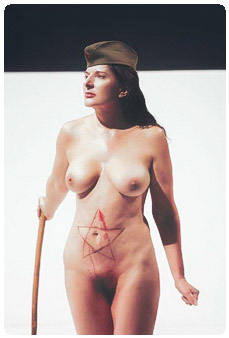
Marina Abramovic’s exhibition is comprised of several video projections, which explore how sexuality and the human body were employed in Balkan pagan traditions and culture throughout history. Abramovic researched Serbian folklore and discovered many historic instances of the employment of eroticism and sexuality to address everyday issues. For example, if it rained too much the women of the village would run into the fields and lift their skirts in an attempt to scare the gods and end the rain. Along with amateur actors, Abramovic dressed in traditional folk costumes and reenacted ancient rituals.
Marina Abramović: The Grandmother of Performance Art
Marina Abramović (born November 30, 1946) is a Serbian performance artist whose work explores the relationship between performer and audience, the limits of the body, and the possibilities of the mind. Over a career spanning five decades, she has pioneered the use of the body as both subject and medium, often subjecting herself to extreme physical and mental pain to reach states of transformation.
Early Life and Education
Born in Belgrade, Yugoslavia (now Serbia), Abramović was raised by parents who were high-ranking Yugoslav partisans and war heroes. Her childhood was marked by a strict, military-style upbringing by her mother, who controlled her life even into her late twenties (Abramović famously had to be home by a 10 PM curfew long after she had begun her career).
1965–1970: Studied at the Academy of Fine Arts in Belgrade.
1970–1972: Completed post-graduate studies at the Academy of Fine Arts in Zagreb.
Early Works: Originally a painter, she soon found the two-dimensional canvas too restrictive and moved toward sound installations and, ultimately, performance.
The Early Solo Years (1973–1975)
In her early work, Abramović focused on "Rhythms"—performances that tested her physical endurance and the audience's willingness to intervene.
Rhythm 10 (1973)
In her first major performance, she used 10 knives to play the "knife game" (jabbing a knife between splayed fingers). Every time she cut herself, she would change knives. She recorded the sounds, then replayed the tape, attempting to replicate the same mistakes, merging past and present.
Rhythm 5 (1974)
Abramović constructed a large wooden star (a symbol of her Communist upbringing), soaked it in petroleum, and lit it on fire. She cut her hair and nails, throwing them into the flames, then leapt into the center of the burning star. She eventually lost consciousness due to lack of oxygen and had to be rescued by bystanders. This taught her that "when you lose consciousness, you cannot be present."
Rhythm 0 (1974)
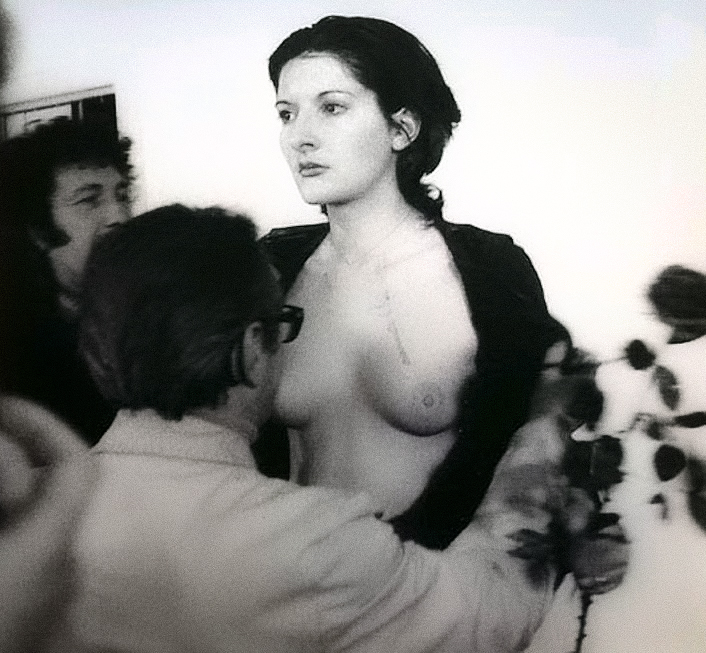
Perhaps her most famous solo work, Abramović stood still for six hours in a gallery with 72 objects on a table—ranging from a rose and honey to a whip, a scalpel, and a loaded gun. A sign invited the audience to use the objects on her as they pleased. By the end, her clothes were cut off, she had been cut with the scalpel, and someone had held the loaded gun to her head. The piece remains a landmark study in human psychology and the thin line between civilization and cruelty.
The Ulay Years: Duality and Oneness (1976–1988)
In 1976, Abramović moved to Amsterdam and met German artist Ulay (Uwe Laysiepen). For the next 12 years, they lived in a van and worked as a "two-headed body," exploring the ego and the boundaries of a relationship.
Imponderabilia (1977): The pair stood naked in a narrow doorway of a museum; visitors had to squeeze between them, choosing which artist to face.
Breathing In/Breathing Out (1977): They blocked their nostrils with cigarette filters and pressed their mouths together, inhaling each other's exhaled CO2 until they both collapsed unconscious.
Rest Energy (1980): In a four-minute performance, Abramović held a heavy bow while Ulay held the string and a real arrow pointed directly at her heart. Microphones recorded their racing heartbeats.
The Lovers (1988): Their relationship ended with an epic performance. Each started at opposite ends of the Great Wall of China, walking for 90 days (2,500 km each) to meet in the middle to say a final goodbye.
Balkan Baroque (1997)
In response to the Yugoslav Wars, she sat for four days, six hours a day, scrubbing thousands of bloody cow bones in a basement at the Venice Biennale. The performance was a harrowing meditation on the impossibility of washing away the "stain" of war. It won her the Golden Lion for Best Artist.
The Artist Is Present (2010)
During her retrospective at MoMA in New York, Abramović sat silently in a chair for 736 hours over three months. Visitors took turns sitting across from her in silence, maintaining eye contact. More than 1,500 people sat with her, many of them moved to tears.
The Reunion: In a viral moment, Ulay unexpectedly sat across from her on the opening night. Breaking her own rules, she reached out and took his hands, marking their first emotional reconciliation in decades.
Seven Deaths of Maria Callas (2020)
An operatic project where Abramović explores the life and tragic deaths of the famous soprano, reflecting on the intersection of performance, obsession, and the female archetype of the "dying woman."