"I demand that a film express either the joy of making cinema or the agony of making cinema. I am not at all interested in anything in between."--Francois Truffaut
The 400 Blows is the debut outing for French director François Truffaut, who arrived in the filmmaking arena after taking a detour through film criticism. (During the years when he wrote for André Bazin's "Cahiers du Cinéma," Truffaut developed a reputation as being an acerbic, unforgiving critic.) Along with Godard, Rohmer, Malle, Vadim, and Chabrol (amongst others), Truffaut was one of the founding auteurs of the French "New Wave" cinema - a philosophy that sought to enliven the Gaelic motion picture industry by taking bold chances and telling personal stories.
Les Quatre Cents Coups became one of the first and most influential of the French New Wave films (it was released around the same time as Godard's Breathless), and, as such, was at the vanguard of a movement that had a worldwide impact on movie-making for more than a decade.
400 Coups title comes from French expression "faire les 400 coups" , which loosely translates to "lead wild and undisciplined life" , so literal translation of the English title makes very little sense.
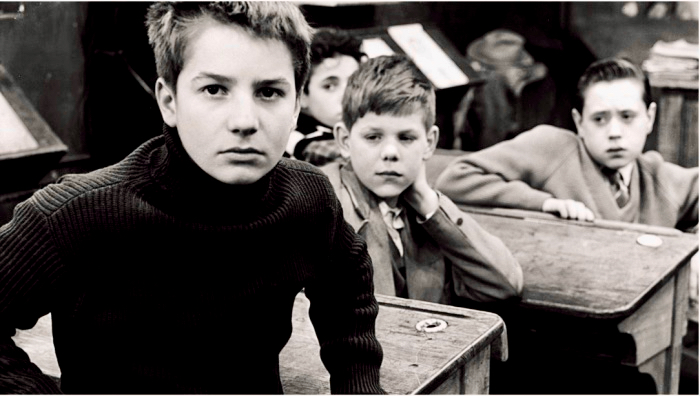
Antoine Doinel (Jean-Pierre Leaud) is a 13-year-old boy who keeps getting into trouble at school. His parents do their best to keep him in line but lack understanding. After being found out and punished for skipping classes, he runs away from home and spends a night on the streets. Reconciliation with his parents seems to offer hope, until he’s caught red-handed in the act of stealing a typewriter. His mother hands him over to the authorities who send him to a reform school. From here he makes another break for freedom, but, standing on the shore, looking out to sea, he finds himself alone with nowhere left to run to.
Les Quatre Cents Coups was widely acclaimed on its release, winning numerous awards, including the Best Director Award at the 1959 Cannes Film Festival. Luminaries such as Jean Cocteau praised the film highly and journalists were quick to associate it with the New Wave of films coming out of France. Today, it remains as moving and eloquent as ever, and is considered by many to be one of the best films ever made.
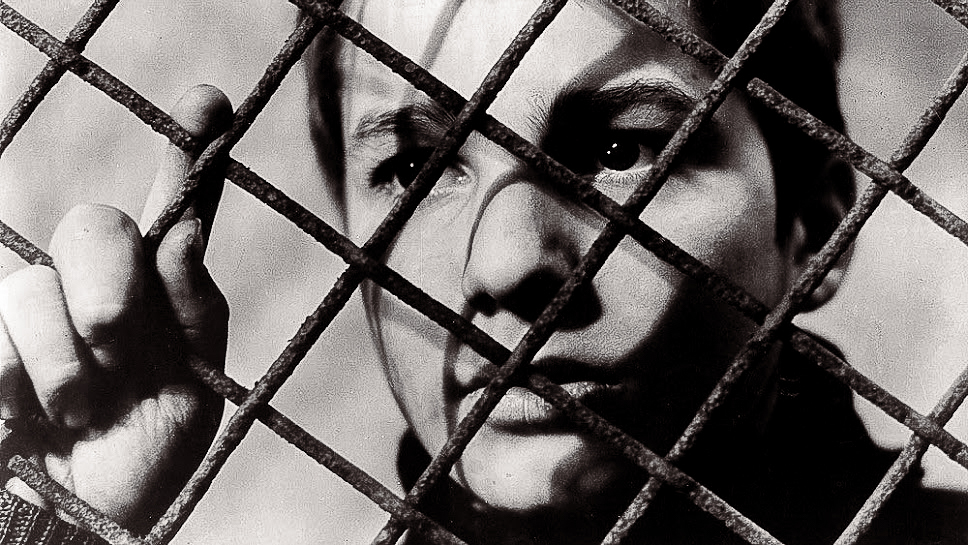
Francois Truffaut's "The 400 Blows" (1959) is one of the most intensely touching stories ever made about a young adolescent. Inspired by Truffaut's own early life, it shows a resourceful boy growing up in Paris and apparently dashing headlong into a life of crime. Adults see him as a troublemaker. We are allowed to share some of his private moments, as when he lights a candle before a little shrine to Balzac in his bedroom. The film's famous final shot, a zoom in to a freeze frame, shows him looking directly into the camera. He has just run away from a house of detention, and is on the beach, caught between land and water, between past and future. It is the first time he has seen the sea.
https://www.rogerebert.com/reviews/great-movie-the-400-blows-1959
The end sequence, culminating in his arrival at a vast lonely shore, is mysterious. Antoine runs away from his correctional facility, and his escape seems to morph into something else; without an immediate pursuer, it becomes an intuition, or premonition, of the lonely long-distance run he has endured and will continue to endure.

MORE ABOUT FILM
Les Quatre
Cents coups
Dossier pédagogique>>>
FRENCH NEW WAVE CINEMA-MAJOR WORK >>>

François
Truffaut
"I demand that a film express either the joy of making cinema or the agony of making cinema. Born in Paris, François Truffaut's early life was marked by instability. A "secret child" who never knew his biological father, he found refuge in the dark theaters of Paris. Cinema wasn't just a hobby; in his own words, it "saved his life."Before getting behind the camera, Truffaut was the "Gravedigger of French Cinema"—a ferocious critic for Cahiers du Cinéma. He attacked the "Tradition of Quality" and championed the Auteur Theory, arguing that the director is the true author of a film, akin to a novelist.
The Critic (1950s): Frustrated by the "stale" French cinema of the post-war era, Truffaut wrote scathing reviews for the magazine Cahiers du Cinéma. His article "A Certain Tendency of the French Cinema" (1954) was a manifesto. He attacked screenwriters who adapted literary works without cinematic vision and called for directors to write their own dialogue and invent their own visual language
The 400 Blows is one of the most influential films in cinema history. It marked the directorial debut of François Truffaut and is widely credited with launching the French New Wave. The title comes from the French idiom "faire les quatre cents coups", which translates literally to "to do the 400 blows" but idiomatically means "to raise hell" or "to sow one's wild oats."
Plot Summary
The film follows Antoine Doinel (played by Jean-Pierre Léaud), a misunderstood 12-year-old boy growing up in Paris. Antoine is a "problem child" only because the adults in his life—his neglectful mother, his well-meaning but detached stepfather, and his authoritarian schoolteacher—fail to provide the affection and stability he needs.
Cinematic Significance
The film rejected the "Tradition of Quality" (expensive, studio-bound French cinema) in favor of a more personal, low-budget, and spontaneous style.
The Auteur Theory: Truffaut, formerly a critic for Cahiers du Cinéma, practiced what he preached: the director should be the "author" of the film.
Location Shooting: Instead of soundstages, Truffaut shot on the streets of Paris using natural light and lightweight cameras.
The Final Shot: The film famously ends with a freeze frame of Antoine looking directly into the camera. This ambiguous ending—leaving the audience to wonder if Antoine has found freedom or is simply trapped by the edge of the world—is one of the most discussed shots in film history.
Critical Legacy
At the 1959 Cannes Film Festival, Truffaut won the Best Director award. The film remains a staple of film studies for its raw honesty and its revolutionary approach to narrative structure.




-2.jpg)
-2.jpg)



.jpg)