And, indeed, I will ask on my own account here, an idle question: which is better—cheap happiness or exalted sufferings? Well, which is better?---Fyodor Dostoevsky ---Notes from Underground Fyodor Dostoevsky ---Notes from Underground Even now, so many years later, all this is somehow a very evil memory. I have many evil memories now, but ... hadn’t I better end my “Notes” here? I believe I made a mistake in beginning to write them, anyway I have felt ashamed all the time I’ve been writing this story; so it’s hardly literature so much as a corrective punishment. Why, to tell long stories, showing how I have spoiled my life through morally rotting in my corner, through lack of fitting environment, through divorce from real life, and rankling spite in my underground world, would certainly not be interesting; a novel needs a hero, and all the traits for an anti-hero are expressly gathered together here, and what matters most, it all produces an unpleasant impression, for we are...
Hope
To be human is to be a miracle of evolution conscious of its own miraculousness — a consciousness beautiful and bittersweet, for we have paid for it with a parallel awareness not only of our fundamental improbability but of our staggering fragility, of how physiologically precarious our survival is and how psychologically vulnerable our sanity. To make that awareness bearable, we have evolved a singular faculty that might just be the crowning miracle of our consciousness: hope.--
Erich Fromm
"Breaking the Waves is a movie that broke the rules, exploding so many norms of mainstream cinema that its very existence—not to mention its vast popularity and critical acclaim—seems almost as astonishing as themiracle that gives the story its visionary ending."
Breaking the Waves is the first and best film in Lars von Trier´s Golden Heart Trilogy(1998´s “The Idiots” and 2000´s “Dancer in the Dark” complete the trilogy), and his first film since signing theDogme 95 pactwith director Thomas Vinterberg. Despite opposition from the Calvinist community in which she lives, Bess (Emily Watson ) fall in love with stranger, oil-rig worker Jan (Skarsgård), and marries him. For a brief time, the couple enjoys wedding bliss, with Jan introducing Bess to the mysteries of sex, but Jan must soon return to his job on the rig. The days he returns to the rig she can not tolerate his absence, and her days consist of praying for his return . When he returns one day paralyzed by an accident Bess life is to be changed forever . Bess' emotional trauma turns into obsession and she prays to God for his recovery and offers to do anything to have her husband back whole. Distraught over his wife's sex life ending , Jan suggests she take lovers and describe her experience afterwards, so they might still enjoy sex through her talking. Bess consents reluctantly .
On one level, Lars von Trier’s masterpiece is a story of "amour fou" between a man and a woman whose blazing passion puts them instantly at odds with her puritanical community. It’s also a blistering critique of the repression and denial that faith-based moralizers confuse with principles and decency—and a penetrating exploration of the meaning of goodness in the modern world.
The epilogue of Breaking the Waves is impossible to describe—it must literally be seen to be believed—but it grows organically and coherently from everything that’s come before it, bringing the film to a bold and brilliant conclusion. First, it returns to the story’s main philosophical concern, presenting an inquest where the kindly Dr. Richardson is required to state his professional view of the psychological condition that led Bess to her doom. Earlier, he admits, he saw her as immature, unstable, obsessive, even psychotic. But in hindsight, his verdict is very different. “If you were to ask me again to write the conclusion,” he says, “then I might use a word like good.” That is clearly von Trier’s diagnosis as well, and after witnessing her story, we are likely to share it.
"Not many movies like this get made, because not many filmmakers are so bold, angry and defiant. Like many truly spiritual films, it will offend the Pharisees. Here we have a story that forces us to take sides, to ask what really is right and wrong in a universe that seems harsh and indifferent. Is religious belief only a consolation for our inescapable destination in the grave? Or can faith give the power to triumph over death and evil? Bess knows."
Born Lars Trier in Copenhagen (1956), he added the aristocratic "von" as a provocation during his time at the National Film School of Denmark. His career is a relentless pursuit of emotional truth through artificial constraints.
Von Trier's work is defined by his thematic trilogies, which explore the depths of human suffering, feminine grace, and European existential dread. His co-founding of Dogme 95 revolutionized independent cinema by stripping it of its commercial "trickery."
Set in a remote, deeply conservative Calvinist community in the Scottish Highlands during the early 1970s, the film follows Bess McNeill (Emily Watson), a simple and devoutly religious young woman. Despite the disapproval of her church elders, she marries Jan (Stellan Skarsgård), a Danish oil rig worker.
Bess is intensely devoted to Jan, and when he returns to the rigs, she prays fervently for his return. Her prayer is answered in a tragic "Monkey’s Paw" fashion: Jan is paralyzed in a horrific industrial accident and returns home permanently bedridden.
1. The "Golden Heart" Heroine
The film is based on a children's book von Trier read about a girl who gives away everything she has until she has nothing left. Bess represents the "Golden Heart" archetype: a woman whose goodness is so absolute that it appears as madness or sin to a judgmental society.
2. Faith vs. Dogma
The film draws a sharp contrast between:
Individual Spirituality: Bess has a personal, conversational relationship with God (often speaking both parts of the dialogue). Her faith is based on love and sacrifice.
Institutional Religion: The village church is depicted as joyless, repressive, and obsessed with the "word" over the human spirit. The elders eventually excommunicate Bess, judging her actions by the letter of the law rather than the intent of her heart.
Visual Style and Production
Breaking the Waves was filmed shortly after the creation of the Dogme 95 manifesto, though it does not strictly follow all its rules (it uses a period setting and non-diegetic "chapter" music).
Handheld Camera: Robby Müller used a highly mobile, grainy handheld style that creates an intimate, documentary-like feel, heightening the emotional vulnerability of the characters.
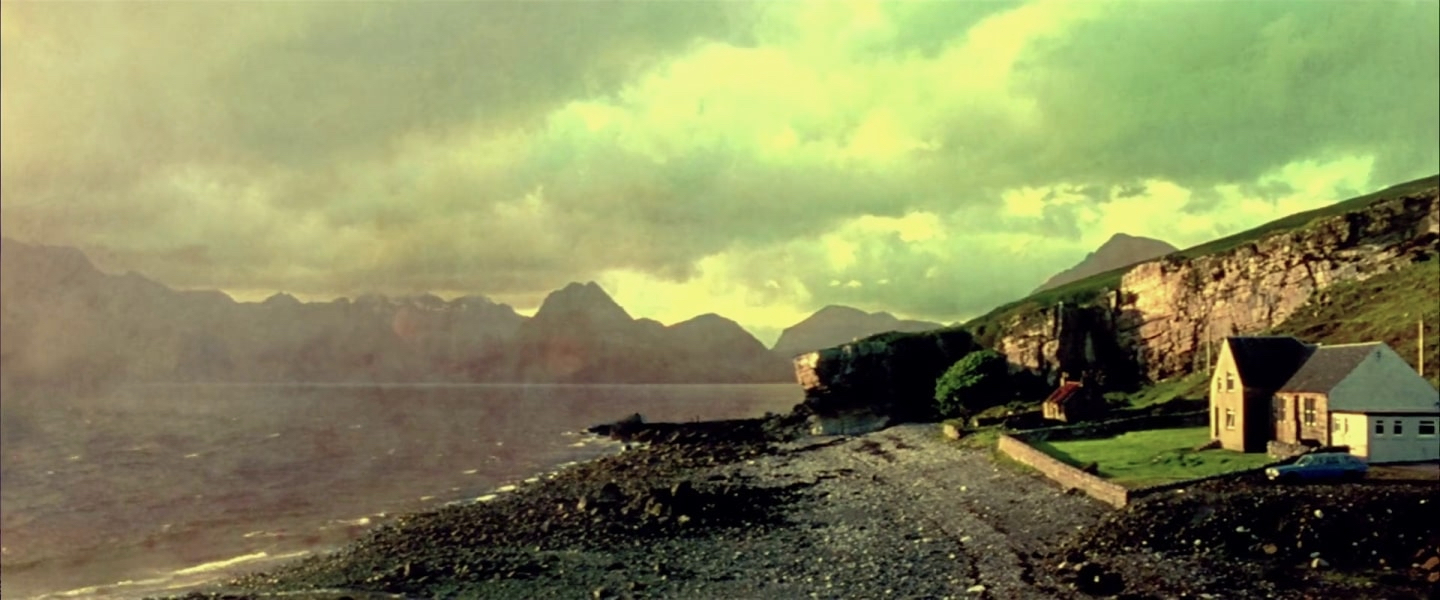
Chapter Breaks: The film is divided into chapters, each introduced by a static, painterly wide shot of the Scottish landscape, manipulated digitally to look like a moving postcard. These are accompanied by 1970s rock classics (e.g., David Bowie, T. Rex, Elton John), providing a stark contrast to the silence of the village.
Emily Watson’s Debut: Watson was an unknown stage actress when cast. Her performance is widely considered one of the greatest debuts in cinema history, earning her an Academy Award nomination for Best Actress.
The film won the Grand Prix at the 1996 Cannes Film Festival.
Melancholia (2011)
Lars von Trier's "Melancholia" opens with music from Wagner's "Tristan und Isolde," mourning and apocalyptic, and disturbing images of a world not right. A woman dressed as a bride runs through a forest whose branches seem to grab at her in a Disney nightmare. She floats in a pond, holding flowers, like Ophelia. Another woman makes her way with a child over marshy grass that sucks at her. Looming in the sky is another planet, vast in size. The Earth is about to end.
If I were choosing a director to make a film about the end of the world, von Trier the gloomy Dane might be my first choice. The only other name that comes to mind is Werner Herzog's. Both understand that at such a time silly little romantic subplots take on a vast irrelevance. Doctor Johnson told Boswell: "Depend upon it, sir, when a man knows he is to be hanged in a fortnight, it concentrates his mind wonderfully." In the cast of von Trier's characters, impending doom seems to have created a mental state of dazed detachment. They continue to act as if their personal concerns have the slightest relevance. Von Trier has never made a more realistic domestic drama, depicting a family that is dysfunctional not in crazy ways but in ways showing a defiant streak of intelligent individualism.
In any film involving the destruction of the globe, we know that, if it is not to be saved, there must be a "money shot" depicting the actual cataclysm. I doubt any could do better than von Trier does here. There are no tidal waves. No animals fleeing through burning forests. No skyscrapers falling. None of that easy stuff. No, there is simply a character standing on a hill and staring straight at the impending doom, as von Trier shows it happening in what logically must be slow motion, with a fearsome preliminary merging of planetary atmospheres.


.jpg)


-2.jpg)
-2-2.jpg)
-2-2.jpg)





.jpg)
