_
Hope
Links
- Get link
- X
- Other Apps
Sophie's Choice (1982)
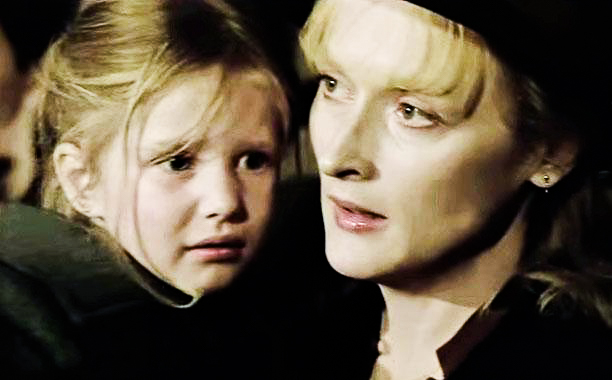
Director Alan J. Pakula adapted to the screen William Styron's acclaimed novel about a Polish immigrant, Sophie Zawistowska (Meryl Streep), living in Brooklyn after WWII.
As the film progresses Stingo begins to unlock pieces of her real past, wading through her blend of truth and lies, and pushing her to reveal her most nightmarish secret in the film’s unforgettable final 20 minutes:
“I’m going to tell you something now I have never told anybody.”
There is hardly an emotion that Streep doesn't touch in this movie, and yet we're never aware of her straining. This is one of the most astonishing and yet one of the most unaffected and natural performances I can imagine.
“Sophie’s Choice” is a fine, absorbing, wonderfully acted, heartbreaking movie. It is about three people who are faced with a series of choices, some frivolous, some tragic. As they flounder in the bewilderment of being human in an age of madness, they become our friends, and we love themhttps://www.rogerebert.com/reviews/sophies-choice-1982
Directed by Alan J. Pakula and adapted from the 1979 novel by William Styron, Sophie's Choice is a seminal work of 20th-century cinema. It is widely regarded as one of the most powerful explorations of trauma, guilt, and the "unimaginable" moral compromises forced upon individuals during the Holocaust.
The "Choice"
The central moment of the film, and the source of its title, occurs in a flashback to the platform at Auschwitz. Sophie, arriving with her two children (Jan and Eva), is confronted by an SS doctor. In a moment of pure cruelty, he informs her that she may keep one child, but the other must go to the gas chambers. If she refuses to choose, both will be killed. In a state of paralyzed terror, Sophie chooses to save her son, Jan, and watches as her daughter, Eva, is taken away.
Critical Significance
The Nature of Guilt: The film explores "survivor's guilt" not as a generic feeling of sadness, but as a specific, corrosive force. Sophie’s eventually tragic end with Nathan is portrayed as an escape from a past she cannot outrun.
Historical Authenticity: While the film was criticized by some (notably Pauline Kael) for its melodrama, it is lauded for its unflinching depiction of the psychological scars left by the Nazi regime.
Cultural Legacy: The phrase "Sophie's Choice" has entered the English lexicon as an idiom for an impossible decision between two beloved or essential things where every outcome is tragic.
Awards & Accolades
Academy Awards: Winner - Best Actress (Meryl Streep). Nominated for Best Adapted Screenplay, Cinematography, Costume Design, and Original Score.

.jpg)


.jpg)


.jpg)