_

Notes from Underground

  And, indeed, I will ask on my own account here, an idle question: which is better—cheap happiness or exalted sufferings? Well, which is better?---Fyodor Dostoevsky ---Notes from Underground Fyodor Dostoevsky ---Notes from Underground Even now, so many years later, all this is somehow a very evil memory. I have many evil memories now, but ... hadn’t I better end my “Notes” here? I believe I made a mistake in beginning to write them, anyway I have felt ashamed all the time I’ve been writing this story; so it’s hardly literature so much as a corrective punishment.  Why, to tell long stories, showing how I have spoiled my life through morally rotting in my corner, through lack of fitting environment, through divorce from real life, and rankling spite in my underground world, would certainly not be interesting; a novel needs a hero, and all the traits for an anti-hero are expressly gathered together here, and what matters most, it all produces an unpleasant impression, for we are...

Hope

To be human is to be a miracle of evolution conscious of its own miraculousness — a consciousness beautiful and bittersweet, for we have paid for it with a parallel awareness not only of our fundamental improbability but of our staggering fragility, of how physiologically precarious our survival is and how psychologically vulnerable our sanity. To make that awareness bearable, we have evolved a singular faculty that might just be the crowning miracle of our consciousness: hope.-- Erich Fromm


Runaway Train (1985)


“The train is a symbol for whatever you want it to be,” the film’s director, Andrei Konchalovsky, explains. “It can be viewed as a prison because they can’t get out of it, or considered as freedom because they escaped from prison on it, or considered as our civilization running out of control because no-one can stop it.

"The ending of the movie is astonishing in its emotional impact. I will not describe it. All I will say is that Konchalovsky has found the perfect visual image to express the ideas in his film. Instead of a speech, we get a picture, and the picture says everything that needs to be said. Afterward, just as the screen goes dark, there are a couple of lines from Shakespeare that may resonate more deeply the more you think about the Voight character."


Russian director Andrei Konchalovsky's second American film may well be the only existential adventure flick in Hollywood history. 
Two prisoners, Manny (Jon Voight) and Buck (Eric Roberts), escape from a desolate Alaskan maximum-security facility. They hop aboard a speeding train, making a clean escape. But the engineer has suffered a heart attack, and the train goes out of control.
"Runaway Train" is a reminder that the great adventures are great because they happen to people we care about."Runaway Train" is based on an original screenplay by the Japanese master Akira Kurosawa, whose best movies use action as a means of studying character.
"The nihilism and the vicious intensity of Mr. Voight's performance here are entirely different from anything else he has done on screen."
The action sequences in the movie are stunning. Frequently in recent movies, I've seen truly spectacular stunts and not been much excited, because I knew they were stunts. All I could appreciate was their smoothness of execution. In "Runaway Train," as the characters try to climb along the sides of the ice-covered locomotives, as the train crashes through barriers and other trains, as men dangle from helicopters and try to kill the convicts, there is such a raw, uncluttered desperation in the feats that they put slick Hollywood stunts to shame.


Andrei Konchalovsky

Andrei Konchalovsky was born into one of Russia's most artistic families. His father, Sergey Mikhalkov, was a celebrated writer who penned the Soviet national anthem. His younger brother, Nikita Mikhalkov, is an Oscar-winning director (Burnt by the Sun).Before cinema, there was music. Konchalovsky studied at a music school and subsequently mastered the piano at the prestigious Moscow Conservatoire, instilling a sense of rhythm and harmony that would define his editing style. At age 22, he entered the All-Russian State Institute of Cinema (VGIK), joining the legendary workshop of Mikhail Romm. It was here he met Andrei Tarkovsky.


Runaway Train is a high-octane action-thriller directed by Andrei Konchalovsky and produced by the legendary B-movie studio Cannon Films. While it presents as a gritty 1980s action flick, it is widely regarded as one of the most "philosophical" and artistic entries in the genre, largely due to its origins with Japanese master Akira Kurosawa.


Production History & The Kurosawa Connection

The film has one of the most fascinating "development hell" stories in Hollywood:

  • Original Script: Akira Kurosawa wrote the original screenplay in the 1960s, intending it to be his first color film and his English-language debut.

  • The Shelf: After financial and production difficulties in the U.S., Kurosawa abandoned the project. It sat for nearly 20 years until Cannon Films (Menahem Golan and Yoram Globus) acquired it.

  • Director: Russian director Andrei Konchalovsky took the helm, bringing a cold, existential European sensibility to the American action format.

  • Cast Debuts: The film is notable for being the feature film debut of Danny Trejo, who was originally hired as a boxing consultant but was cast as an inmate after being recognized by screenwriter (and ex-con) Edward Bunker. It also featured a young Tommy "Tiny" Lister Jr.


The Ending and Themes

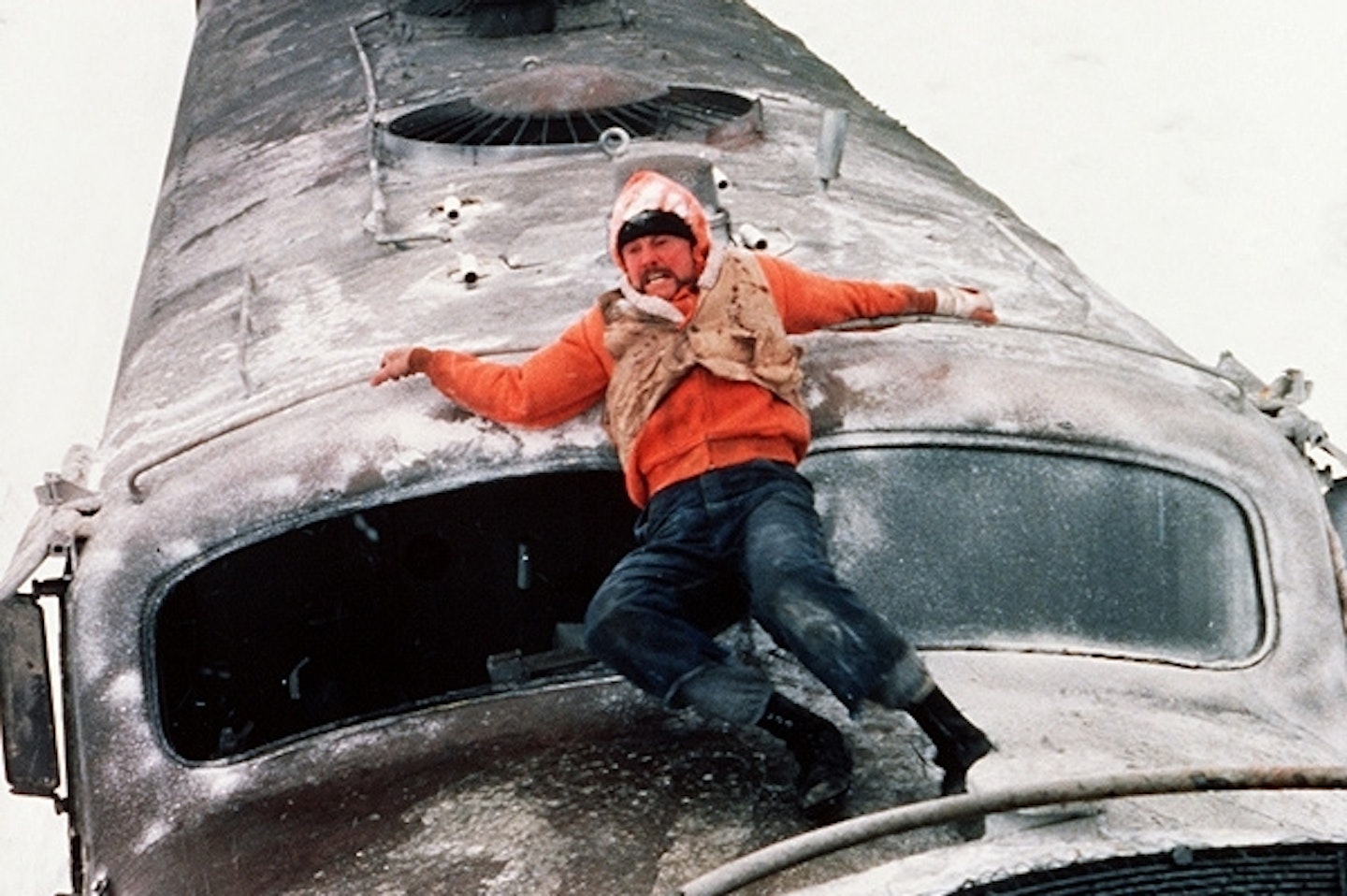
The film concludes with a famously poetic and haunting finale. Manny uncouples the lead locomotive, saving Buck and Sara but trapping himself and the captured Warden Ranken on the engine as it speeds toward a dead-end spur.

The movie ends with a shot of Manny standing atop the speeding locomotive in a blizzard, his arms outstretched like a crucifix or a conqueror, as the screen fades to black. The credits are preceded by a quote from William Shakespeare’s Richard III:

"No beast so fierce but knows some touch of pity. But I know none, and therefore am no beast."


Critical Reception & Awards

Despite being a box office disappointment, the film was a massive critical success and remains a cult classic.

  • Academy Awards: * Nominated for Best Actor (Jon Voight)

    • Nominated for Best Supporting Actor (Eric Roberts)

    • Nominated for Best Film Editing

  • Golden Globes: Jon Voight won the award for Best Actor – Motion Picture Drama.

  • Cannes Film Festival: Nominated for the Palme d'Or.


Popular Posts