And, indeed, I will ask on my own account here, an idle question: which is better—cheap happiness or exalted sufferings? Well, which is better?---Fyodor Dostoevsky ---Notes from Underground Fyodor Dostoevsky ---Notes from Underground Even now, so many years later, all this is somehow a very evil memory. I have many evil memories now, but ... hadn’t I better end my “Notes” here? I believe I made a mistake in beginning to write them, anyway I have felt ashamed all the time I’ve been writing this story; so it’s hardly literature so much as a corrective punishment. Why, to tell long stories, showing how I have spoiled my life through morally rotting in my corner, through lack of fitting environment, through divorce from real life, and rankling spite in my underground world, would certainly not be interesting; a novel needs a hero, and all the traits for an anti-hero are expressly gathered together here, and what matters most, it all produces an unpleasant impression, for we are...
Hope
To be human is to be a miracle of evolution conscious of its own miraculousness — a consciousness beautiful and bittersweet, for we have paid for it with a parallel awareness not only of our fundamental improbability but of our staggering fragility, of how physiologically precarious our survival is and how psychologically vulnerable our sanity. To make that awareness bearable, we have evolved a singular faculty that might just be the crowning miracle of our consciousness: hope.--
Erich Fromm
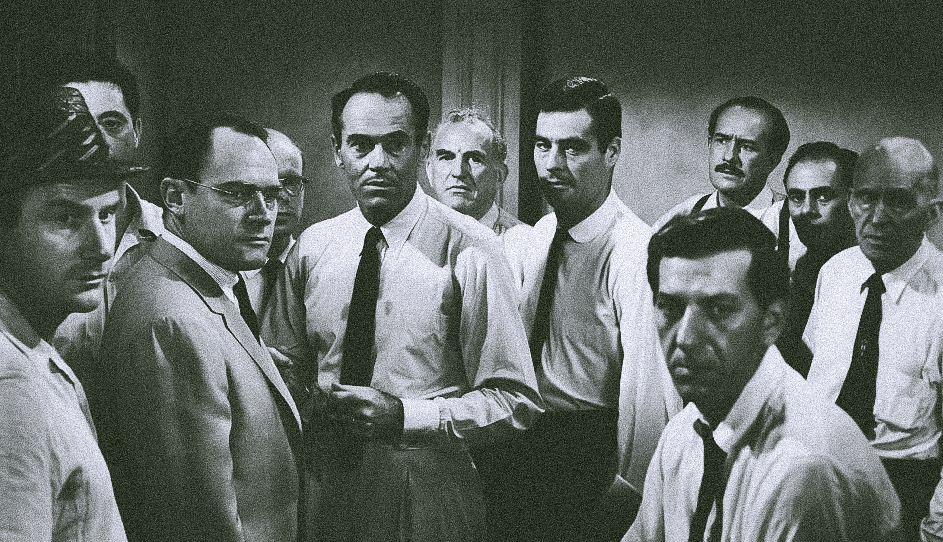
"12 Angry Men, by Sidney Lumet, may be the most radical courtroom drama in cinema history. A behind-closed-doors look at the American legal system that is as riveting as it is spare, this iconic adaptation of Reginald Rose’s teleplay stars Henry Fonda as the dissenting member on a jury of white men ready to pass judgment on a Puerto Rican teenager charged with murdering his father. The result is a saga of epic proportions that plays out over a tense afternoon in one sweltering room. Lumet’s electrifying snapshot of 1950s America on the verge of change is one of the great feature film debuts"
This was Sidney Lumet's first feature film - a low-budget ($350,000) film shot in only 19 days from a screenplay by Reginald Rose, who based his script on his own teleplay of the same name. The defense and the prosecution have rested and the jury is filing into the jury room to decide if a young Spanish-American is guilty or innocent of murdering his father. The film shows us nothing of the trial itself except for the judge's perfunctory, almost bored, charge to the jury. His tone of voice indicates the verdict is a foregone conclusion. We hear neither prosecutor nor defense attorney, and learn of the evidence only second-hand, as the jurors debate it. The story then gets focused on the deliberations of 12 jurors serving on a murder case. Eleven jurors vote for a quick conviction, but one (played by Henry Fonda) tries to convince the others that the accused may be innocent, despite overwhelming evidence to the contrary. One against eleven, but that is only beginning.
Twelve Angry Men was a financial disaster when it first opened , but it did receive three Academy Award nominations (with no wins): Best Picture, Best Director, and Best Adapted Screenplay. All three categories lost to David Lean's Oscar-sweeping, extravagant epic film The Bridge on the River Kwai. Henry Fonda's central role as a juror with resolute caution was un-nominated as Best Actor.
The principle of reasonable doubt, the belief that a defendant is innocent until proven guilty, is one of the most enlightened elements of our Constitution, although many Americans have had difficulty in accepting it. "It's an open and shut case," snaps Juror No. 3 (Lee J. Cobb) as the jury first gathers in their claustrophobic little room. When the first ballot is taken, 10 of his fellow jurors agree, and there is only one holdout--Juror No. 8 (Henry Fonda).
In a length of only 95 minutes (it sometimes feels as if the movie is shot in real time), the jurors are all defined in terms of their personalities, backgrounds, occupations, prejudices and emotional tilts. Evidence is debated so completely that we feel we know as much as the jury does, especially about the old man who says he heard the murder and saw the defendant fleeing, and the lady across the street who says she saw it happen through the windows of a moving L train.
"Twelve Angry Men," an iconic courtroom drama by Reginald Rose, did not begin on the stage as is often the case. Instead, the popular play was adapted from the author's 1954 live teleplay that debuted on CBS and was soon made into a movie.
Sidney Lumet didn't have a "signature style" in the traditional sense. He didn't use flashy camera moves or stylized color palettes unless the story demanded it. Instead, he was a master of efficiency, performance, and moral complexity. Rising from the high-pressure world of live TV in the 1950s, he brought a "one-take" discipline to Hollywood, often finishing films ahead of schedule and under budget.
A high school football coach; tries to keep order but lacks natural leadership.
2
John Fiedler
A meek bank teller who is initially bullied but finds his voice regarding the technicalities of the knife.
3
Lee J. Cobb
The antagonist; a businessman whose personal pain regarding his son blinds him to the facts.
4
E.G. Marshall
A logical, cold stockbroker who relies strictly on evidence until his own logic is used against him.
5
Jack Klugman
Grew up in the slums; provides crucial insight into how to properly use a switchblade.
6
Edward Binns
A principled house painter who values respect, particularly for the elderly.
7
Jack Warden
A salesman more interested in getting to a baseball game than the trial; represents apathy.
8 ( Davis)
Henry Fonda
The protagonist; a compassionate architect who insists on the "reasonable doubt" standard.
9 (McCardle)
Joseph Sweeney
An elderly, observant man; the first to support Juror 8 out of respect for his courage.
10
Ed Begley
A bigoted garage owner whose prejudice eventually causes the other jurors to literally turn their backs on him.
11
George Voskovec
A watchmaker and European immigrant who has a deep reverence for the American justice system.
12
Robert Webber
An indecisive advertising executive who treats the deliberation like a marketing brainstorm.
Reasonable Doubt
The film is the ultimate "civics lesson." It argues that the jury's job isn't to determine "the truth" or "innocence," but to decide if the prosecution has proven guilt beyond a reasonable doubt. Even if the boy likely did it, the lack of certainty necessitates an acquittal.




.jpg)



.jpg)