"I knew these people," Travis begins, in one of the great monologues of movie history. "These two people. They were in love with each other. The girl was very young, about 17 or 18, I guess. And the guy was quite a bit older. He was kind of raggedy and wild. And she was very beautiful, you know?"
Paris, Texas (1984) among other things is a road movie, a modern Western, a story of the loss , film with stunning photography and incredible music by Ry Cooder (one of the best, if not the best music scored for the movie feature). It represents the peak of Wim Wenders’ career in the ’70s and early ’80s and film deservedly won the Palme d’Or 1984 at the Cannes Film Festival.
The film opens with stunning aerial footage of desert and mountains in West Texas.Emerging from the desert, Travis (Harry Dean Stanton), lost and severely hydrated, is rescued by a German doctor living in a remote village. Travis refuses to speak, but the doctor manages to track down and contact Travis’ younger brother, Walt Henderson (Dean Stockwell), the hardworking owner of a billboard company in Los Angeles.
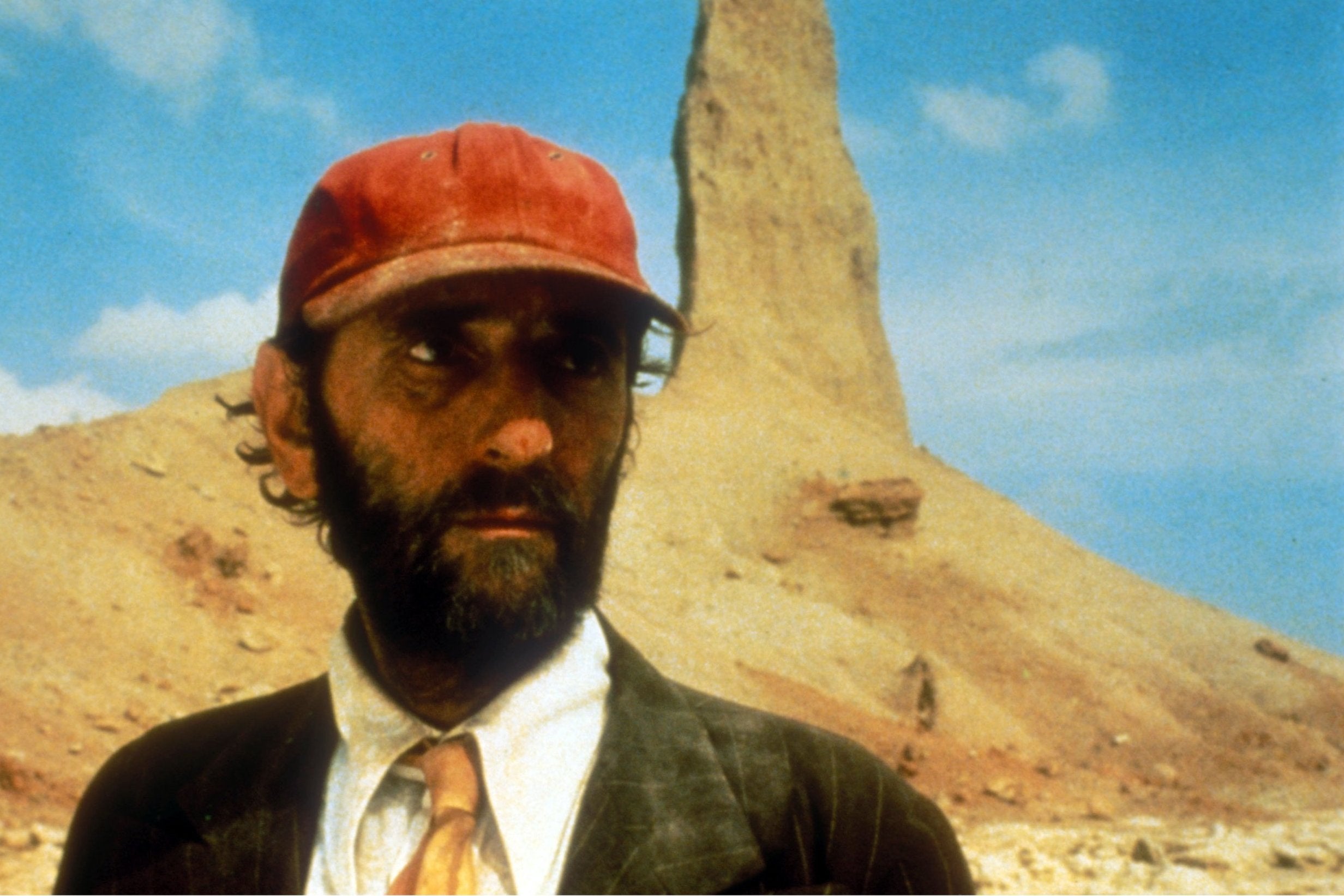
Walt and his wife Anne (Aurore Clement) live in Los Angeles with Hunter (Hunter Carson), who is Travis' son. We gradually learn pieces of the story: Hunter was left with the Hendersons by Travis' wife Jane (Nastassja Kinski), who could no longer care for him, but who sends a check every month from a bank in Houston. The man comes walking out of the desert like a Biblical figure, a penitent who has renounced the world. He wears jeans and a baseball cap, the universal costume of America, but the scraggly beard, the deep eye sockets and the tireless lope of his walk tell a story of wandering in the wilderness. What is he looking for? Does he remember?
Wim Wenders' "Paris, Texas" (1984) is the story of loss upon loss. This man, whose name is Travis, was once married and had a little boy. Then that all went wrong, and he lost his wife and child, and for years he wandered. Now he will find his family and lose it again, this time not through madness but through sacrifice. He will give them up out of his love for them.
Travis is not insane, not acting out his alienation. He is simply lost in grief, despairing at the way his marriage was joyous for a brief time and then was destroyed by his own drinking and jealousy. He stays for a time with the Hendersons, slowly wins Hunter's trust, walks home with him from school in a sweet little scene where they copy each other's gaits. Then he has a serious conversation with Hunter that leads to them getting into Travis's old Ford pickup and driving to Houston to find Jane.

ROBBY MÜLLER CINEMATOGRAPHER >>>
She was born in Berlin in 1960, the daughter of infamous cinematic wild man Klaus Kinski, and, at the age of 12, so the story goes, she was discovered while dancing with friends in a club and cast in her first film, "Wrong Move" (1975), an early work from up-and-coming German director Wim Wenders.
Directed by Wim Wenders and written by Sam Shepard, Paris, Texas is a haunting, visually sublime exploration of the American landscape and the fractured nature of the human heart. Winning the Palme d'Or at the 1984 Cannes Film Festival, it remains one of the most celebrated examples of "New German Cinema" finding its soul in the American West


The Narrative: From Silence to Confession
The film follows Travis Henderson (Harry Dean Stanton), a man who emerges from the South Texas desert after being missing for four years.
The Reconnection: Travis is found by his brother, Walt (Dean Stockwell), who brings him back to Los Angeles. There, Travis must navigate a delicate reunion with his seven-year-old son, Hunter, who has been raised by Walt and his wife, Anne.
The Road Trip: The middle act shifts into a classic road movie. Travis and Hunter travel back to Texas to find Jane (Nastassja Kinski), the wife/mother who vanished years prior.
The Peep Show Climax: The film culminates in two extended dialogue sequences at a Houston peep-show club. Communicating through a one-way mirror and a telephone, Travis tells Jane a "story" that reveals the dark, jealous history of their relationship, leading to a bittersweet resolution of forgiveness without reconciliation.


Visual and Auditory Identity
The film’s power is inseparable from its aesthetic choices:
Robby Müller’s Cinematography: Müller captured the American Southwest not as a dusty wasteland, but as a vibrant, neon-soaked dreamscape. His use of primary colors—particularly the saturated reds (Travis’s cap, Jane’s sweater) and cool blues—creates a psychological map of the characters' emotions.
Ry Cooder’s Score: The minimalist, echoing slide guitar score is iconic. Based on Blind Willie Johnson’s "Dark Was the Night, Cold Was the Ground," the music provides a sonic representation of the vast, lonely Texas horizons.
The Concept of "Paris, Texas": The title refers to a vacant lot Travis bought in Paris, Texas, based on a joke his father used to tell. It represents a "promised land" or a fixed point of origin that doesn't exist, symbolizing the characters' search for a home that has already been destroyed.


Production History & Trivia
The Script: Sam Shepard wrote the script as the film was being shot. He would often send pages to Wenders via mail. Because Shepard had to leave to act in another film, L.M. Kit Carson (father of Hunter Carson, who played Hunter) helped finalize the dialogue for the third act.
The "Peep Show" Set: The iconic booth was a practical set. To get the lighting right, Müller had to balance the reflection of the glass so Kinski could not see Stanton, while the audience could see both.
Harry Dean Stanton's Breakthrough: Despite a long career as a character actor, this was Stanton’s first leading role. He famously asked Wenders, "How do I play this?" Wenders replied, "Just play yourself."


Legacy
Paris, Texas is often cited as a major influence on directors like Wes Anderson and Quentin Tarantino, and musicians like Kurt Cobain and Elliott Smith. It serves as the ultimate "outsider's" look at America—a European director capturing the mythic beauty and inherent sadness of the American Dream through the lens of a broken family. It remains a definitive work on the impossibility of truly "returning home."


-3.jpg)





.jpg)