Talking
Heads
Widely regarded as the greatest concert film ever made. An exploration of rhythm, stagecraft, and the architecture of a performance.
"More than three decades after Jonathan Demme’s 1984 Talking Heads concert film, Stop Making Sense represents not only the definitive document of this most idiosyncratic and forward-looking of rock acts, but also a landmark cinematic achievement. Assembled from footage of four December 1983 performances at L.A.’s Pantages Theater, it’s a masterfully executed and profoundly ambitious reimagining of the concert film genre, achieving something at once wildly theatrical but unpretentious, endlessly bizarre but utterly legible, and publicly joyous without resorting to pandering."
Much like Martin Scorsese’s The Last Waltz (generally considered the relevant competition in the category of Best Concert Film Ever) was a collaboration between the filmmaker and The Band’s erstwhile leader Robbie Robertson, Stop Making Sense is the by-product of the twin-engined genius of Byrne and Demme. Released more than 20 years ago , it remains an inimitable marvel and a fascinating time capsule: the fleeting intersection between two visionary artists whose propensity for sly, subversive takes on populist entertainments made them ideal compatriots in a sound and vision experiment as enduringly vital as any in the history of rock ’n’ roll.
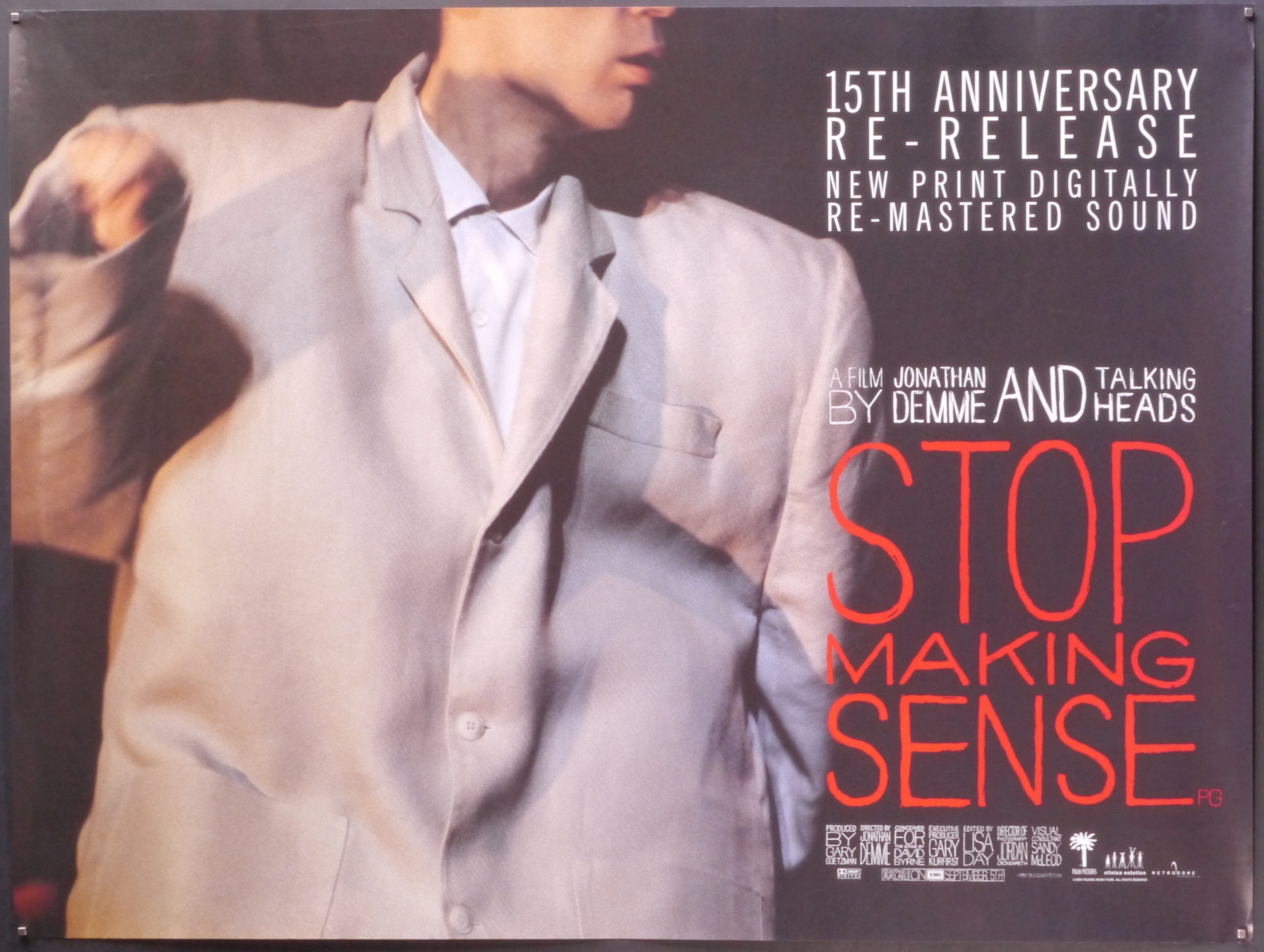
Director Jonathan Demme captures the frantic energy and artsy groove of Talking Heads in this concert movie shot at the Hollywood Pantages Theatre in 1983. The band's frontman, David Byrne, first appears on an empty stage, armed with only an acoustic guitar, and is gradually joined by bassist Tina Weymouth, drummer Chris Frantz, keyboardist Jerry Harrison and a cadre of backup singers as they perform the band's hits, culminating in an iconic performance featuring Byrne in an enormous suit.
The music of the Talking Heads draws from many sources, in addition to traditional rock 'n' roll. You can hear the echoes, in Byrne's voice, of one of his heroes, country singer Hank Williams. In the music itself, there are elements of reggae and of gospel, especially in the driving repetitions of single phrases that end some of the songs. What is particularly delightful is that the Talking Heads are musical: For people who have passed over that invisible divide into the age group when rock sounds like noise, the Heads will sound like music. The film's peak moments come through Byrne's simple physical presence. He jogs in place with his sidemen; he runs around the stage; he seems so happy to be alive and making music. Like Springsteen and Prince, he serves as a reminder of how sour and weary and strung-out many rock bands have become.

David Byrne Remembers Jonathan Demme, Collaborating On 'Stop Making Sense' >>>
.jpeg)
Jonathan Demme was one of the most versatile, empathetic, and deceptively radical American filmmakers of the late 20th and early 21st centuries. Rising from the legendary Roger Corman school of B-movies, Demme developed a style defined by an infectious love for people, music, and eccentric Americana.
Whether directing a grueling psychological thriller, a screwball romantic comedy, or arguably the greatest concert film ever made, his work is consistently anchored by an unwavering, non-judgmental humanism.
The Signature Demme Style
The "Direct-to-Camera" Close-Up: Perhaps Demme’s most famous visual signature. He frequently had his actors look directly into the camera lens during conversations. This wasn't to break the fourth wall, but to force the audience into a state of intense, subjective empathy with the character’s immediate emotional state.
Radical Empathy for Outsiders: Demme’s camera never looks down on his characters. From the oddball dreamers in Melvin and Howard to the marginalized protagonists of Philadelphia, he champions the eccentric, the forgotten, and the misunderstood.
A Lifelong Love Affair with Music: Demme didn't just use soundtracks; he let music drive the narrative rhythm. He collaborated deeply with artists like Talking Heads, Neil Young, Robyn Hitchcock, and Bruce Springsteen, seamlessly weaving live performance and eclectic needle-drops into the DNA of his cinema.
| Film | Genre / Era | Why It Matters |
| Melvin and Howard (1980) | Drifter Comedy-Drama | The film that cemented his critical reputation. A gentle, bittersweet, and beautifully observed slice of working-class Americana. |
| Stop Making Sense (1984) | Concert Documentary | Capturing the Talking Heads at their peak, Demme strips away the typical rock-doc clichés to create a masterclass in kinetic energy, lighting, and framing. |
| Something Wild (1986) | Genre-Bending Indie | A yuppie nightmare comedy that seamlessly morphs into a dark, violent thriller. It perfectly showcases Demme's ability to balance wildly shifting tones. |
| The Silence of the Lambs (1991) | Psychological Thriller | A masterpiece of tension that swept the "Big Five" Academy Awards. Demme elevates pulp horror into high art using claustrophobic POV shots and incredible performances. |
| Rachel Getting Married (2008) | Cinema Verité Drama | Shot with a loose, handheld, documentary-style camera, this raw look at family dysfunction and recovery feels incredibly intimate and alive. |
The Solo Start: David Byrne walks onto a bare stage with an acoustic guitar and a boombox to perform "Psycho Killer."
The Integration: With each subsequent song, a new member joins. Tina Weymouth joins for "Heaven," Chris Frantz for "Thank You for Sending Me an Angel," and Jerry Harrison for "Found a Job."
The Full Ensemble: By "Burning Down the House," the stage is populated by the core four plus an incredible touring band including Bernie Worrell (keyboards), Alex Weir (guitar), Steve Scales (percussion), and backing vocalists Lynn Mabry and Ednah Holt.
The Set: Throughout the first half, stagehands in black are seen moving risers and equipment into place, making the "process" of the show part of the art.

Digital Audio: It was the first movie made entirely using early digital audio techniques, resulting in a clarity of sound that many fans prefer over the original studio recordings.
The "Long Take": Demme and cinematographer Jordan Cronenweth (who shot Blade Runner) used long, steady takes. Instead of the frenetic "MTV-style" editing of the 80s, the camera lingers on the performers, capturing their exhaustion, sweat, and genuine joy.
Audience Absence: The audience is almost entirely invisible and silent until the final song, "Crosseyed and Painless." This creates an intimate "black box" theater atmosphere where the focus remains on the musicians' interactions.

The film’s most enduring image is David Byrne’s "Big Suit," debuted during "Girlfriend Is Better."
Inspiration: Byrne wanted his head to appear smaller to emphasize the physical gestures of his body. He was inspired by Japanese Kabuki theater and the idea that "everything is bigger on stage."
Symbolism: He described it as a "socially conscious" suit—a literalization of the "businessman" persona that looked like a "large box" or an architectural structure rather than a garment.
In 2021, the film was selected for preservation in the United States National Film Registry by the Library of Congress. In 2023, A24 released a 4K restoration that brought the film back to IMAX and theaters globally, introducing the "Big Suit" and the polyrhythmic genius of Talking Heads to a new generation of fans.


.jpeg)


