'Dog Day Afternoon" never makes mistake. The characters are all believable, sympathetic, convincing. We care for them. In a film about cops and robbers, there are no bad guys. Just people trying to get through a summer afternoon that has taken a strange turn.'
The film is based on an actual bank robbery that took place in New York in the 1970s. And it seems to borrow, too, from that curious episode in Stockholm when hostages, barricaded in a bank vault with would-be robbers, began to identify with their captors. The presence of reporters and live TV cameras changed the nature of those events, helped to dictate them, made them into happenings with their own internal logic. But Lumet's film is also a study of a fascinating character: Sonny, the bank robber who takes charge, played by Al Pacino as a compulsive and most complex man. He's street-smart, he fought in Vietnam, he's running the stick-up in order to get money for his homosexual lover to have a sex-change operation. He's also married to a chubby and shrill woman with three kids, and he has a terrifically possessive mother (the Freudianism gets a little thick at times). Sonny isn't explained or analyzed -- just presented.
Sonny and his zombie-like partner, Sal, hit the bank at closing time (a third confederate gets cold feet and leaves early). The stick-up is discovered, the bank is surrounded, the live TV mini-cams line up across the street, and Sonny is in the position, inadvertently, of having taken hostages. Sonny is gay, along with many other things.The film takes place almost entirely within a bank branch and the barbershop across the street, which becomes the police and FBI "command center." Back and forth Lumet's camera moves, on a shuttle of negotiations. The side view down the street in either direction shows their escape route, until it's blocked by a crowd that quickly forms and becomes a character in itself.
Sidney Lumet is a master filmmaker. His book on directing joins David Mamet's as two contrasting approaches to the subject, both written with clarity and conviction. Starting young by directing live TV, Lumet launched his big screen career with "12 Angry Men," based on one of his TV productions. His subjects have ranged widely; he clearly cares for the story above all else and doesn't specialize in genres or themes. In the screenplay, Cazale’s role was written to be a smart-ass street kid. But Al came to me and said, ‘Sidney, please, I beg you, read John Cazale for it.’ And when John came in I was so discouraged and thought ‘Al must be out of his mind.’ This guy looks thirty, thirty-two, and that’s the last thing I want in this part. But Al had great taste in actors, and I hadn’t yet seen him in The Godfather.
And Cazale came in, and then he read, and my heart broke… One of the things that I love about the casting of John Cazale was that he had a tremendous sadness about him. I don’t know where it came from; I don’t believe in invading the privacy of the actors that I work with, or getting into their heads. But my God—it’s there—in every shot of him. And not just in this movie, but in Godfather II also.
When Al asked him during a scene, ‘Is there any country you want to go to?’ Cazale improvised his answer by saying, after long thought, ‘Wyoming.’ To me that was the funniest, saddest line in the movie, and my favorite, because in the script he wasn’t supposed to say anything. I almost ruined the take because I started to laugh so hard… but it was a brilliant, brilliant, ad lib. —Sidney Lumet
"The robbery should have taken 10 minutes. 4 hours later, the bank was like a circus side-show. 8 hours later, it was the hottest thing on live T.V."
Dog Day Afternoon is a biographical crime drama that chronicles a botched bank robbery that turned into a media-saturated hostage crisis. It is widely considered one of the greatest films ever made, characterized by its "New York" grit and Al Pacino’s career-defining performance.


The True Story: "The Boys in the Bank"
The film is based on the real-life events of August 22, 1972, when John Wojtowicz and Salvatore Naturile held up a Chase Manhattan bank in Gravesend, Brooklyn.
The Article: Screenwriter Frank Pierson based the script on the Life magazine article "The Boys in the Bank" by P.F. Kluge and Thomas Moore.
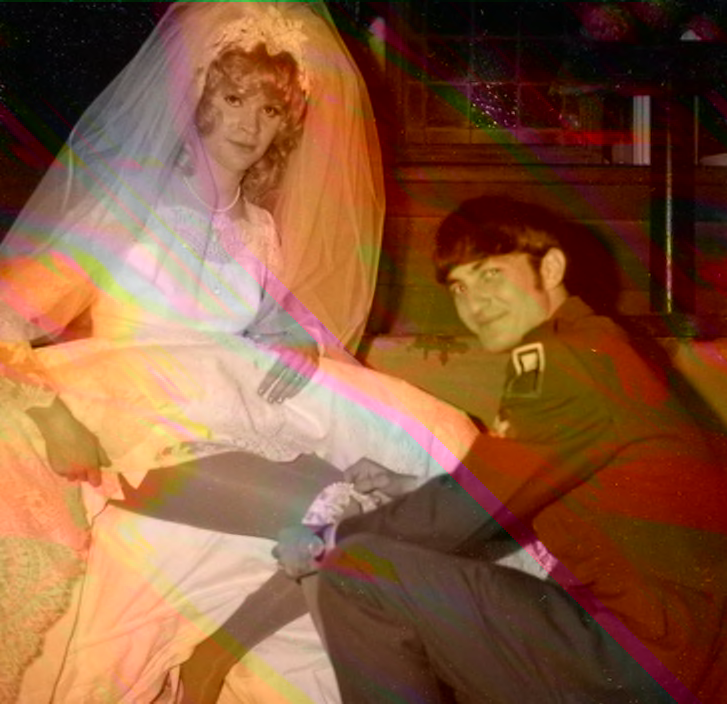
The Motive: The real John Wojtowicz did indeed rob the bank to pay for the surgery of his partner, Elizabeth Eden (represented as Leon in the film).
The Result: Wojtowicz was eventually sentenced to 20 years in prison; he used the money he earned from the film rights to pay for Eden's surgery.

Key Themes & Style
The Media Circus
Sidney Lumet masterfully depicts the birth of modern "infotainment." The film shows how the media turns a desperate criminal into a celebrity in real-time, highlighting the performative nature of the standoff.
"ATTICA! ATTICA!"
One of the most famous improvised moments in cinema history occurs when Sonny steps outside the bank and begins chanting "Attica!"—referencing the 1971 Attica Prison riot. It served as a powerful rallying cry against police authority, capturing the counter-cultural spirit of the era.
Realism and Improv
Lumet famously chose to use no musical score during the film (except for the opening song "Amoreena" by Elton John). This, combined with the fact that roughly 60% of the dialogue was improvised or developed through intensive rehearsals, gives the movie a documentary-like intensity.

Awards and Legacy
The film was a massive critical and commercial success, grossing over $50 million on a small budget.
Academy Awards: 6 Nominations, 1 Win (Best Original Screenplay).
Cultural Impact: In 2009, it was selected for preservation in the National Film Registry by the Library of Congress for being "culturally, historically, or aesthetically significant."
Elizabeth Eden & John Wojtowicz on their wedding day, 1971.
The Real Story Of John Wojtowicz And The Bank Robbery That Inspired ‘Dog Day Afternoon >>>
Charles Ruppmann/NY Daily News Archive via Getty ImagesJohn Wojtowicz looks through the bank window during the robbery.





.jpg)