"Charles Laughton's "The Night of the Hunter” (1955) is one of the greatest of all American films, but has never received the attention it deserves because of its lack of the proper trappings. Many “great movies” are by great directors, but Laughton directed only this one film, which was a critical and commercial failure long overshadowed by his acting career. Many great movies use actors who come draped in respectability and prestige, but Robert Mitchum has always been a raffish outsider. And many great movies are realistic, but “Night of the Hunter” is an expressionistic oddity, telling its chilling story through visual fantasy. People don't know how to categorize it, so they leave it off their lists."
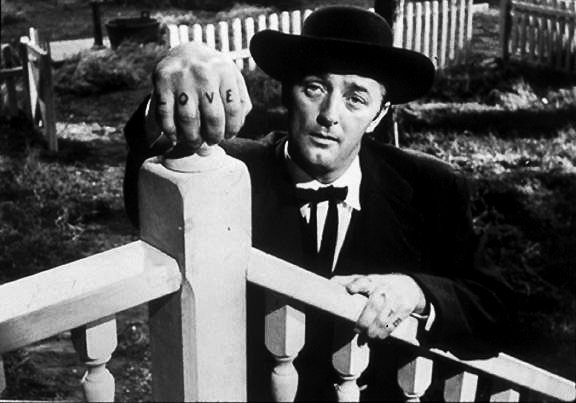
Everybody knows the Mitchum character, the sinister “Reverend” Harry Powell. Even those who haven't seen the movie have heard about the knuckles of his two hands, and how one has the letters H-A-T-E tattooed on them, and the other the letters L-O-V-E. Bruce Springsteen drew on those images in his song "Cautious Man”.
But does this familiarity give "The Night of the Hunter” the recognition it deserves? I don't think so because those famous trademarks distract from its real accomplishment. It is one of the most frightening of movies, with one of the most unforgettable of villains, and on both of those scores it holds up as well after four decades.
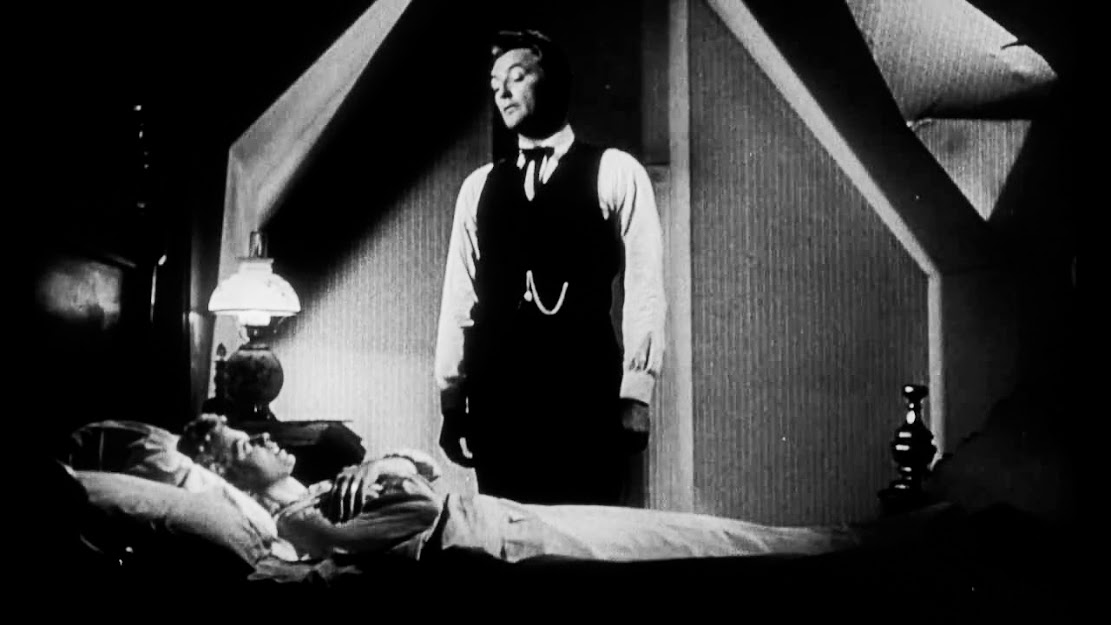
The story, somewhat rearranged: In a prison cell, Harry Powell discovers the secret of a condemned man (Peter Graves), who has hidden $10,000 somewhere around his house. After being released from prison, Powell seeks out the man's widow, Willa Harper (Shelley Winters), and two children, John (Billy Chapin) and the owl-faced Pearl (Sally Jane Bruce). They know where the money is, but don't trust the “preacher.” But their mother buys his con game and marries him, leading to a tortured wedding night inside a high-gabled bedroom that looks a cross between a chapel and a crypt.
Charles Laughton showed here that he had an original eye, and a taste for material that stretched the conventions of the movies. It is risky to combine horror and humor, and foolhardy to approach them through expressionism. For his first film, Laughton made a film like no other before or since, and with such confidence it seemed to draw on a lifetime of work. Critics were baffled by it, the public rejected it, and the studio had a much more expensive Mitchum picture (“Not as a Stranger”) it wanted to promote instead. But nobody who has seen "The Night of the Hunter” has forgotten it, or Mitchum's voice coiling down those basement stairs: "Chillll . . . dren?”
Robert Mitchum is a preaching paterfamilias from hell, and Charles Laughton's complex 1955 classic thoroughly deserves the turnaround in its reputation over the years
I come not with peace, but with a sword," says Robert Mitchum's psychopathic bogus preacher, brandishing a switchblade that at moments of extreme sexual excitement and disgust will poke out of his trouser-pocket, tearing the material. His performance in Charles Laughton's The Night of the Hunter (1955) – now on re-release – is startlingly stiff-necked and straight backed, with a mannered theatrical baritone, a change from Mitchum's usual rangy coolness.
The Director's Vision
Laughton intended the film to be a "nightmarish sort of Mother Goose tale." He drew heavily from the silent film era, particularly the work of D.W. Griffith, which led him to cast the "First Lady of American Cinema," Lillian Gish. The film's commercial failure was so devastating to Laughton that he never directed another film, a fact often cited as one of Hollywood's greatest tragedies.
The Binary of LOVE and HATE
Robert Mitchum’s character, Harry Powell, famously has "L-O-V-E" tattooed on the knuckles of one hand and "H-A-T-E" on the other. He uses these to perform a pantomime of the struggle between good and evil, a chilling irony given that he is a serial killer hiding behind the veneer of a "man of God."
Religious Hypocrisy vs. True Faith
The film presents a sharp critique of how religious fervor can be manipulated.
Harry Powell: Represents the "false prophet," using scripture to justify misogyny, greed, and murder.
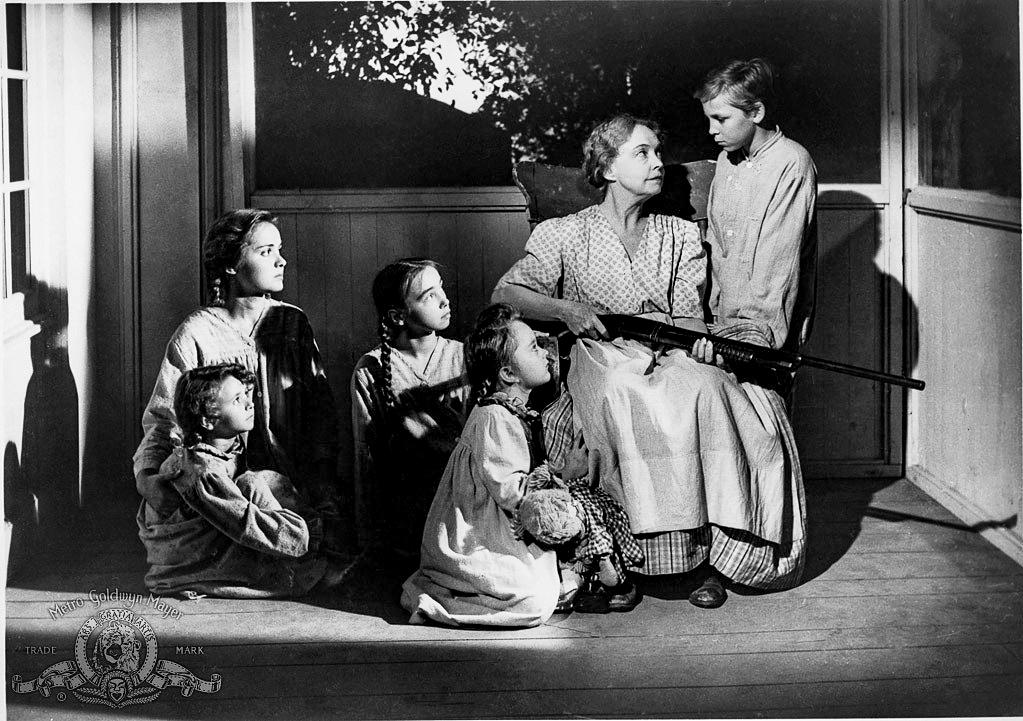
Rachel Cooper: Represents a resilient, earthy, and protective form of Christianity. She is the "Good Shepherd" who protects the "little things" (the children) from the "wolf" (Powell).
Legacy and Influence
Initial Reception: Upon release, it was dismissed as "pretentious" and "weird." It wasn't until decades later that critics recognized its ahead-of-its-time synthesis of genres.
Cahiers du Cinéma: Voted the film the second greatest of all time (behind Citizen Kane).
AFI Ranking: Frequently appears on lists of the most thrilling and influential American films.
Cultural Influence: * Spike Lee: Directly referenced the LOVE/HATE knuckles in Do the Right Thing through the character Radio Raheem.
The Coen Brothers: Their use of Southern Gothic atmosphere and idiosyncratic villains owes a heavy debt to Laughton’s film.
Stephen King: Has cited the film as a major influence on his depictions of small-town horror and religious zealotry.






.jpg)