"All the President's Men" is truer to the craft of journalism than to the art of storytelling, and that's its problem. The movie is as accurate about the processes used by investigative reporters as we have any right to expect, and yet process finally overwhelms narrative -- we're adrift in a sea of names, dates, telephone numbers, coincidences, lucky breaks, false leads, dogged footwork, denials, evasions, and sometimes even the truth. Just such thousands of details led up to Watergate and the Nixon resignation, yes, but the movie's more about the details than about their results.
That's not to say the movie isn't good at accomplishing what it sets out to do. It provides the most observant study of working journalists we're ever likely to see in a feature film (Bob Woodward and Carl Bernstein may at last, merciful God, replace Hildy Johnson and Walter Burns as career models). And it succeeds brilliantly in suggesting the mixture of exhilaration, paranoia, self-doubt, and courage that permeated the Washington Post as its two young reporters went after a presidency.
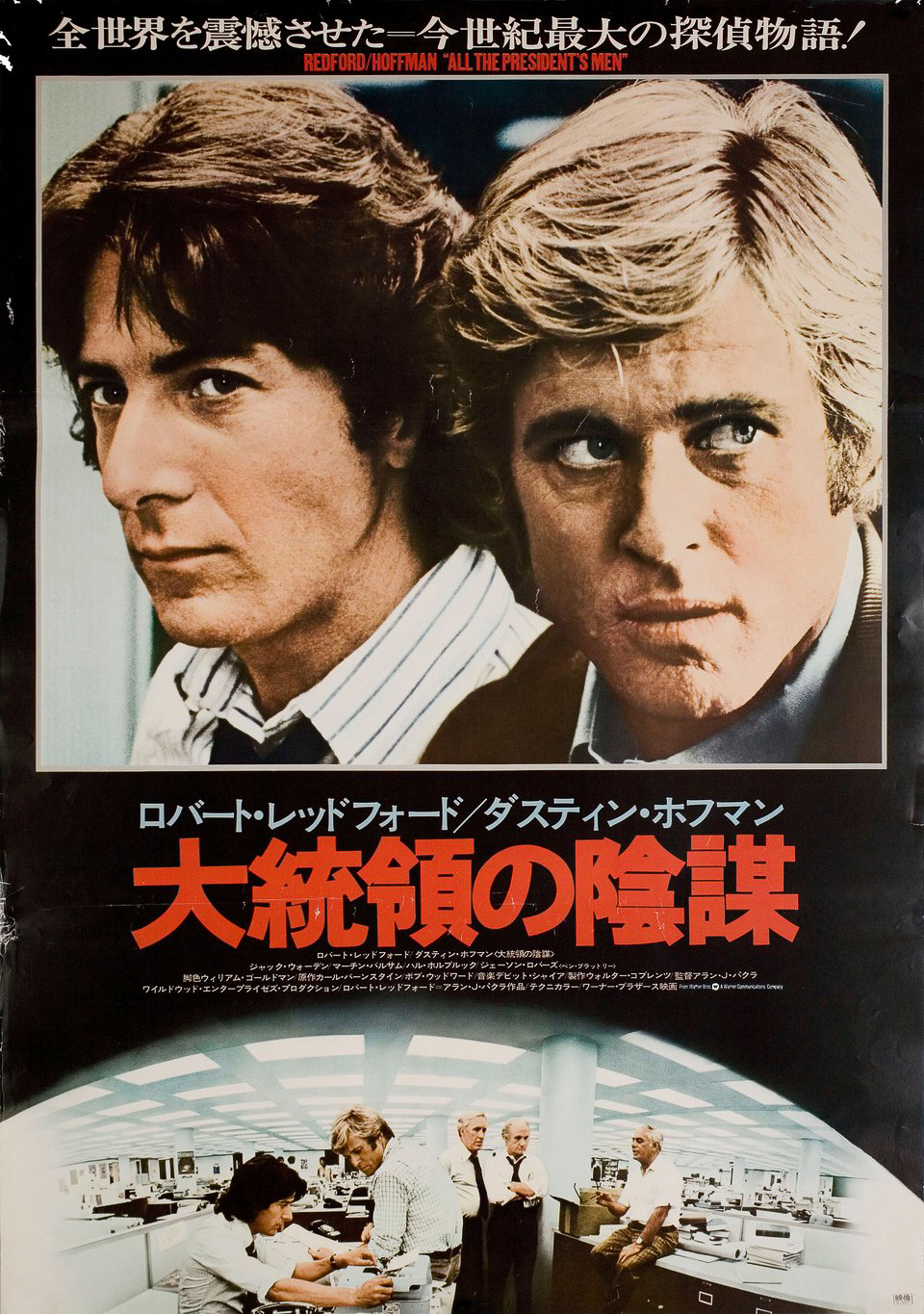
When Robert Redford announced that he'd bought the rights to "All the President's Men," the joke in the newsroom was about reporters becoming movie stars. What in fact has happened is that the stars, Redford as Woodward and Dustin Hoffman as Bernstein, became reporters: They sink into their characters and become wholly credible. There's not a false or "Hollywood" note in the whole movie, and that's commendable -- but how much authenticity will viewers settle for? To what secret and sneaky degree.

There must have been a temptation to flesh out the Woodward and Bernstein characters, to change the pace with subplots about their private lives, but the film sticks resolutely to its subject. This is the story of a story: of two reporters starting with an apparently minor break-in and following it, almost incredulously at times, as it finally leads all the way to the White House. At times the momentum of Watergate seems to propel Woodward and Bernstein, instead of the other way around. It must have occasionally been like that at the time, and it's to the movie's credit that it doesn't force its characters into the center of every scene.
The film begins, as did the Watergate affair, with five men breaking into the headquarters of the Democratic National Committee (DNC) on 1 June 1972. The DNC was based in the Watergate office, hotel and residential complex in the Foggy Bottom neighbourhood of Washington DC. The late Frank Wills, the real-life security guard who discovered the break-in, played himself in this movie. The story is first taken up by junior journalist Bob Woodward (Robert Redford) as a minor incident. Soon, though, it begins to bloat out in all directions. Ben Bradlee (Jason Robards), the executive editor of the Washington Post, brings the more experienced Carl Bernstein (Dustin Hoffman) on board to work with him.
Woodward and Bernstein begin to dig – and here students of the history of journalism may marvel at how immensely more difficult all this investigative work was in the days before mobile phones and the internet, especially when at one point they have to go through all the hard-copy borrowing records at the Library of Congress by hand. The film shows correctly that their most mysterious source was known as Deep Throat, a high government official turned whistleblower, nicknamed after a notorious pornographic film of the time. The film never reveals who Deep Throat was, but that’s fair enough: his identity was not publicly confirmed for almost 30 years after it was made. In 2005, former FBI associate director Mark Felt finally admitted it had been him.
“Follow the money”
So catchy and apt has this phrase proved that it is now often attributed to Felt, even though he never said it. It does not appear in the Washington Post coverage of the affair, nor in Woodward and Bernstein’s book, also called All the President’s Men. In fact, screenwriter William Goldman – who also wrote Butch Cassidy and the Sundance Kid, The Princess Bride and Marathon Man – invented the line for the movie.https://www.theguardian.com/film/2014/oct/10/all-the-presidents-men-watergate-conspiracy-richard-nixon-woodward-bernstein-redford-hoffman
Journalism's Finest 2 Hours and 16 Minutes
By Ken Ringle
Washington Post Staff Writer
June 14, 1992
It changes names, alters facts, eliminates crucial historical figures and mythologizes others.
It over-glamorizes reporting, oversimplifies editing and makes power appear the only proper subject for a newsman's pen.
But 20 years after Watergate, "All the President's Men" remains the best film ever made about the craft of journalism and an eerily accurate evocation of the mood and psychology -- if not the details -- of that byzantine presidential deceit and its unmasking.
For those of us who lived through those draining, mesmerizing, pulse-racing days within these walls a generation ago, there's both wonder and discomfort in that realization. Wonder because few of us ever hoped for as three-dimensional a portrait from Hollywood; discomfort because most journalists in those days thought of themselves as chroniclers of events, not major players. To revisit the 1976 film is to be reminded how much in our profession -- and our building -- the film helped change, not always for the better.
More >>>

Born in the Bronx to Polish Jewish immigrants, Alan Jay Pakula transitioned from a Yale drama student to one of Hollywood’s most precise formal stylists. He began his career as a producer, notably for the 1962 masterpiece To Kill a Mockingbird, before stepping behind the lens to direct.Pakula earned a reputation as an "actor's director", possessing an uncanny ability to draw career-defining, Oscar-winning performances from legends like Jane Fonda and Meryl Streep. His films were cerebral, atmospheric, and deeply concerned with the internal psychology of individuals battling external, invisible systems of power.

The film begins in June 1972 with the "third-rate burglary" of the Democratic National Committee headquarters at the Watergate complex in Washington, D.C. Bob Woodward (Redford), a young reporter for The Washington Post, covers the arraignment and notices a suspicious connection between the burglars and the White House. He is eventually paired with Carl Bernstein (Hoffman), and together they follow a trail of money and "dirty tricks" that leads to the highest levels of the Nixon administration.


Historical Accuracy
The Guard: Frank Wills, the actual security guard who discovered the taped door at the Watergate, plays himself in the film. This adds a layer of docudrama realism to the opening sequence.
Timeline: The movie ends in January 1973, with the second inauguration of Richard Nixon. It uses a teletype montage to summarize the subsequent events: the Senate hearings, the discovery of the tapes, and Nixon's ultimate resignation in 1974. By stopping before the resignation, the film keeps its focus strictly on the reporting process rather than the political fallout.
The Process: Unlike many Hollywood thrillers, the film focuses on the drudgery of journalism: making hundreds of fruitless phone calls, knocking on doors of reluctant CREEP (Committee to Re-elect the President) employees, and scouring thousands of library slips. It highlights the "shoe-leather" reporting required to build a case piece by piece.
Key Figures: The film accurately depicts the internal dynamics of The Washington Post, specifically the skepticism and eventual support of editors like Howard Simons, Harry Rosenfeld, and Ben Bradlee. It also correctly portrays the "Canuck Letter" and the targeting of Senator Edmund Muskie as part of the broader "Segretti" sabotage campaign.
The Library of Congress: The famous overhead shot in the Library of Congress, showing Woodward and Bernstein as tiny specs among a sea of records, serves as a visual metaphor for the overwhelming scale of the investigation they were undertaking.

Key Production Details
The Set: Because The Washington Post declined to let the production film in their actual newsroom, the filmmakers built a $450,000 replica on a soundstage in Hollywood. They even transported trash and old directories from the real Post offices to ensure authentic detail.
Cinematography: Gordon Willis (known for The Godfather) used distinctive lighting to contrast the brightly lit, clinical newsroom with the deep, shadowy darkness of the parking garages where Woodward met his informant, "Deep Throat."
"Deep Throat": The film popularized the name of the secret informant, later revealed in 2005 to be FBI Associate Director Mark Felt. The famous line "Follow the money" was actually written by screenwriter William Goldman and never appeared in the original book or real-life transcripts.
Sound Design: The film features a remarkably sparse score by David Shire. Instead of music, Pakula used the rhythmic, percussive sounds of typewriters—often amplified—to create tension. The "attack" of the typewriter keys at the start of the film is intended to sound like gunfire, signaling the beginning of a war between the press and the presidency.

Cultural Legacy
The "Gate" Suffix: The film (and the event it depicts) cemented the practice of adding "-gate" to any subsequent political scandal.
Journalism Schools: Following the film's release, journalism schools in the U.S. saw a massive spike in enrollment, a phenomenon known as the "Woodward and Bernstein effect."
The Paranoia Trilogy: It is considered the final installment of Alan J. Pakula’s "Paranoia Trilogy," preceded by Klute (1971) and The Parallax View (1974).
Following his resignation, US President Richard Nixon bids farewell to White House staff on 9 August 1974, as his wife Pat and daughter Tricia look on. Photograph: AP


.jpeg)



.jpg)