"The "Purple Rose of Cairo" is audacious and witty and has a lot of good laughs in it, but the best thing about the movie is the way Woody Allen uses it to toy with the very essence of reality and fantasy."
Set during the Great Depression, the main character, a woman (played by Mia Farrow ), is a sweet, rather baffled small-town waitress whose big, shiftless lug of a husband bats her around. She is a good candidate for the magic of the movies. Up on the screen, sophisticated people have cocktails and plan trips down the Nile and are recognized by the doormen in nightclubs. The hero in the movie is played by Jeff Daniels .He is a genial, open-faced smoothie with all the right moves, but he has a problem: He only knows what his character knows in the movie, and his experience is literally limited to what happens to his character in the plot. He’s great at talking sweetly to a woman, and holding hands, and kissing—but just when the crucial moment arrives, the movie fades out, and therefore, alas, so does he."Purple Rose" is delightful from beginning to end, not only because of the clarity and charm with which Daniels and Farrow explore the problems of their characters, but also because the movie is so intelligent. It’s not brainy or intellectual—no one in the whole movie speaks with more complexity than your average 1930s movie hero—but the movie is filled with wit and invention, and Allen trusts us to find the ironies, relish the contradictions, and figure things out for ourselves. While we do that, he makes us laugh and he makes us think, and when you get right down to it, forget about the fantasies; those are two of the most exciting things that could happen to anybody in a movie. The more you think about "The Purple Rose of Cairo", and about the movies, and about why you go to the movies, the deeper the damned thing gets.
https://www.rogerebert.com/reviews/the-purple-rose-of-cairo-1985
It is one of 3 Woody Allen’s own favorite films.
"Beloved by critics if not so much by audiences – not only is it great, it’s the the kind of film that only Woody Allen can make."
https://gemini.google.com/share/47d2cef3b2ab
Plot Summary
The story centers on Cecilia (Mia Farrow), a clumsy, daydreaming waitress trapped in a miserable life. Her husband, Monk (Danny Aiello), is an abusive, unemployed gambler who spends their meager earnings on liquor. Cecilia's only solace is the local movie theater, the Jewel, where she watches Hollywood features to escape her grim surroundings.
Her obsession focuses on a new RKO release titled The Purple Rose of Cairo. After watching the film multiple times, the handsome, wide-eyed explorer on screen, Tom Baxter (Jeff Daniels), notices her in the audience. Breaking the "fourth wall," Tom addresses Cecilia directly and steps off the silver screen and into the real world to be with her.
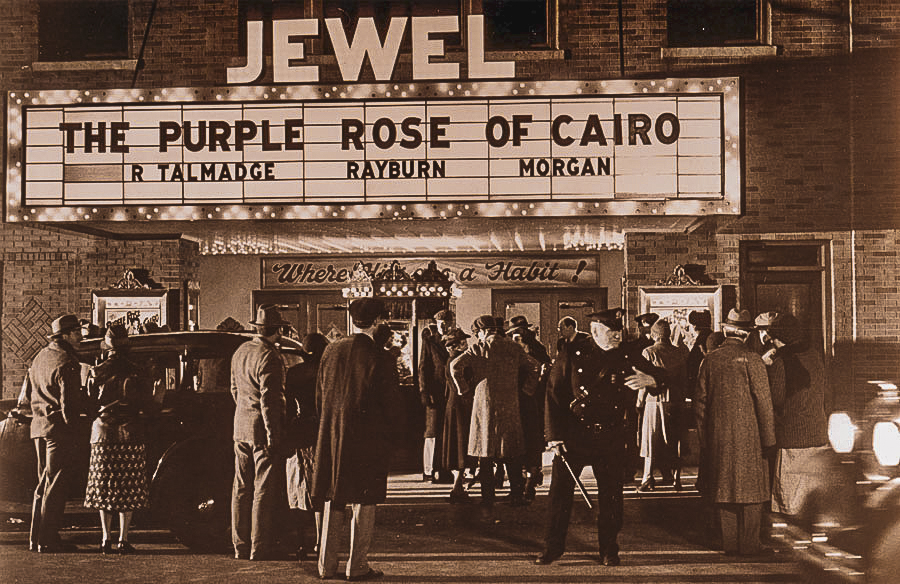
Casting Changes: Michael Keaton was originally cast as Tom/Gil and actually filmed for ten days. Allen realized Keaton was too "modern" and "street-smart" for the role of a 1930s matinee idol, leading to the casting of Jeff Daniels, whose "corn-fed" look fit the era perfectly.
Cinematography: Gordon Willis used distinct color palettes. The real world is shot in muted, sepia-toned colors, while the film-within-a-film is high-contrast, "silvery" black and white, mimicking the orthochromatic look of early sound films.
Special Effects: The "screen crossing" was achieved using a combination of rear-projection and perfectly matched lighting. The actors on the screen had to remain perfectly still or repeat loops while the "real" actors interacted with them.
The "Top Hat" Ending: The use of "Cheek to Cheek" from Top Hat at the end is one of the most famous uses of licensed music in cinema history, providing a hauntingly beautiful counterpoint to Cecilia's tragic situation.
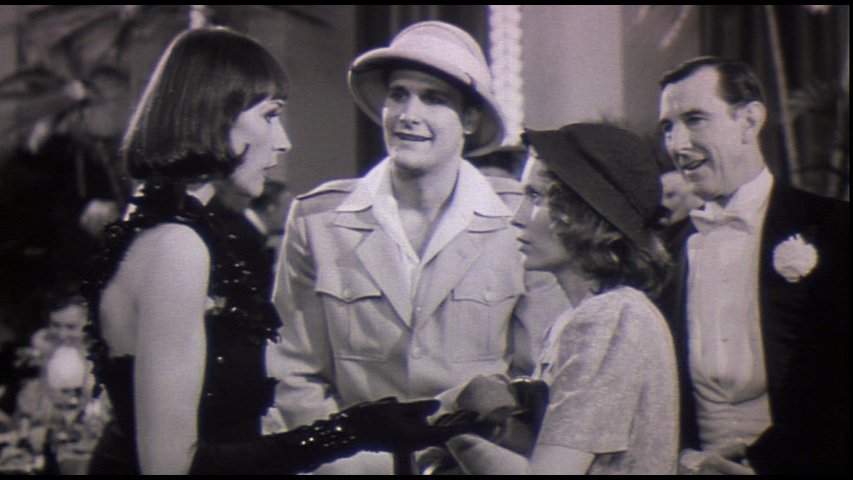
Critical Reception and Legacy
Awards: The film won the BAFTA for Best Film and Best Screenplay, and the Golden Globe for Best Screenplay. It was nominated for the Academy Award for Best Original Screenplay.
Critics: It holds a high rating on Rotten Tomatoes, with critics often citing it as Allen's most "magical" and "coherent" film.
Allen's Personal Rank: Woody Allen consistently ranks this as his best film, alongside Stardust Memories and Match Point, because it successfully realized his philosophical intent regarding the cruelty of reality.
Annie Hall (1977)
“Annie Hall” contains more intellectual wit and cultural references than any other movie ever to win the Oscar for best picture, and in winning the award in 1977 it edged out “Star Wars,” an outcome unthinkable today. The victory marked the beginning of Woody Allen‘s career as an important filmmaker (his earlier work was funny but slight) and it signaled the end of the 1970s golden age of American movies. With “Star Wars,” the age of the blockbuster was upon us, and movies this quirky and idiosyncratic would find themselves shouldered aside by Hollywood’s greed for mega-hits. “Annie Hall” grossed about $40 million–less than any other modern best picture winner, and less than the budgets of many of them.
Alvy Singer, the gag writer and stand-up comic played by Allen in the movie, is the template for many of his other roles–neurotic, wisecracking, kvetching, a romantic who is not insecure about sex so much as dubious about all the trouble it takes. Annie Hall, played by Diane Keaton, sets the form for many of Allen’s onscreen girlfriends: Pretty, smart, scatterbrained, younger, with affection gradually fading into exasperation. Women put up with a lot in Allen’s movies, but at a certain point they draw the line.
Alvy is smarter than the ground rules of Hollywood currently allow. Watching even the more creative recent movies, one becomes aware of a subtle censorship being imposed, in which the characters cannot talk about anything the audience might not be familiar with. This generates characters driven by plot and emotion rather than by ideas; they use catch-phrases rather than witticisms. Consider the famous sequence where Annie and Alvy are standing in line for the movies and the blowhard behind them pontificates loudly about Fellini. When the pest switches over to McLuhan, Alvy loses patience, confronts him, and then triumphantly produces Marshall McLuhan himself from behind a movie poster to inform him, “You know nothing of my work!” This scene would be penciled out today on the presumption that no one in the audience would have heard of Fellini or McLuhan.