And, indeed, I will ask on my own account here, an idle question: which is better—cheap happiness or exalted sufferings? Well, which is better?---Fyodor Dostoevsky ---Notes from Underground Fyodor Dostoevsky ---Notes from Underground Even now, so many years later, all this is somehow a very evil memory. I have many evil memories now, but ... hadn’t I better end my “Notes” here? I believe I made a mistake in beginning to write them, anyway I have felt ashamed all the time I’ve been writing this story; so it’s hardly literature so much as a corrective punishment. Why, to tell long stories, showing how I have spoiled my life through morally rotting in my corner, through lack of fitting environment, through divorce from real life, and rankling spite in my underground world, would certainly not be interesting; a novel needs a hero, and all the traits for an anti-hero are expressly gathered together here, and what matters most, it all produces an unpleasant impression, for we are...
Hope
To be human is to be a miracle of evolution conscious of its own miraculousness — a consciousness beautiful and bittersweet, for we have paid for it with a parallel awareness not only of our fundamental improbability but of our staggering fragility, of how physiologically precarious our survival is and how psychologically vulnerable our sanity. To make that awareness bearable, we have evolved a singular faculty that might just be the crowning miracle of our consciousness: hope.--
Erich Fromm
“Persona” is a film we return to over the years, for the beauty of its images and because we hope to understand its mysteries.
Visually stunning and displaying more intense close-ups than probably any other film we’ve seen, the film was shot by Bergman’s frequent partner, the celebrated Swedish cinematographer Sven Nykvist. The shot of Andersson and Ullmann’s face joined together, the startling sequence of the image breaking apart in the middle of the film and the beautiful dichotomy between light and dark echoing the same relationship between silence and voice is Bergman and Nykvist’s visual triumph that is forever etched in our memory. With famous opera composer Lars Johan Werle’s score and Ulla Ryghe editing skills, Persona is a work of technical mastery, while Andersson and Ullmann delivered on what Bergman expected from them to the degree of critics claiming the film rested on their inspired shoulders. Persona is still a delight to watch, a visionary, influential, highly contemplative work of art that hasn’t aged a day Shakespeare used six words to pose the essential human choice: “To be, or not to be?” Elizabeth, a character in Ingmar Bergman’s “Persona,” uses two to answer it: “No, don’t!” She is an actress who one night stopped speaking in the middle of the performance, and has been silent ever since. Now her nurse, Alma, has in a fit of rage started to throw a pot of boiling water at her. “No, don’t!” translates as: I do not want to feel pain, I do not want to be scarred, I do not want to die. She wants . . . to be. She admits . . . she exists.
“Persona” (1966) is a film we return to over the years, for the beauty of its images and because we hope to understand its mysteries. It is apparently not a difficult film: Everything that happens is perfectly clear, and even the dream sequences are clear–as dreams. But it suggests buried truths, and we despair of finding them. “Persona” was one of the first movies I reviewed, in 1967. I did not think I understood it. A third of a century later I know most of what I am ever likely to know about films, and I think I understand that the best approach to “Persona” is a literal one.
Elizabeth (Liv Ullmann) stops speaking in the middle of Electra, and will not speak again. A psychiatrist thinks it might help if Elizabeth and Nurse Alma (Bibi Andersson) spend the summer at her isolated house. Held in the same box of space and time, the two women somehow merge. Elizabeth says nothing, and Alma talks and talks, confessing her plans and her fears, and eventually, in a great and daring monologue, confessing an erotic episode during which she was, for a time, completely happy.
The two actresses look somewhat similar. Bergman emphasizes this similarity in a disturbing shot where he combines half of one face with half of the other. Later he superimposes the two faces, like a morph. Andersson told me she and Ullmann had no idea Bergman was going to do this, and when she first saw the film she found it disturbing and frightening. Bergman told me, “The human face is the great subject of the cinema. Everything is there.”
Their visual merging suggests a deeper psychic attraction. Elizabeth, the patient, mute and apparently ill, is stronger than Alma, and eventually the nurse feels her soul being overcome by the other woman’s strength. There is a moment when her resentment flares and she lashes back. In the sunny courtyard of the cottage, she picks up the pieces of a broken glass, and then deliberately leaves a shard where Elizabeth might walk. Elizabeth cuts her foot, but this is essentially a victory for the actress, who has forced the nurse to abandon the discipline of her profession and reveal weakness.
Elizabeth looks at Alma, seeming to know the glass shard was not an accident, and at that moment Bergman allows his film to seem to tear and burn. The screen goes blank. Then the film reconstitutes itself. This sequence mirrors the way the film has opened. In both cases, a projector lamp flares to life, and there is a montage from the earliest days of the cinema: jerky silent skeletons, images of coffins, a hand with a nail being driven into it. The middle “break” ends with the camera moving in toward an eye, and even into the veins in the eyeball, as if to penetrate the mind.
Early in the film, Elizabeth watches images from Vietnam on the TV news, including a Buddhist monk burning himself. Later, there are photographs from the Warsaw ghetto, of Jews being rounded up; the film lingers on the face of a small boy. Have the horrors of the world caused Elizabeth to stop speaking? The film does not say, but obviously they are implicated. For Alma, horrors are closer to home: She doubts the validity of her relationship with the man she plans to marry, she doubts her abilities as a nurse, she doubts she has the strength to stand up to Elizabeth.
But Elizabeth has private torments, too, and Bergman expresses them in a sequence so simple and yet so bold we are astonished by its audacity. First there is a dream sequence (if it is a dream; opinions differ), in which Elizabeth enters the room of Alma in the middle of the night. In a Swedish summer, night is a finger drawn by twilight between one day and the next, and soft pale light floods the room. The two women look at one another like images in a mirror. They turn and face us, one brushing back the other’s hair. A man’s voice calls, “Elizabeth.” It is her husband, Mr. Vogler (Gunnar Bjornstrand). They are outside. He caresses Alma’s face and calls her “Elizabeth.” No, she says, she is not Elizabeth. Elizabeth takes Alma’s hand and uses it to caress her husband’s face
Inside, later, Alma delivers a long monologue about Elizabeth’s child. The child is born deformed, and Elizabeth left it with relatives so she can return to the theater. The story is unbearably painful. It is told with the camera on Elizabeth. Then it is told again, word for word, with the camera on Alma. I believe this is not simply Bergman trying it both ways, as has been suggested, but literally both women telling the same story–through Alma when it is Elizabeth’s turn, since Elizabeth does not speak. It shows their beings are in union.
The other monologue in the movie is more famous; Alma’s story of sex on the beach involving herself, her girlfriend and two boys. The imagery of this monologue is so powerful that I have heard people describe the scene as if they actually saw it in the film. In all three monologues, Bergman is showing how ideas create images and reality.
The most real objective experiences in the film are the cut foot and the threat of boiling water, which by “breaking” the film show how everything else is made of thought (or art). The most real experience Alma has ever had is her orgasm on the beach. Elizabeth’s pain and Alma’s ecstasy were able to break through the reveries of their lives. Most of what we think of as “ourselves” is not direct experience of the world, but a mental broadcast made of ideas, memories, media input, other people, jobs, roles, duties, lusts, hopes, fears. Elizabeth chooses to be who she is’ Alma is not strong enough to choose not to be Elizabeth. The title is the key. “Persona.” Singular.
The title itself refers to the Latin word for "mask" used by actors, but it primarily evokes Carl Jung’s theory of the Persona—the social face an individual presents to the world to hide their true self.
Elisabet (The Persona): By choosing silence, she attempts to shed all "acting" and roles (mother, wife, celebrity). However, her silence becomes its own kind of performance.
Alma (The Soul/Shadow): Her name means "soul" in Latin. Throughout the film, she acts as the mirror for Elisabet's repressed emotions. As they merge, Alma begins to take on Elisabet’s coldness, while Elisabet "consumes" Alma's vitality.
The Failure of Language
Bergman explores the idea that words are often used to lie or obscure the truth. Elisabet’s silence is a protest against the "falseness" of human interaction. Paradoxically, Alma’s constant talking leads her to a more profound breakdown than Elisabet's silence.
Motherhood and Guilt
Both women are haunted by the concept of motherhood. Elisabet is revealed to have a deep-seated resentment toward her son, whom she never wanted. The recurring image of the boy (seen in the opening and the end) is often interpreted as Elisabet's son—or perhaps a representation of Bergman himself—reaching out for a mother who remains an unreachable image.
INGMAR BERMAN ON ‘PERSONA’
“It is a tremendously irrational process that appears different every time. The core of the films, the originally explosive material, creates the film; the final film can consist of perhaps apparently strangely unimportant impulses. The idea for Persona, for example, came from a picture. One day I suddenly saw in front of me two women sitting next to each other and comparing hands with one another. I thought to myself that one of them is mute and the other one speaks. This little thought returned time and again and I wondered: why did it return, why did it repeat itself? It was as if it returned so that I would start to work on it. And then you realize that there is something behind this picture, it is as if it was on a door. And if you open the door carefully, there is a long corridor that becomes broader and broader and you suddenly see scenes that act themselves out and people who start to speak and situations that start to develop themselves on both sides.
But I think this is true of all artisticness. Film may be specially visual. For me, it goes on to develop itself in rhythm and in light. If I return to the picture in Persona, light broke down through the hats (they wore sort of basket hats) and over the girls’ faces. The sun was strong in this picture. It’s very strange, but the light is an integrated part of my first experience. It is often awfully concrete pictures and some sort of acoustic sensation. Other ideas can grow out of a dream or a piece of music, a few strokes of a piece of music. The Silence, for example, grew out of Bartok’s Concerto for Orchestra. Winter Light grew out of Stravinsky’s Psalm Symphony. I don’t know how, but sometimes music creates a tension, a situation.” —Ingmar Bergman
Visual and Formal Innovation
The Cinematography of Sven Nykvist
The film is noted for its "two-headed" compositions. Nykvist uses extreme close-ups to turn the human face into a landscape.
The Mirror Motif: Many shots are framed so that one woman is looking at the other, but the camera placement makes it appear as though they are looking at themselves in a mirror.
The Merged Face: In one of the most famous shots in cinema, Bergman and Nykvist literally combined half of Liv Ullmann’s face with half of Bibi Andersson’s to create a third, "true" identity.
Breaking the Fourth Wall
Bergman constantly reminds the audience they are watching a film.
The Film Rip: In the middle of a tense scene, the film strip appears to "break" and burn away, a meta-commentary on the breakdown of the narrative and the characters' psyches.
The Camera Crew: At the end, we briefly see the film crew and the camera, stripping away the illusion of the story and returning the "actors" to the real world.
Legacy
Persona is frequently cited in "Greatest Films of All Time" lists. Its influence can be seen in the works of:
David Lynch: Particularly in Mulholland Drive, which mirrors the identity-swap and dream-like logic.
Robert Altman: In his film 3 Women.
Park Chan-wook: In the psychological tensions of The Handmaiden.
It remains a Rorschach test for viewers—a film that refuses to offer a single "correct" explanation, instead reflecting the anxieties and projections of the person watching it.
Shows Bergman’s directing style as Gunnar Björnstrand and Ingrid Thulin are guided through a key scene in the film (in an essay included with the disc, Sjöman reveals that this episode is an “arranged rehearsal,” made several days after the real shooting for the scene had been done).
Shows the planning of the film’s release, both in Sweden and internationally; interviews audience members and critics about their reaction to the film.
‘Persona’: Ingmar Bergman’s Psychological Masterpiece as the White Whale of Critical Analysis >>>(Full Cinephila & Beyond)
By Sven Mikulec
In 1963 Ingmar Bergman was appointed head of the Royal Dramatic Theater in Stockholm. Refusing to cut back on his filmmaking projects, exhausted and stressed out, he soon fell ill. In his nine weeks of recovery from a rather difficult case of pneumonia accompanied by acute penicillin poisoning, trying to keep his mind occupied, Bergman developed an idea for a new film—the groundbreaking and analytically elusive Persona, today hailed as one of the most significant and accomplished films of the 20th century. Having all the time in the world to contemplate his work, filmmaking and art in general, he came up with a story centered on duality, loneliness, insanity, personal identity and the theme of representation. The crucial image on which he based his vision came to him as he saw a slide of actresses Bibi Andersson and Liv Ullmann sunbathing together, with a resemblance he deemed uncanny. Andersson was his long-time collaborator, but Ullmann was a complete mystery to him. One brief chance encounter on the street, however, put his mind at ease. He was convinced he found two perfect matches for the main parts in the film. Having contacted filmmaker Kenne Fant, then CEO of the Swedish Film Industry, Bergman asked if he would fund his next project, after which Fant wanted to know more about the film’s plot. “Well, it’s about one person who speaks and one who doesn’t, and they compare hands and get all mingled up in one another,” Bergman responded. Assuming such a film simply couldn’t cost a lot of money, Fant agreed and the project was on its way.
Shot during two months of the summer of 1965, Persona had a rough start, as almost nothing went according to plan when the production took place at the Filmstaden studio in Stockholm, but as soon as the crew moved to the island of Fårö, where Bergman would later frequently go to charge his creative batteries, the production somehow took off. Upon its release, most critics were respectful, acknowledging the obvious craft that went into the creation of the film, but almost all of them agreed the film was a real challenge to decipher, resisting unanimous analysis and simple categorization. Persona is definitely among only a handful of films to receive such extensive analytical treatment by critics and scholars, who saw it as their white whale. A part of the beauty of this film, in fact, lies in this very quality: Persona can’t be stripped down to a single, unambiguous truth, something that Bergman himself understood all too well. “On many points I am unsure, and in one instance, at least, I know nothing,” he stated when asked what the exact theme and message of the film really was.
Visually stunning and displaying more intense close-ups than probably any other film we’ve seen, the film was shot by Bergman’s frequent partner, the celebrated Swedish cinematographer Sven Nykvist. The shot of Andersson and Ullmann’s face joined together, the startling sequence of the image breaking apart in the middle of the film and the beautiful dichotomy between light and dark echoing the same relationship between silence and voice is Bergman and Nykvist’s visual triumph that is forever etched in our memory. With famous opera composer Lars Johan Werle’s score and Ulla Ryghe editing skills, Persona is a work of technical mastery, while Andersson and Ullmann delivered on what Bergman expected from them to the degree of critics claiming the film rested on their inspired shoulders. Persona is still a delight to watch, a visionary, influential, highly contemplative work of art that hasn’t aged a day
“I’ve really managed to make a film that has sparked a debate it would be very tactless of me to barge in on that debate and talk about what I really meant by the film. It would be tactless toward the audience, because I’m sure they all have their own interpretations, and tactless towards those commenting on it in the media, who might feel hurt if they found they’d misinterpreted the film. Therefore I prefer not to say anything at all. I played my part in this debate when I made the film.” —Ingmar Bergman
“One can say that film direction is the transformation of visions, ideas, dreams, and hopes into pictures that are to convey these feelings to the audiences in the most efficient manner. One creates some sort of medium, this long strip of film that reproduces one’s dreams through a lot of machines. Pictures to the feelings of others, to other people. One can also say that film direction can be given a technical definition. Along with an awful lot of people, performers, and technicians, and a tremendous lot of machines, one produces a product. It’s an everyday product or a work of art, whichever one prefers.” —Ingmar Bergman
Conversation with Bibi Andersson on Ingmar Bergman’s latest film, Persona, and on the influence that this director, with which she shot eight films, has had on her. Broadcast date: 19 May, 1966.
At the end of Persona, mask and person, speech and silence, actor and ‘soul’ remain divided—however parasitically, even vampiristically, they are shown to be intertwined. —‘Persona’ by Susan Sontag, Sight and Sound, autumn 1967
SVEN NYKVIST
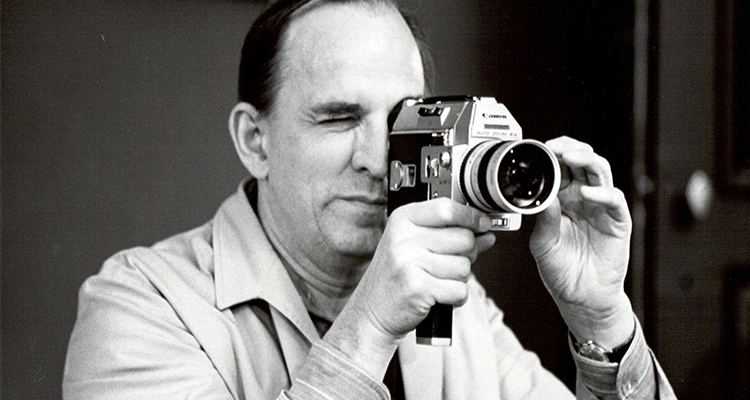
“One of the foremost cinematographers in film history, Sven Nykvist was a longtime collaborator of Ingmar Bergman who also worked with other fantastic film directors like Andrei Tarkovsky, Roman Polanski, and Woody Allen. As Liv Ullmann says in this window to the cinematographer, When you talk about Ingmar’s genius and Ingmar’s enormous importance for film, I don’t think you can do that without talking about Sven Nykvist. A poet of light, Ingmar Bergman turned to Sven Nykvist for his openness to filmmaking. His efficient use of available light and experimenting style was alluring and led to a great collaboration between the two filmmakers. Nykvist was a daring filmmaker, which related to the intuitiveness both he and Bergman shared. This daring, however, never opposed the performances of actors for he mixed the importance of aesthetics with the importance of capturing the genuine and human performances of actors. A pioneer of the expressive qualities of light, Sven Nykvist, cinema’s Rembrandt, is a filmmaker to admire and study, and this short documentary With One Eye He Cries is a great way to enter the world of the celebrated cinematographer.” —Edwin Adrian Nieves, A-BitterSweet-Life
“Sufficient time is rarely taken to study light. It is as important as the lines the actors speak, or the direction given to them. It is an integral part of the story and that is why such close coordination is needed between director and cinematographer. Light is a treasure chest: once properly understood, it can bring another dimension to the medium… As I worked with Ingmar, I learned how to express in light the words in the script, and make it reflect the nuances of the drama. Light became a passion which has dominated my life.” —Sven Nykvist


-2.jpg)

.webp)





.jpg)