_
And, indeed, I will ask on my own account here, an idle question: which is better—cheap happiness or exalted sufferings? Well, which is better?---Fyodor Dostoevsky ---Notes from Underground Fyodor Dostoevsky ---Notes from Underground Even now, so many years later, all this is somehow a very evil memory. I have many evil memories now, but ... hadn’t I better end my “Notes” here? I believe I made a mistake in beginning to write them, anyway I have felt ashamed all the time I’ve been writing this story; so it’s hardly literature so much as a corrective punishment. Why, to tell long stories, showing how I have spoiled my life through morally rotting in my corner, through lack of fitting environment, through divorce from real life, and rankling spite in my underground world, would certainly not be interesting; a novel needs a hero, and all the traits for an anti-hero are expressly gathered together here, and what matters most, it all produces an unpleasant impression, for we are...
Hope
To be human is to be a miracle of evolution conscious of its own miraculousness — a consciousness beautiful and bittersweet, for we have paid for it with a parallel awareness not only of our fundamental improbability but of our staggering fragility, of how physiologically precarious our survival is and how psychologically vulnerable our sanity. To make that awareness bearable, we have evolved a singular faculty that might just be the crowning miracle of our consciousness: hope.--
Erich Fromm
THE MATCH FACTORY GIRL (1990)
Aki Kaurismäki's Proletariat TrilogyThe Match Factory Girl
"A masterclass in cinematic minimalism, dark humor, and social critique."
"The Match Factory Girl" is the third film in Kaurismaki's Proletariat Trilogy. It follows "Shadows in Paradise," about a aimless garbage collector and "Ariel" (1988), about a coal miner who escapes his subterranean work by turning to crime. The three films have been packaged together and released by Criterion.
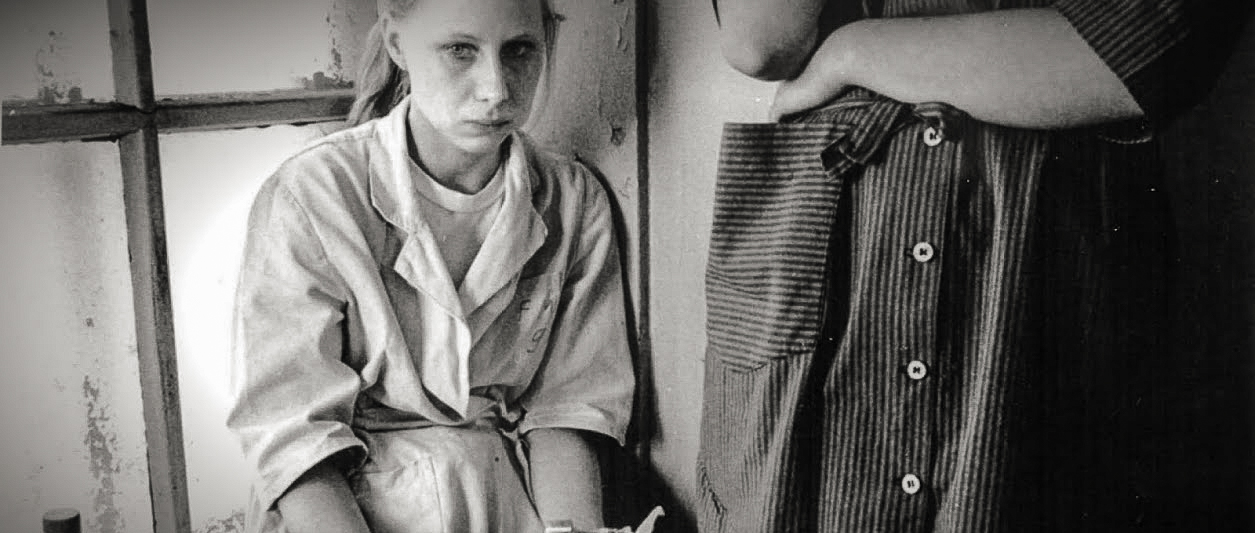
''The Match Factory Girl'' opens with production line in a factory that follows the stages in which wood get treated to get to the final product at the end of line, which is box of matches. At the end of this long mechanical chain stands Iris making certain the mailing labels are stuck securely on the boxes.
She pays rent to her mother and stepfather to sleep on the couch. She puts on cheap makeup, goes to a dance only to find herself the only woman left sitting against the wall at end of the evening.
One day she makes a bold step ,without knowledge of her parents she takes part of her paycheck to buy a cheap-looking red-flowered dress in which she goes to a dance.
This poor girl. I wanted to reach out my arms and hug her. That was during the first half of "The Match Factory Girl." Then my sympathy began to wane. By the end of the film, I think it's safe to say Iris gives as good as she gets.
The Finnish director Aki Kaurismäki fascinates me. I am never sure if he intends us to laugh or cry with his characters--both, I suppose. He often portrays unremarkable lives of unrelenting grimness, sadness, desolation. When his characters are not tragic, he elevates them to such levels as stupidity, cluelessness, self-delusion or mental illness. Iris, the match factory girl, incorporates all of these attributes.
"This cannot be tragedy because she lacks the stature to be a heroine. It cannot be comedy because she doesn't get the joke. What can it be?"
Aki Kaurismäki-Criterion Collection >>>
FILM DIRECTORS-AKI KAURISMAKI >>>

The Anatomy of the Film
1. Mechanical Alienation vs. Human Disposability
The film opens with a famous, near-silent documentary-style sequence tracking the automated manufacturing of matches—logs peeled, sliced, dipped in sulfur, and boxed. When the camera finally cuts to Iris (played with extraordinary, stone-faced vulnerability by Kati Outinen), she is positioned merely as the final cog in this mechanical line, checking labels. Kaurismäki establishes immediately that the world treats Iris exactly like a match: cheap, mass-produced, and entirely disposable.
2. The Narrative Cruelty
Iris’s life is an exercise in suffocating exploitation:
At home: She supports a parasitic mother and stepfather who view her strictly as a paycheck and domestic servant.
Socially: She sits wallflower-still at local dance halls, ignored by a changing, modernizing Helsinki.
The Catalyst: A brief, transactional encounter with an affluent man named Aarne leaves her pregnant. Aarne’s response is a chillingly detached note accompanied by a check, instructing her to "get rid of it."
3. The Kaurismäki Tone
What prevents the film from descending into unwatchable misery is Kaurismäki’s hyper-specific aesthetic grammar. The film features almost no dialogue; characters communicate in sparse, functional sentences or heavy glances. The misery is punctuated by an incredibly dark, deadpan humor and an ironic use of music—melancholic Finnish tango and upbeat pop songs fill the sonic void, acting as a bitter commentary on Iris's internal longing.
The Pivot to Vengeance
When Iris finally snaps, her rebellion isn't a loud, Hollywood-style outburst. It is executed with the exact same methodical, quiet efficiency she used at the match factory. Armed with a box of rat poison, she systematically and impassively targets those who exploited her:
Aarne: Slipped neatly into his drink during a silent confrontation.
The Stepfather & Mother: Left casually in a bottle on the kitchen table.
The Unfortunate Stranger: A man at a bar who attempts to hit on her, poisoned purely as collateral damage of her total disillusionment.
There is a profound, dark catharsis in seeing Iris reclaim agency, even if it leads inevitably to her stoic, silent arrest in the final frame.
"Iris represents the ultimate evolution of the Kaurismäki protagonist: someone pushed so far past the margins of society that her only remaining language is absolute negation."

The Match Factory Girl is a bleakly comic tragedy that follows Iris (Kati Outinen), a plain, quiet young woman who works on a matchbox assembly line in Helsinki. Her life is a cycle of repetitive labor at the factory and emotional servitude at home, where she supports her unloving mother and lazy, abusive stepfather. After a series of cruel betrayals—a one-night stand that leads to a rejected pregnancy and further abuse from her parents—the habitually passive Iris finally snaps, embarking on a cold, calculated path of revenge.

Themes and Style
1. Minimalism and "The Bresson Effect"
Kaurismäki famously stated he wanted to make a film that would make Robert Bresson (the master of cinematic austerity) look like a director of "epic action pictures."
Silence: There is almost no dialogue for the first 15 minutes. Emotions are conveyed through the radio, the television, and Kati Outinen's "impenetrable" face.
Static Cinematography: The camera rarely moves, framing the characters in beige, dingy interiors that emphasize their entrapment.
2. The "Little Match Girl" Subversion
The film is a modern, cynical retelling of Hans Christian Andersen’s The Little Match Girl. While Andersen’s protagonist finds relief through a freezing death and a vision of heaven, Kaurismäki’s Iris takes agency. Her "heaven" is not spiritual; it is the grim satisfaction of removing the people who exploited her. She moves from a prison of poverty to a literal prison, but for the first time, it is on her own terms.
3. Historical Grounding
Throughout the film, television news broadcasts show the Tiananmen Square protests and the death of Ayatollah Khomeini. This creates a sharp contrast between the "small" tragedy of Iris’s lonely life and the "large" geopolitical tragedies of 1989, suggesting that violence and oppression exist on every scale of human existence.
4. Deadpan Humor
Despite the grim subject matter, the film is considered a comedy by many critics. The humor is "dry as a bone," derived from the absurdity of the characters' silence and the hyper-efficiency of Iris’s eventual murder spree.
Legacy
The Match Factory Girl cemented Kati Outinen as Kaurismäki’s muse and established the director’s signature style: a mixture of 1950s rock-and-roll aesthetics, social realism, and a uniquely Finnish brand of melancholic wit. It holds a rare 100% on Rotten Tomatoes and was added to Roger Ebert’s "Great Movies" list.


