The Architecture of Despair: A Comprehensive Analysis of the Life, Literary Evolution, and Socio-Cultural Legacy of Charles Bukowski
The literary phenomenon of Charles Bukowski represents one of the most significant and polarizing trajectories in twentieth-century American letters. Often marginalized during his most productive years as a "cult" or "underground" figure, Bukowski eventually ascended to a status of global canonical importance, characterized by a staggering prolificacy that includes six novels, hundreds of short stories, and over five thousand poems. His aesthetic, frequently categorized under the rubric of "dirty realism," functions as a sustained interrogation of the American working-class experience, stripped of the teleological promises of the American Dream and replaced by a gritty, unvarnished focus on the mundane drudgery of survival. Through his semi-autobiographical alter ego, Henry Chinaski, Bukowski constructed a narrative framework that transformed personal anguish—rooted in a childhood of severe abuse and a life of systemic alienation—into a universally resonant exploration of the human condition.
Genealogical Roots and the Crucible of Early Childhood
The foundations of Bukowski’s worldview were established in the fractured socio-economic landscape of post-World War I Europe. Born Heinrich Karl Bukowski on August 16, 1920, in Andernach, Prussia, within the Weimar Republic, his heritage was a complex blend of German and American influences. His father, Heinrich (Henry) Bukowski, was an American sergeant of German descent who remained in Germany following his service in the U.S. Army of occupation after the empire's defeat in 1918. His mother, Katharina Fett, was a native German from a Catholic family in the Eifel region. Although Bukowski often claimed to be born out of wedlock to emphasize his "outsider" status, marital records indicate his parents married one month prior to his birth.
The family’s early years were marked by economic instability. Following a brief attempt to establish a building contracting business in Pfaffendorf, the crippling postwar reparations and subsequent hyperinflation of the German economy forced the family to emigrate. On April 18, 1923, they sailed from Bremerhaven to Baltimore, Maryland, eventually settling in Mid-City, Los Angeles, in 1930. This transition from a defeated European power to a Depression-era American metropolis provided the initial geographic and psychological cartography for Bukowski’s later explorations of urban decay and social displacement.
Table 1: Genealogical and Formative Chronology
The domestic environment in Los Angeles was characterized by a "living nightmare" of systemic violence and psychological terror. Heinrich Sr., frequently unemployed and burdened by the failure of his middle-class aspirations, implemented a regimen of brutal discipline. Bukowski later recounted being beaten with a razor strop three times a week from the ages of six to eleven, often for the smallest imagined offenses. This early exposure to "undeserved pain" became a formative element of his creative identity, fostering a profound skepticism toward traditional morality and the bourgeois idealism touted by his father.
Clinical Alienation: The Transformation of the Physical Self
During his adolescence, Bukowski’s social isolation was compounded by a catastrophic medical condition. He developed an extreme case of acne vulgaris, described by his physicians as one of the most severe they had ever encountered. This condition not only caused immense physical pain but also resulted in a permanent disfigurement that deepened his sense of being an "intruder and outcast". neighborhood children ridiculed his appearance and his German accent, further driving him into a state of "shy and socially withdrawn" introspection.
In this crucible of physical and emotional suffering, Bukowski discovered two primary coping mechanisms: alcohol and literature. His first encounter with alcohol at age thirteen—a glass of wine in a friend's father's cellar—was described as "magic," a realization that provided a temporary escape from the "pain of his father's violent discipline". Simultaneously, he began to frequent the public library, immersing himself in the works of writers who challenged conventional "wisdom," such as Ernest Hemingway, Sinclair Lewis, and Upton Sinclair. These early influences, combined with a lifelong appreciation for classical music and horse racing, provided the intellectual and emotional framework that would sustain him during his decades of obscurity.
The Lost Decade: Drifting, Labor, and the Charity Ward
Following his departure from Los Angeles City College in 1941, Bukowski embarked on a period of intense geographic and professional instability. Exempted from military service during World War II for psychological reasons, he spent the war years traveling across the United States, supporting himself through a succession of "menial jobs". His experiences during this time—working as a stock boy, dishwasher, elevator operator, and laborer in slaughterhouses and dog biscuit factories—provided the raw material for his later picaresque novel Factotum.
While Bukowski published his first short story, "Aftermath of a Lengthy Rejection Slip," in Story magazine in 1944 at the age of twenty-four, the subsequent years were marked by a lack of literary success. Discouraged by a "steady stream of rejection slips," he effectively abandoned writing for a decade, choosing instead to live as an alcoholic on skid row. This "ten-year binge" took him through various cities before he returned to Los Angeles in 1946, where he met Jane Cooney Baker, a woman who would become a significant and tragic figure in his life and work.
The physical toll of this lifestyle culminated in the spring of 1955 when Bukowski was hospitalized in the charity ward of Los Angeles County Hospital, nearly dead from a massive bleeding ulcer. This near-death experience served as a profound epiphany. Following a life-saving blood transfusion from his father, Bukowski was released from the hospital and immediately began writing poetry. This shift from prose to poetry marked a pivotal transition in his creative trajectory, allowing him to develop the "economical, gritty fashion" and "confessional tone" that would define his mature voice.
The Postal Epoch: Bureaucracy as a Microcosm of Drudgery
The most significant professional influence on Bukowski’s literary output was his twelve-year tenure with the United States Postal Service. His time at the USPS was divided into two distinct periods: a three-year stint as a substitute mail carrier (1952–1955) and an eleven-year period as a mail sorter or clerk (1958–1969). These years of "stultifying" labor provided not only financial security—including a $15,000 inheritance during the 1960s—but also a detailed understanding of the "bureaucratic systems" that wear down the human spirit.
Bukowski’s first novel, Post Office (1971), is a direct "autobiographical account" of these years, detailing the "routine drudgery" of a mail carrier’s life and the "constant interactions with supervisors". The novel introduces Henry Chinaski as he cycles through the chaos of "sub" assignments, eventually becoming a regular before resigning in a state of exhaustion. Bukowski used this setting to explore the "futility and senselessness of most human endeavor," contrasting the rigid "code of ethics" of the government agency with Chinaski’s own "raucous exploits" and disdain for authority.
Table 2: Comparative Analysis of the USPS Tenure and Literary Output
The transition from a postal clerk to a full-time writer was facilitated by John Martin, the editor of Black Sparrow Press. Martin, recognizing Bukowski’s "unique voice," offered him a $100 monthly stipend for life on the condition that he quit the post office and devote himself to writing. Bukowski famously accepted, stating that he had a choice between staying at the post office and "going crazy" or becoming a "starving writer". This "unholy alliance" with Martin provided the stable foundation for Bukowski’s gargantuan literary output over the following two decades.
Dirty Realism and the Aesthetic of the Unvarnished
Bukowski’s literary style is a hallmark of the "Dirty Realism" movement, a term coined by Anne Buford in 1983 to describe a "highly realist genre of literature" characterized by its "gritty subject matter" and "minimalist style". Bukowski’s prose and poetry intentionally avoid "flowery language" and "literary formalism," opting instead for a "blunt and direct reflection" of his experiences. This aesthetic prioritize the "raw reality" of the story, using "sparse and concrete language" to capture the essence of life on the margins of society.
The "Bukowski style" is defined by several key linguistic and structural elements:
Economical Prose: Influenced by Hemingway and Fante, Bukowski utilized a "sharp, precise, and economical" style that eschewed metaphor in favor of "lively anecdotes".
Declarative Columns: His free verse often consists of "declarative sentences broken up into a long, narrow column," giving an impression of "speed and terseness" even when the subject matter is sentimental.
Confessional Tone: An "autodidactic confessional poet," Bukowski transformed "autobiographical data into miniature tragedies," maintaining a "nothing-to-lose truthfulness" that set him apart from his contemporaries.
Bleak Humor: Despite the "grim outlook" of his work, it is often infused with "dark humor" and "wry observations," providing a "glimmer of hope amidst all the human suffering".
This stylistic approach allowed Bukowski to function as a "contemporary Whitman" who took risks with "long, extravagant lines" while simultaneously operating as a "pulp fiction hero" through the character of Henry Chinaski. His rejection of "traditional poetic conventions" made his work more "accessible and relatable" to a broad audience, fostering a "cult following" that eventually propelled him into the literary mainstream.
The Chinaski Cycle: A Semiautobiographical Masterwork
The most enduring element of Bukowski’s prose is the creation of Henry "Hank" Chinaski, his literary alter ego and "antihero". Chinaski appears in five of Bukowski’s six novels and numerous short stories, serving as a vehicle through which the author explored the various stages of his own life. While the character is a "literary creation," his biography mirrors Bukowski’s own experiences with alcohol, hangovers, unemployment, and "volatile relationships".
Analysis of the Six Major Novels
Post Office (1971): Written in just twenty nights following his resignation from the USPS, this novel chronicles the "misadventures" of a postal clerk. It is a "hilarious and vulgar" representation of life lived "on the skids," establishing the tone for the novels that followed.
Factotum (1975): Serving as a prequel to Post Office, this novel details Chinaski’s experiences in "low-life bars and menial jobs" as he struggles to establish himself as a writer. It portrays the "artist as a young man" in a state of perpetual hangovers and social rejection.
Women (1978): This novel documents Chinaski’s "unlikely rise as a ladies' man" after becoming a "cult figure". While some critics have labeled it "misogynistic," it can also be viewed as an "ironic deconstruction" of sexual power relationships, presenting Chinaski as "emotionally vulnerable and physically impotent".
Ham on Rye (1982): Widely considered Bukowski’s "finest achievement," this novel details Chinaski’s coming-of-age during the Great Depression. It provides a "taut, vivid, intense" account of his childhood trauma, "abusive father," and the "disfiguring case of acne" that shaped his outsider perspective.
Hollywood (1989): Based on Bukowski’s experiences writing the screenplay for the movie Barfly, this novel mocks the "egotistical Hollywood phonies" while tracing the "convoluted path from script to screen".
Pulp (1994): Bukowski’s final novel, published posthumously, is a "spoof of hard-boiled detective novels". It departs from the Chinaski protagonist in favor of Nick Belane, yet retains the author’s signature "slavic nihilism" and "existential despair".
Table 3: Evolution of the Chinaski Persona Across Major Novels
The Poetic Legacy: From Loujon to the World
While his novels brought him commercial success, Bukowski remained a "prolific and seminal figure" in the world of poetry, publishing thirty-two volumes during his life. His early collections, such as It Catches My Heart in Its Hands (1963) and Crucifix in a Deathhand (1965), were published by Loujon Press as "laborious letterpress" projects limited to a few hundred copies. These works, characterized by "raw, surreal imagery," helped Bukowski gain popularity in the "alternative literary scene" through "word of mouth".
As his relationship with Black Sparrow Press matured, his poetry became more "narrative and sexually oriented," moving away from metaphor toward a "conversational" style. Collections like Mockingbird Wish Me Luck (1972) and Love Is a Dog from Hell (1977) became "cornerstones" of his legacy, capturing the "essence of love's unpredictable nature" and the "harsh sweet kiss of dreams". Even as he faced his mortality in works like The Last Night of the Earth Poems (1992), Bukowski maintained his "trademark wit and brutal truth," reflecting on life’s absurdities with an "unapologetic voice".
Critical Reception and the Gender Conflict
The reception of Bukowski’s work has been marked by a profound divide between academic criticism and popular acclaim. In the United States, he was frequently dismissed by the literary establishment as the "poet laureate of Los Angeles low life" or the "bard of the barroom". Critics often charged him with being "crude, vulgar and sexist," particularly in his portrayal of women as "one-dimensional sexualized objects".
However, scholarly analysis—particularly from European thinkers—has offered a more complex interpretation. Some suggest that Bukowski’s treatment of women stems from his own "fear of intimacy" and "emotional vulnerability". In novels like Women, the protagonist's "dominance and power" is often "reduced to a minimum," suggesting a "gradual deconstruction of masculinity". Proponents argue that his writing "satirizes the machismo attitude" through its "routine use of sex, alcohol abuse, and violence," ultimately "caustically indicting bourgeois society" rather than celebrating the depravity he depicted.
Cinematic Reflections: The Bukowski Lens
The transition of Bukowski’s work to the silver screen was a complex process characterized by the author's own "reluctance to get involved". Despite his skepticism of the medium, several significant adaptations and documentaries were produced that expanded his cult status into the mainstream.
Barfly (1987): Directed by Barbet Schroeder and starring Mickey Rourke, this film was based on a screenplay written by Bukowski. While it made him a "household name," Bukowski later expressed dissatisfaction with Rourke’s performance, claiming the actor "overplayed" the role and was "too pretty" to capture the true grit of Chinaski.
Factotum (2005): Directed by Bent Hamer and starring Matt Dillon, this adaptation focused on the "refusal to change" that defines the Bukowski/Chinaski character.
Foreign Adaptations: European directors were often more receptive to Bukowski’s "visceral prose". Marco Ferreri directed Tales of Ordinary Madness (1981) in Italy, and Dominique Deruddere directed the acclaimed Belgian film Crazy Love (1987).
Bukowski: Born Into This (2003): This "powerful documentary" directed by John Dullaghan is widely considered the definitive visual account of Bukowski’s life, capturing his "essence" through exhaustive archival research and interviews with celebrities like Bono, Sean Penn, and Tom Waits.
Table 4: Key Media and Documentary Milestones
Legacy and Influence on Contemporary Culture
Following his death from leukemia on March 9, 1994, Charles Bukowski has passed into the "mythology of American writers," achieving a level of "last name recognition" comparable to Hemingway or Faulkner. His influence is particularly evident in the world of music, where his "gruff voice" and "unfiltered portrayal of life" have resonated with diverse artists.
Bono (U2): Credits Bukowski with teaching him to "get straight down to the bone" and paid tribute to him in the song "Dirty Day".
Tom Waits: Considers Bukowski a "huge influence," citing his work as "very musical" and echoing his focus on "dark places, sadness, drifters and loneliness".
Indie and Punk Rock: Bands such as Modest Mouse, Red Hot Chili Peppers, and Hot Water Music have referenced Bukowski or named songs and albums after his works. Pop-punk artists relate to his "wearing the heart on your sleeve" style and his "counterculture to Americana conformity".
Bukowski’s philosophical observations—exemplified by the Zen-inspired epitaph "Don't try" on his headstone—continue to influence writers and readers alike. He remains a "great dark force" in American literature, a writer who "wrote with all of his blood and all of his bones" and whose legacy continues to grow through a steady stream of posthumous publications.
Philosophical Observations: Solitude, Alcohol, and the Human Circus
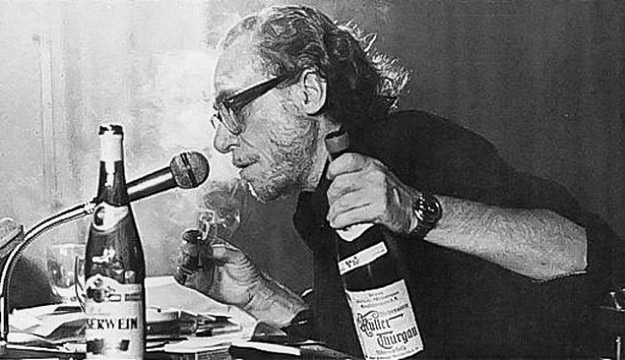
The core of Bukowski’s worldview was a profound appreciation for solitude and a cynical yet empathetic understanding of the "human circus". He viewed drinking as an "emotional thing" that "joggles you out of the standardism of everyday life," acting as a "form of suicide where you're allowed to return to life and begin all over the next day". Despite his reputation as a "drunken brawler," Bukowski’s relationship with alcohol was deeply intertwined with his "creative identity," providing a "spark for his creative fire" and a "key that unlocked a wellspring of emotions".
His perspective on solitude was equally essential to his craft. He claimed to have never been "lonely" because he possessed a "terrible itch for solitude," a condition in which the "darkness of the room was like sunlight". For Bukowski, real loneliness was felt most acutely at parties or in "stadiums full of people," where the "impersonal instruments of civilized industrial society" were most pervasive. This "slavic nihilism" and the belief that "the only good fight" is to "go all the way" regardless of the cost remain the defining ethos of his life and work.
Charles Bukowski’s career, spanning over several decades and resulting in more than sixty books, represents a sustained "monument to alienation and despair" that nonetheless offers "glimmers of beauty and joy in the most unexpected places". By transforming his "private agony into a poetry with universal implications," he secured a lasting place in the twentieth-century literary canon as the "voice for everyman" and the "champion of the marginalized".
Posthumous Prolificacy and the Future of the Canon
The end of Bukowski’s physical life did not mark the end of his literary output. Due to his "massive output" and the meticulous management of his estate by John Martin and his widow, Linda Lee Bukowski, new collections have appeared "every other year or so". Works like Slouching Toward Nirvana (2005) and The People Look Like Flowers At Last (2007) have expanded his corpus, while recent editorial projects like Storm for the Living and the Dead (2017) have sought to present his poems "exactly as Bukowski originally wrote them," removing decades of editorial "makeup".
This ongoing publication schedule ensures that Bukowski remains a "reliable steady seller," with thousands of copies of his Essential Bukowski and other themed anthologies sold annually. As scholars continue to dissect the "intricate dance between his drinking, his verse, and the insights offered by contemporary scholars," it becomes increasingly clear that Bukowski was not merely a "cult author," but an established part of the literary landscape who "caustically indictment bourgeois society while celebrating the desperate lives" of those on its fringes.
His reputation has evolved from that of a "dirty old man" to a "literary giant" whose "raw honesty and authenticity" continue to resonate with "the defeated, the demented and the damned"—a readership he was immensely "proud of". Whether viewed as a "contemporary Whitman" or a "black mountain of fire," Charles Bukowski remains a "natural force" that appears "maybe once in a generation," leaving behind a legacy that is as "visceral" and "unadaptable" as the man himself.
Synthesis of Themes and Socio-Political Resonance
The enduring resonance of Bukowski's work can be attributed to its alignment with broader socio-political shifts in late twentieth-century America. As the post-war economic boom began to fracture, giving way to the stagnation and disillusionment of the 1970s and 80s, Bukowski's focus on "poverty, alcoholism, and the struggles of the working class" provided a necessary counter-narrative to the polished "middle-class ideals" of the era. His "rebellious spirit" and "deep-seated distrust of authority" mirrored the countercultural movements of his time, even as he remained a "literary outsider" who rejected the "formal structure" of contemporaries like the Beats.
Bukowski's "proletarian ethos" and his ability to "convey powerful emotions and vivid imagery with minimalistic prose" made him a "powerful voice for the marginalized". His work addresses the "ordinary lives of poor Americans" not through the lens of political activism, but through the "unflinching portrayal of society's underbelly" and the "drudgery of work". This focus on the "sub-ordinary"—the "grit of flophouse hotels and bare-bones apartments"—provided a "bird's-eye view" of being authentically "down and out," a perspective that transcends the specificities of time and place to offer a "universal" exploration of survival.
Ultimately, the architecture of despair constructed by Charles Bukowski remains a significant and "insightful" contribution to modern letters. By "walking through the fire" of his own existence and documenting the journey with "raw honesty," he created a body of work that continues to "touch upon the harsh realities of life" and invite readers to "reflect on the artificial qualities of society". His legacy is defined by a "beautiful fight" that "still is," a testament to the power of art to emerge from the "darkness" and "nights that flame with fire".
The Final Reckoning: Death and the "Don't Try" Philosophy
As Bukowski faced his final years in San Pedro, his writing became increasingly "elegiac" and reflective. The transition from the "skid row hellholes" of his youth to an $80,000 house and a BMW was a dramatic shift that he chronicled in Hollywood and his late journals, such as The Captain is Out to Lunch. Yet, despite this material success, he maintained his "misanthropic" and "nihilistic" worldview, refusing to become "obvious" or to "bash into the walls" of conventional expectation.
His diagnosis of leukemia in the early 1990s brought a "tragic overtone" to his final works, as he sought to "come to terms with his diagnosis" through the lens of his trademark "wit and brutal truth". The Zen-inspired epitaph "Don't try" remains his final instruction—a reminder that "art should come easily and naturally" and that "the sun inside you" must "roar out of you" like a "rocket". Charles Bukowski’s life and career serve as a powerful reminder that "what is terrible is not death but the lives people live or don't live up until their death," and that the "only good fight" is to "ride life straight to perfect laughter".
Through his "massive output," his "cult hero" status, and his "unapologetic approach" to the "complexities of human experience," Bukowski has earned a "lasting place in literary history". He remains a "seminal figure" whose "raw, unfiltered portrayal of life" continues to provide a "lens through which readers could understand" the "bittersweet reality of everyday life". In the end, Bukowski’s work is a "testament to the resilience" of the human spirit, a "shambling, low-life figure" who nonetheless "made it" into the "front door of American Literature".




-3.jpg)


