After 50 Years, “Midnight Cowboy” Stands Alone >>>
The Director of Outsiders
JOHN
SCHLESINGER
"I'm interested in the people who don't fit in. The people who are on the edge."
John Schlesinger was a defining voice of mid-to-late 20th-century cinema, possessing a rare fluidity that allowed him to transition seamlessly from the gritty, localized realism of the British New Wave to the cynical, neon-lit landscapes of New Hollywood.
Rather than sticking to a singular visual trademark, Schlesinger's auteur signature lay in his sharp psychological acuity, an uncompromising look at human desperation, and a recurring fascination with outsiders attempting to navigate hostile or indifferent social systems.
The Cinematic Evolution
Schlesinger’s filmography reflects the tectonic shifts occurring in international cinema across three distinct eras:
1. The British Kitchen Sink Realism (Early 1960s)
Starting in documentary television (BBC's Monitor), Schlesinger quickly became a crucial pillar of the British New Wave. His early fiction features captured the disillusionment of the post-war British working class, utilizing location shooting and acute social observation.
A Kind of Loving (1962): A stark, unromanticized look at regional working-class marriage and societal pressure that won the Golden Bear at Berlin.
Billy Liar (1963): A brilliant blend of kitchen-sink austerity and surreal fantasy sequences, capturing the suffocating nature of provincial life through a young man's escapist delusions.
Darling (1965): A cynical, stylistically modern dissection of the empty glamour of "Swinging London," which earned Julie Christie an Academy Award.
2. The Transatlantic Transition & New Hollywood Peak (Late 1960s–1970s)
As Hollywood underwent its creative revolution, Schlesinger relocated to America, bringing his European sensibility to bear on the country's deep-seated anxieties, urban decay, and countercultural shifts.
Midnight Cowboy (1969): His undisputed masterpiece. By framing the mythic American cowboy as a naive, desperate sex worker in a hellish, grimy New York City, Schlesinger captured a profound sense of urban alienation. It remains the only X-rated film ever to win the Academy Award for Best Picture.
Sunday Bloody Sunday (1971): A deeply personal, quiet, and groundbreaking British drama that treated a bisexual love triangle involving a middle-aged Jewish doctor and a divorced woman with unprecedented maturity and zero moralizing.
Marathon Man (1976): A masterclass in paranoia and visceral tension, using New York's gritty architecture to heighten a dense, post-Watergate thriller plot.
3. The Later Genre Explorations (1980s–1990s)
While his later career was commercially uneven, Schlesinger continued to experiment across genres, frequently returning to themes of espionage, deception, and psychological vulnerability.
Core Thematic Concerns
The Geography of Alienation: Whether it is the gray, cramped terrace houses of Northern England or the predatory, steam-venting streets of Times Square, Schlesinger used physical environments as externalizations of his characters' internal entrapment.
Compromised Intimacy: Love and connection in Schlesinger's world are rarely pure; they are constantly bartered, hidden, or complicated by financial necessity, social stigma, and psychological damage.
The Facade of Modernity: From the hollow media culture of Darling to the plastic superficiality of Los Angeles in The Day of the Locust (1975), he was deeply skeptical of institutional promises of success and glamour.
Where would you like to begin exploring his work? We can do a deep dive into the editing and street-photography style of Midnight Cowboy, or look at how Billy Liar bridged the gap between gritty realism and the French New Wave's playful subjectivity.
Waldo Salt
"I ended up at 50, over the hill, thinking I had no future...
then I started to write."
"We are all born with human needs. The conflict between those needs and what we do to meet those needs is the drama of life."
Waldo Salt (1914–1987) was one of Hollywood’s most resilient and transformative screenwriters. His life story reads like a classic three-act cinematic narrative: a meteoric early rise, a devastating mid-career exile during the McCarthy era, and a triumphant late-career renaissance that redefined American cinema in the 1970s.
The Three Acts of an Iconic Career
Act I: The Hollywood Prodigy (1930s–1940s)
Graduating from Stanford University at just 18, Salt quickly established himself as a highly capable studio writer at MGM. He worked on notable projects like The Shopworn Angel (1938) and did uncredited work on the classic The Philadelphia Story (1940). After serving as a consultant for the U.S. Office of War Information during World War II, his commercial stock continued to soar with hits like the swashbuckler The Flame and the Arrow (1950).
Act II: The Blacklist and Exile (1951–1962)
Salt's career ground to an absolute halt in 1951 when he was subpoenaed by the House Un-American Activities Committee (HUAC) due to his association with the American Communist Party. He refused to cooperate or name names, standing firmly on his constitutional rights.
Dubbed one of the "Unfriendly Nineteen," Salt was blacklisted by the major studios. For over a decade, he was forced into creative exile, scraping by under various pseudonyms (such as Mel Davenport) to write episodes for British television shows like The Adventures of Robin Hood.
Act III: The Renaissance (1969–1978)
By the late 1960s, the blacklist had collapsed, but Salt was in his 50s, broke, and struggling to re-establish his voice. Rather than chasing generic studio assignments, he made a conscious decision to approach screenwriting purely as a uncompromising artist.
The result was a string of gritty, deeply human masterpieces that captured the disillusioned spirit of the New Hollywood era:
Midnight Cowboy (1969): An adaptation of James Leo Herlihy’s novel about an unlikely friendship between a naive Texas hustler and a crippled con man. It became the only X-rated film to win the Academy Award for Best Picture, and earned Salt his first Oscar for Best Adapted Screenplay.
Serpico (1973): Salt teamed up with Norman Wexler to adapt the true story of Frank Serpico (played by Al Pacino), an honest New York cop fighting systemic police corruption. The script earned Salt another Academy Award nomination.
Coming Home (1978): A raw, groundbreaking look at the emotional and psychological trauma experienced by Vietnam War veterans returning home. The film won Salt his second Academy Award, this time for Best Original Screenplay.
Legacy and Impact
Today, Salt's dedication to screenwriting as an art form lives on at the Sundance Film Festival, which annually presents the Waldo Salt Screenwriting Award to recognize outstanding and highly creative storytelling in independent American cinema.
Synopsis & Context
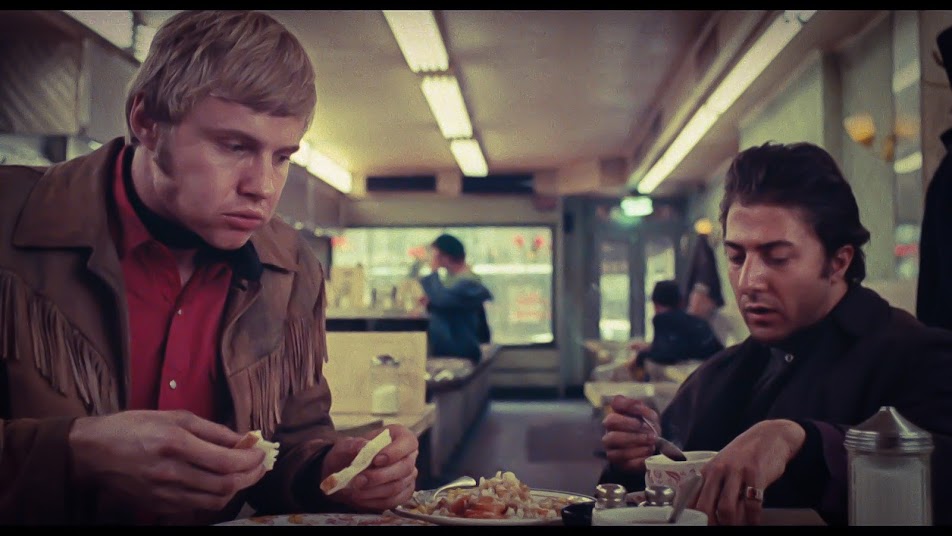
The story follows Joe Buck (Jon Voight), a handsome, naive dishwasher from a small Texas town. Clad in a crisp new cowboy outfit, Joe boards a bus for New York City, convinced that he can easily make a fortune as a hustler servicing wealthy Manhattan women.
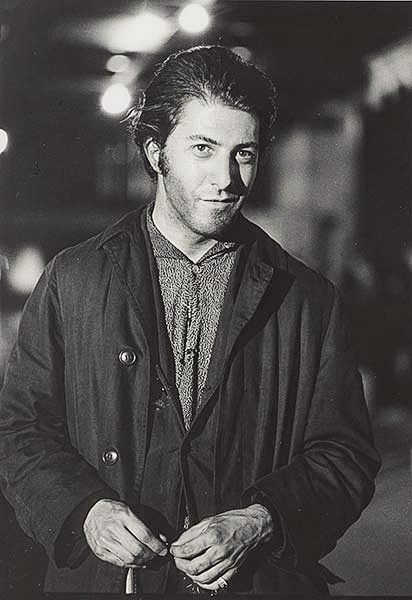
Upon arrival, his romanticized fantasy of the big city is shattered by indifferent crowds, financial desperation, and predatory characters. Destitute and out of his depth, Joe crosses paths with Enrico Salvatore "Ratso" Rizzo (Dustin Hoffman), a crippled, tubercular, petty con artist living in a condemned building. Initially, Ratso cons Joe, but as both men hit rock bottom, they form a desperate, co-dependent partnership that evolves into a deeply moving bond of friendship and survival.
Character Dynamics
The emotional heart of the film lies in the stark contrast and ultimate synergy between its two lead characters.
Joe Buck (The Naive Outsider): Joe represents a warped projection of the classic American Cowboy. He is physically imposing but emotionally infantile, scarred by a childhood of abandonment and sexual trauma (revealed in fragmented flashbacks). His cowboy attire is a defensive armor—a performative masculinity meant to hide his deep vulnerability and desperate need for love.
"Ratso" Rizzo (The Cynical Insider): Ratso is the physical manifestation of New York's underbelly: decaying, bitter, and hyper-vigilant. Yet beneath his filthy exterior and abrasive con-man persona lies an aching desire for dignity and escape. His dream is to go to Florida, a warm paradise where he imagines his physical ailments will magically heal.
As their partnership deepens, their roles blur. Joe becomes Ratso's protector and caretaker, while Ratso becomes Joe's pragmatic guide to reality. Their relationship challenges traditional boundaries of masculinity, displaying a tender, domestic intimacy rare for American cinema at the time.

The Death of the American Dream
Midnight Cowboy systematically deconstructs the myths of American prosperity and rugged individualism. Joe Buck travels East (reversing the traditional Westward expansion of American pioneer myth) to find fortune, only to discover that the frontier is closed and paved over with concrete and commercialism. The "cowboy" is no longer a hero of the plains; he is an anachronism, a novelty, and a target for exploitation.
Urban Alienation vs. Human Connection
John Schlesinger portrays New York City as a hostile, mechanized landscape of towering glass, flashing neon, and indifferent masses. People walk past suffering without blinking. In this desert of steel, Joe and Ratso's survival depends entirely on their willingness to look past each other's flaws and offer genuine companionship. Their connection is a fragile rebellion against a society that views them as human garbage.
Illusion vs. Reality
The film is saturated with media saturation, television screens, and advertising. Joe is constantly bombarded by radio broadcasts and billboards promising sex, wealth, and happiness. Both Joe's fantasy of being a high-class stud and Ratso's fantasy of a sunny, effortless life in Miami are survival mechanisms designed to mask the bleakness of their immediate reality.

Cultural Impact & Legacy
The X-Rating and the Academy Awards
Midnight Cowboy holds a unique place in film history. Released during the infancy of the MPAA rating system, it was originally given an X rating due to its frank depictions of homosexuality, prostitution, drug use, and psychological trauma.
Despite this rating—which typically restricted advertising and theater distribution—the film was a massive critical and commercial success. It went on to receive seven Academy Award nominations and won three:
Best Picture (making it the first and only X-rated film ever to win the top prize)
Best Director (John Schlesinger)
Best Adapted Screenplay (Waldo Salt)
(The film was later re-evaluated and re-rated R in 1971 without any cuts, reflecting rapidly changing cultural standards.)
Conclusion
Ultimately, Midnight Cowboy remains a landmark achievement of the New Hollywood era. It bypassed the glossy, sanitized storytelling of Old Hollywood to deliver an uncompromising, deeply empathetic look at the margins of society. Through its unforgettable performances, innovative editing, and haunting atmosphere, it proved that cinema could be gritty, uncomfortable, and devastatingly beautiful all at once.
HoJ John Schlesinger’s Homeless and Lonesome ‘Midnight Cowboy’ Rode His Way to the Top and Became the First and Only X-rated Movie to Win a Best Picture Oscar >>>

Key Cinematic & Thematic Elements
The Myth of the West vs. Urban Decay: Schlesinger uses Joe's fringe jacket and cowboy hat to sharply deconstruct the classic American myth. In the cold, indifferent streets of Times Square, the cowboy symbol is completely stripped of its heroic stature, turning Joe into an object of exploitation and mockery rather than desire.
Visual Style and Editing: Heavily influenced by the French New Wave, cinematographer Adam Holender capturing a raw, documentary-style New York. Editor Hugh A. Robertson weaves in fragmented, jarring, and hallucinatory flashbacks that slowly reveal Joe’s deeply traumatizing past, blending memory with the harsh present.
A Masterclass in Character Acting: The core of the film is the profound, evolving tenderness between Joe and Ratso. As their individual delusions shatter, their relationship shifts from a transactional hustle to a genuine, protective brotherhood. Hoffman’s frantic, desperate energy balances perfectly against Voight's quiet, bewildered vulnerability.
"I'm walkin' here!"
Hoffman’s iconic, improvised line when a real New York taxi cab nearly hit him during a guerrilla-style shoot on a live city street perfectly encapsulates the film's raw, unvarnished energy.
Jon Voight, Dustin Hoffman in "Midnight Cowboy" 1969 News Photo - Getty Images >>>


-3-2.jpg)