And, indeed, I will ask on my own account here, an idle question: which is better—cheap happiness or exalted sufferings? Well, which is better?---Fyodor Dostoevsky ---Notes from Underground Fyodor Dostoevsky ---Notes from Underground Even now, so many years later, all this is somehow a very evil memory. I have many evil memories now, but ... hadn’t I better end my “Notes” here? I believe I made a mistake in beginning to write them, anyway I have felt ashamed all the time I’ve been writing this story; so it’s hardly literature so much as a corrective punishment. Why, to tell long stories, showing how I have spoiled my life through morally rotting in my corner, through lack of fitting environment, through divorce from real life, and rankling spite in my underground world, would certainly not be interesting; a novel needs a hero, and all the traits for an anti-hero are expressly gathered together here, and what matters most, it all produces an unpleasant impression, for we are...
Hope
To be human is to be a miracle of evolution conscious of its own miraculousness — a consciousness beautiful and bittersweet, for we have paid for it with a parallel awareness not only of our fundamental improbability but of our staggering fragility, of how physiologically precarious our survival is and how psychologically vulnerable our sanity. To make that awareness bearable, we have evolved a singular faculty that might just be the crowning miracle of our consciousness: hope.--
Erich Fromm
Explore the disintegration of a society through the windows of a dilapidated bus on its way to Belgrade, April 1941.
WHO’S SINGIN’ OVER THERE“ – One of the most brilliant Serbian films of all time
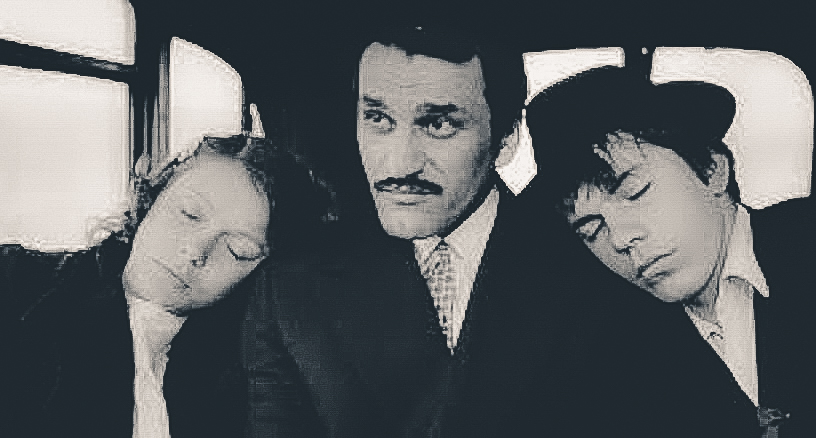
Slobodan Šijan’s highly paced cult debut Who’s Singin’ Over There? (written by famous Serbian playwright & screenwriter Dušan Kovačević) revolves around a group of bus passengers heading towards Belgrade. The story is set on the 5th of April 1941, one day before the Nazis invaded Yugoslavia by bombarding Belgrade. The unlikely voyagers on the rusty bus seem to come from all parts of the kingdom – there is a World War I veteran, a TB-infected, moaner, a pop singer eager to attract the attention of a fellow female passenger, the woman’s husband, an unlucky hunter, a Nazi sympathizer, and finally the bus crew – father and son (conductor and driver), who are careful to “comply with the rules” until one of the passengers dares them to drive two kilometres blind-folded without crashing the bus.
The film takes place on April 5, 1941—the day before the Axis powers launched the devastating bombing of Belgrade, dragging Yugoslavia into World War II.
A deeply eccentric group of passengers boards a rickety, dilapidated bus run by the firm "Krstić & Son" to travel from the rural provinces to the capital. The journey becomes an obstacle course of absurdist delays: a broken bridge, an old farmer plowing up the road, a military checkpoint, and constant petty squabbles among the passengers.
The Iconic Passengers
The film is an ensemble piece where each character represents a different archetype of Yugoslav society:
The Conductor (Pavle Vuisić): A greedy, rule-obsessed, yet strangely sentimental man.
Miško (Aleksandar Berček): The simple-minded son and driver, famous for his father’s boast that he can "drive two kilometers blindfolded."
The Singer (Dragan Nikolić): A dandy and wannabe crooner who spends the trip trying to seduce the young bride.
The Germanophile (Danilo "Bata" Stojković): A stickler for "order and discipline" who constantly praises German efficiency, unaware of the destruction they are about to bring.
The Veteran (Milivoje Tomić): An old man obsessed with his past military glories.
The Hunter (Taško Načić): A clumsy man with a shotgun that poses more danger to the passengers than any game.
The emotional and structural spine of the movie belongs to two young Romani musicians who drift along with the bus. Playing a jaw harp and an accordion, they frequently break the fourth wall to sing the film's iconic refrain, "Za Beograd, za Beograd..." (To Belgrade, To Belgrade...).
They function as a modern Greek chorus, commenting on the hypocrisy, greed, and rising xenophobia of the other passengers. While the rest of the passengers constantly scapegoat and mistrust them, the musicians are the only ones who see the world clearly.
Impending Doom: The movie is a masterclass in tension. While the passengers argue over bus tickets and missing wallets, the audience knows that the historical "end of the world" is only hours away.
Social Satire: It critiques the narrow-mindedness, xenophobia (the passengers eventually scapegoat the Roma musicians), and the stubbornness of the various social classes.
The Ending: Without spoiling the final moments, the arrival in Belgrade coincides with the start of WWII in Yugoslavia. The transition from slapstick comedy to harrowing tragedy is one of the most famous tonal shifts in cinema history.
Legacy
"Ko to tamo peva" is arguably the most quoted film in the former Yugoslavia. Phrases like "Vozi, Miško!" (Drive, Miško!) and "I tata bi, sine" (Dad would too, son) have become permanent parts of the regional lexicon. In 1996, members of the Yugoslav Academy of Film Art and Science voted it the best Yugoslav film made in the 1947–1995 period.
Dušan Kovačević is essentially the grand chronicler of collective trauma and political absurdity. His genius lies in taking the terrifying realities of totalitarianism, war, and societal collapse, and refracting them through a lens of pitch-black comedy.
If Balkan Spy is about individual paranoia—how a broken system infects a single man's psyche—then The Marathon Family and Underground scale that exact same mechanism up to the levels of the family unit and the entire nation.
1. The Marathon Family (Maratonci trče počasni krug, 1982)
The Scale: Institutional & Generational Rot
Where Balkan Spy focuses on a middle-aged man trapped in historical trauma, The Marathon Family (directed by Slobodan Šijan) looks at a microscopic institution: a multi-generational family of undertakers, the Topalovićs.
[ Balkan Spy ]             [ The Marathon Family ]        [ Underground ]
Individual Paranoia   -->   Systemic Family Tyranny   -->  Macro-Historical Myth
(Ilija Čvorović)            (The Topalović Dynasty)        (The Cellar / The State)
Paranoia as Survival: The six generations of men living under one roof don't trust the outside world, and they absolutely do not trust each other. Pantelija, the centenarian patriarch, dies and leaves a will that essentially tears the family apart because nobody believes anyone else deserves the inheritance.
The Micro-State: The Topalović family functions like a miniature totalitarian regime. The eldest members rule through financial tyranny and physical intimidation, while the youngest, Mirko, tries to break free through a romanticized view of art and love—only to be violently corrupted by the end.
The Metaphor: Written on the eve of Tito’s death (and released shortly after), the film acts as a bleak allegory for Yugoslavia itself. The elderly, decaying leadership refuses to pass the torch, holding onto power through fear, coercion, and a monopoly on the local "industry" (which, fittingly, is death).
2. Underground (Podzemlje, 1995)
The Scale: The Macro-Historical Lie
In Underground (directed by Emir Kusturica), Kovačević takes the paranoia of Balkan Spy and expands it into an epic, multi-decade national delusion.
Weaponized Paranoia: During World War II, a manipulative weapons-dealer named Marko hides a group of anti-fascist partisans in a massive subterranean cellar. When the war ends, Marko realizes he can profit enormously by keeping them down there. He manufactures a permanent state of paranoia, playing fake air-raid sirens, inventing news reports, and convincing them that the Nazis are still occupying the surface.
The Ultimate Ilija Čvorović: In a way, Marko is the dark inversion of Ilija from Balkan Spy. Ilija is a victim who genuinely believes his own delusions; Marko is a cynical elite who creates the delusion to exploit others. The people in the cellar live in a perpetual state of fear and heroic resistance against a phantom enemy.
The Tragedy of Disorientation: When the characters finally emerge from the cellar decades later, they cannot comprehend the modern world. Just as Ilija Čvorović loses his grip on what is real and what is a conspiracy, the citizens of Underground wander into a landscape where their decades of sacrifice mean absolutely nothing.
Orson Welles once famously called Pavle Vuisić (affectionately known throughout the Balkans simply as "Paja") the greatest actor in the world, describing him as a "volcano of acting" whose effortless screen presence he deeply envied.
What made Vuisić a certified colossus of Yugoslav cinema was a fascinating paradox: he never attended an acting academy, completely despised the theater, and openly treated acting as a basic blue-collar job just to pay the bills. Yet, the moment a camera rolled, he didn't look like he was acting—he simply existed with a heavy, magnetic realism that anchored every scene he touched.
The Anchor of Šijan's Masterpieces
In Slobodan Šijan's films, Vuisić served as the ultimate pragmatic foil to the absurdism happening around him. He played the ultimate survivors—men driven by raw self-interest, family legacy, and a deeply cynical view of human nature.
In Who's Singin' Over There? (Conductor Krstić): He is the rigid, absolute ruler of the bus. He is calculating and capitalistic, charging for every piece of luggage, yet fiercely protective of his dim-witted son, Miško. While the intellectual characters spouted ideological nonsense, Krstić kept his eyes on the road and the cash box, embodying the raw, stubborn survival instinct of the common man.
In The Marathon Family (Milutin Topalović): As the third-generation patriarch, he operates as the stressed-out middle manager of a criminal empire. He has to balance the terrifying, immortal demands of his elderly father and grandfather while trying to beat some sense into his rebellious son, Mirko. His performance is a brilliant mix of explosive anger and deep, existential exhaustion.
The Brilliant Dynamic with "Bata" Stojković
Much of the magic in these films comes from the incredible chemistry between Pavle Vuisić and Danilo "Bata" Stojković. They were total opposites in their approach to the craft:
The Actor vs. The Force of Nature
Bata Stojković was a meticulous, highly disciplined theater actor who memorized every inflection and analyzed his scripts inside out. Paja, on the other hand, rarely read full scripts, hated doing multiple takes, and constantly improvised his lines to sound more natural.
When Stojković’s rigid, pompous characters clashed with Vuisić’s gruff, unbothered realism, it created a perfect comedic and dramatic friction that defined the golden age of Yugoslav black comedy.
The Secret Poet
Behind the burly frame, the gruff voice, and the permanently grumpy demeanor, Vuisić was a deeply sensitive, highly intellectual bohemian.
He spent his free time on his beloved Ada Ciganlija river, drinking with fishermen, away from the cinematic elite. He secretly wrote beautiful, melancholic poetry on napkins and scraps of paper, much of which he tore up or threw away. He even wrote his own terse, brilliant will, demanding that no actors give speeches at his funeral and that his death be announced only after he was safely buried.
He remains an irreplaceable icon—the definitive face of a cinematic era that managed to be fiercely funny, deeply tragic, and devastatingly honest all at once.
MARATHON FAMILY (
Maratonci trce pocasni krug 1982)
Slobodan Sijan and his writer Dusan Kovacevic, whose first feature was the similarly themed but not as effective “Who’s Singin’ Over There?,” are telling us right off that an era is ending. At the same time, the ceremonial pomp and circumstance in the newsreels is so elaborate and stupendous as to be amusingly self-deflating, thus providing a prologue for the demolishing humor to come. By its end, “The Marathon Family” has skewered not only timeless human greed and folly but also foreshadowed the unparalleled barbarity so shortly to sweep over Europe with World War II. Yet Sijan and Kovacevic’s ability to find something funny in the absurdity of evil never falters.
Set in 1934 in a small Serbian town, the story follows the Topalović family, a dynasty of undertakers consisting of six generations of men (spanning from the bedridden, 150-year-old patriarch Pantelija down to the naive 24-year-old Mirko). No women survive in this house; it is a stagnant, rotting ecosystem of pure patriarchy.
The family business, "Long Home" (Dugi konačište), is a massive racket. They don't just bury people—they secretly dig up old graves, steal the coffins, repaint them, and resell them. The delicate status quo shatters when Pantelija dies, leaving his vast wealth to... himself. At the same time, the youngest, Mirko (Bogdan Diklić), wants out of the death business. He is in love with Kristina, the daughter of Bili Piton (Zoran Radmilović), a local gangster who supplies the Topalovićs with their grave-robbed coffins.
When a conflict over money erupts between the family and Bili Piton, it triggers an absurdist, violent gang war involving early cinema projectors, stolen cars, and tommy guns.
Balkan Spy (Balkanski špijun) is a 1984 Yugoslav comedy movie, directed by Dušan Kovačević and Božidar ‘Bota’ Nikolić.
Ilija Čvorović, a former Stalinist who spent several years in a prison on Goli otok, is contacted by the police to routinely answer questions about his tenant, Petar Markov Jakovljević, a businessman, who spent twenty years living in Paris, and now has returned to Belgrade to open a tailor shop. After only several minutes, Ilija is free to go, however, he is starting to suspect that his tenant might be a spy. As the movie goes on, his paranoia increases and more people gets involved: his wife, his daughter, his brother, Jakovljevic’s friends.
An absolute masterpiece of Yugoslav cinema, Balkanski špijun (Balkan Spy) is arguably one of the sharpest, darkest, and most enduring satires ever filmed about political paranoia and the deep psychological scars of the Cold War state apparatus.
Written by the legendary dramatist Dušan Kovačević (who also co-directed alongside Božidar Nikolić), the film manages to be hysterical while slowly steering into a deeply tragic, almost claustrophobic psychological thriller.
The Premise: From Routine to Madness
The story tracks Ilija Čvorović (played unforgettably by Danilo "Bata" Stojković), a reformed, ordinary Belgrade citizen who spent years in prison during the 1948 Informbiro period—the brutal split between Tito and Stalin.
When the local police call him in for a completely routine, mundane interview regarding his new sub-tenant—Petar Jakovljević (Bora Todorović), a tailor returning after years of working in Paris—a spark catches in Ilija's mind. He becomes instantly, fanatically convinced that Petar is a dangerous capitalist spy sent to dismantle the socialist system. What begins as discreet tracking quickly snowballs into full-blown surveillance operations, wiretapping, buying a weapon stash, and recruiting his fanatical twin brother, Đura (Zvonko Lepetić).
Why the Film Cuts So Deep
The Anatomy of Paranoia: The film perfectly captures how a paranoid mind works. Every normal action by the tenant—buying a present for a friend, going for a jog, meeting acquaintances—is instantly recontextualized by Ilija as a high-level espionage operation.
The Trauma of the Past: Ilija isn't just a comic caricature; he is a tragic byproduct of an authoritarian state. Despite having been tortured and jailed by the state years prior, he has internalized the oppressor's mindset so deeply that he will destroy his own family to prove his absolute loyalty to that same system.
The Perfect Ensemble: The dynamic between Bata Stojković’s manic energy and Mira Banjac (playing his anxious, long-suffering wife, Danica) balances the absurdity with genuine human grounding.
The Cultural Legacy
Decades after its release, Balkanski špijun remains a cornerstone of regional pop culture. Lines like "Đura će ti oprostiti što te je tukao" ("Đura will forgive you for beating you") or "Sve je suprotno od onoga što izgleda da jeste" ("Everything is the opposite of what it appears to be") are still regularly quoted across the former Yugoslav republics to describe political absurdity.