"Jarmusch’s ‘Mystery Train’ a Complex, Minimalist Jewel "
The two Japanese kids in Jim Jarmusch's "Mystery Train" (1989) have the right idea. They're on a train to Memphis. With one suitcase suspended on a pole between them, they wander the bedraggled streets until passing by accident the door of the Sun record studios, which is a shrine for them.
This is not a Memphis approved by the chamber of commerce. The city seems forlorn and deserted: Vacant lots, boarded storefronts, hardly any traffic or pedestrians. I am sure Memphis, then and now, has pleasant outlooks. But Jarmusch isn't your man to look for them.
Can you already guess that "Mystery Train" is a romance? Not a romance between people, but about the romance of the big city and its obscure corners where outsiders, seekers and the forlorn go to spend the night. I hope Charles Bukowski saw this film before he died. Then again, he didn't need to.
The film tells three stories, which are glancingly connected. The characters in all three check in, more or less by chance, at the same hotel. This hotel is on life support. It has no more furniture than a hotel in a Looney Tunes cartoon. People check in, look around, and say "No TV." Just a bed, a couple of busted chairs, a night table and a portrait of Elvis on the wall.
What brings these people to the hotel? Jun (Masatoshi Nagase) and Mitzuko (Youki Kudoh), about 20, from Yokohama, are on a rock and roll odyssey. They share earphones plugged into the same Walkman. She loves Elvis. He's a purist, and prefers Carl Perkins. She's lively, but he keeps a blank poker face; maybe he thinks that makes him look cool. His hair is combed in a meticulous pompadour. He parks a cigarette behind his ear. She speaks a little English, he less.
Luisa (Nicoletta Braschi) has come to Memphis from Italy to pick up a coffin containing her husband's dead body. She has to take the next day's flight. In an almost deserted Formica diner, a con artist (Tom Noonan) tries to panhandle her with that old story about the guy who picked up a hitchhiker outside of Memphis.
In the third story, set in a pool hall named Shades, a Brit named Johnny (Joe Strummer) cultivates his hair and sideburns so artfully that everyone calls him "Elvis."
Elvis is called The King at one time or another by nearly everyone in the film. His shadow falls over the nighttime streets. His ghost appears in one of the hotel rooms.
"Mystery Train" premiered at Cannes 1989, was a great success, and confirmed the promise Jarmusch showed when "Stranger than Paradise" premiered there in 1984. His influence in the1980s resurgence of indie filmmaking is incalculable. He differs from some indies, however, in the formal calculation that goes into his composition and editing. Jarmusch is in no hurry to get anywhere.
After "Stranger Than Paradise," Jarmiusch returned to Cannes in 1986 with "Down By Law," with Tom Waits, who was born to be a Jarmusch star; John Lurie, the musician who began with Jarmusch in his first student film, and Roberto Begnini, who was soon to be famous, but arrived as from another planet. Sometimes his further reaches of style try my patience, as they did in "The Limits of Control" (2009). More often he delights me with the level, almost objective gaze he directs at goofballs and outsiders. He found an unsurprising rapport with Bill Murray, in "Broken Flowers" (2005), with Murray seeking out the former loves of his life. His "Night On Earth" (1991) was five stories set entirely in taxis. "Coffee and Cigarettes" (2003) had poetically peculiar conversations and situations. His "Dead Man" (1995), with an amazing cast ranging from Johnny Depp to Robert Mitchum, didn't work for me, but was so highly praised I need another look.
ROBBY MÜLLER CINEMATOGRAPHER >>>
Narrative Structure: The Triptych
The film is divided into three segments, all taking place in downtown Memphis during the same night. While the characters rarely interact, they are connected by their environment and specific "anchors":
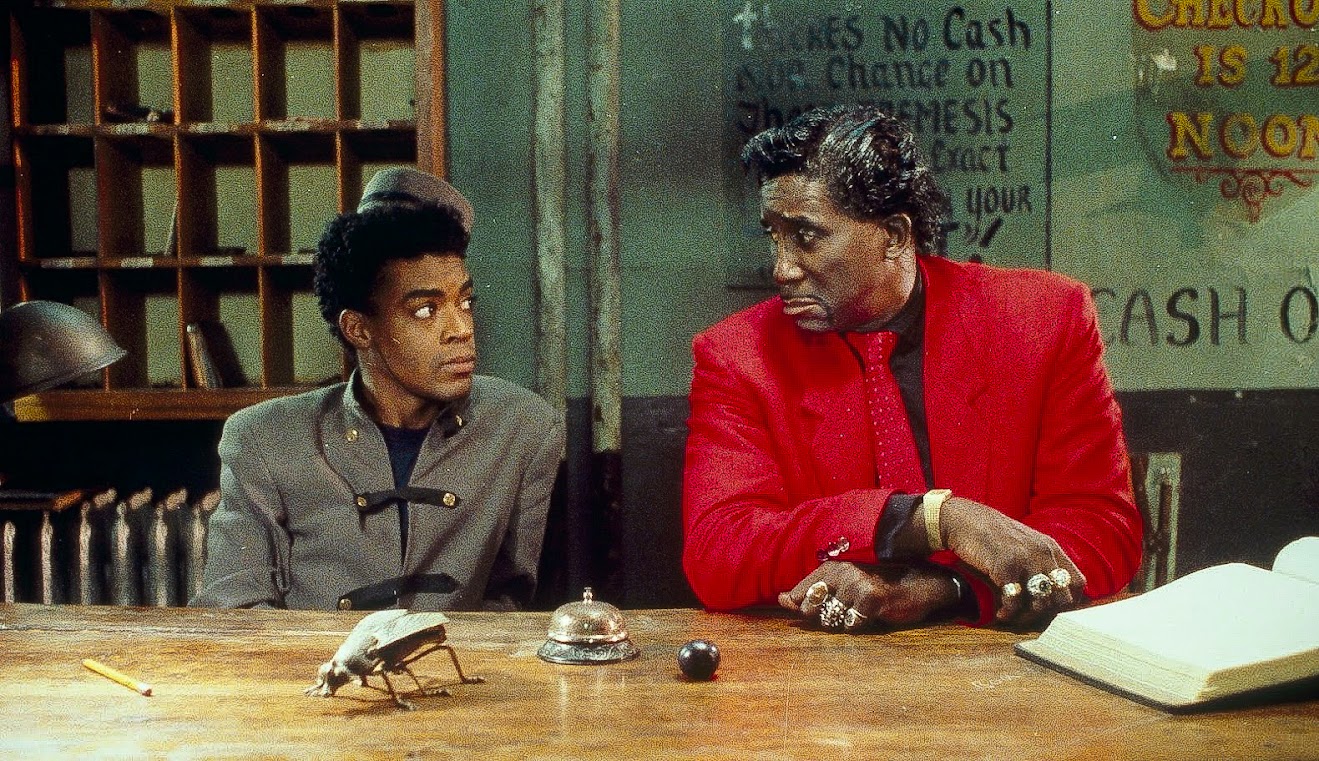
The Arcade Hotel: A seedy flophouse run by a grumpy night clerk (Screamin' Jay Hawkins) and a distracted bellboy (Cinqué Lee).
The Soundtrack of the Night: Every character hears a radio broadcast at 2:17 AM featuring Tom Waits as the DJ and Elvis Presley’s "Blue Moon."
The Gunshot: A shot is heard in the early morning, the context of which is only explained in the final segment.
Segment I: "Far from Yokohama"
Two Japanese teenagers, Mitsuko (Youki Kudoh) and Jun (Masatoshi Nagase), arrive in Memphis on a "pilgrimage" to the birthplace of rock and roll.
The Dynamic: Mitsuko is enthusiastic and obsessive, keeping a scrapbook of Elvis. Jun is a stoic "cool" archetype who takes photos only of the hotel rooms because he believes he will remember the scenery but forget the mundane details.
The Conflict: They bicker over who was the true king of rock: Elvis Presley or Carl Perkins. Their segment highlights the global reach of American pop culture and how it is reinterpreted by "outsiders."
Segment II: "A Ghost"
Luisa (Nicoletta Braschi), an Italian widow, is stranded in Memphis while waiting to fly her husband's coffin back to Italy.
The Encounter: After being hassled by a local con man who tells her a fake story about Elvis’s ghost, she shares a hotel room with Dee Dee (Elizabeth Bracco), a talkative woman who has just broken up with her boyfriend.
The Supernatural: While Dee Dee sleeps, Luisa is visited by a literal apparition of Elvis. Unlike the other characters who seek Elvis through tourism or obsession, the grieving widow is the only one who truly "sees" him.
Segment III: "Lost in Space"
The final segment follows Johnny (Joe Strummer), an Englishman nicknamed "Elvis" (which he hates), who has lost his job and his girlfriend (Dee Dee from Segment II).
The Incident: Drunk and despondent, Johnny robs a liquor store and accidentally shoots the clerk. He flees with his friend Will Robinson and Dee Dee’s brother, Charlie (Steve Buscemi).
The Climax: They hide out at the Arcade Hotel. In the morning, while struggling over a gun, Johnny accidentally shoots Charlie in the leg—this is the gunshot heard in the previous two segments.
-2.jpg)
The "Ghost Town" of Memphis
Jarmusch portrays Memphis not as a thriving city, but as a desolate, decaying shrine to the past. The characters walk past boarded-up storefronts and empty lots. To the tourists, it is a "holy land," but to the residents and the film’s lens, it is a graveyard of the American Dream.


.jpeg)


-2.jpg)



.jpg)