I'll Show You The Life Of The Mind!
Sticky, burning labyrinth of the Coen Brothers' masterpiece on writer's block, artistic ego, and the rot beneath the Hollywood dream.
Joel and Ethan Coen's "Barton Fink" in the first sweep ever at the Cannes film festival, it was awarded the prizes for best film, best direction and best performance by an actor.
The Cinematic Universe of the Coen Brothers
"Barton Fink" might possibly be classified as a satire on the life of the mind. There is no doubt that it is about the perils of the mind for someone as impressionable as Barton Fink (John Turturro). Barton is a pious, prissy New York playwright of very funny, unredeemed humorlessness, someone who has dedicated himself to creating "a living theater of, about and for the Common Man."
The time is the early 1940's, just before World War II, when Clifford Odets and a number of other American playwrights were still riding high on a wave of poetic proletarianism.After having written one Broadway hit, Barton, who resembles the hero of David Lynch's "Eraserhead," goes to Hollywood to earn some big money and maybe, as he says, "to make a difference."
Barton's responsibilities to the Common Man weigh heavily on his skinny frame. He stays not at one of Los Angeles's fancier hotels but at the Earle, a downtown establishment ("For a Day or a Lifetime") whose Art Deco lobby and corridors give no hint of the Skid Row seediness of the rooms.
Barton's adventures in Hollywood are a series of grotesquely funny confrontations as his writer's block becomes manifest and his panic accumulates. His first assignment for Capitol Pictures is a wrestling movie "for Wally Beery."
"It's not a B picture; Capitol Pictures does not make B pictures," says Jack Lipnick (Michael Lerner), Capitol's squat, barrel-chested president, who seems to be a cross between Harry Cohn of Columbia and Louis B. Mayer of M-G-M. It is, of course, a B picture, and Barton hasn't a clue as to how to start. His desperation mounts.
More important to Barton than anyone else is Charlie Meadows (John Goodman), his next-door neighbor at the Earle. He's a big, gregarious insurance man who tells Barton, man-to-man, "You might say that I sell peace of mind."
The shirt-sleeved Charlie is actually too good to be true, but Barton doesn't notice. All he sees is the beer-belly, the sweat, the suspenders, the desperation to please. He's someone in whom Barton can confide."I write about people like yourself, Charlie," Barton announces to his new friend. "The simple working stiff."
It was said by some at Cannes that "Barton Fink" is a movie for people who don't like the Coen brothers' films. Not quite true. It's a film for those who were not sure that the Coens knew what they wanted to do or had the authority to pull off a significant work."Barton Fink" eliminates those doubts. It's an exhilarating original.
https://www.nytimes.com/1991/08/21/movies/review-film-barton-fink-a-dark-comedy-from-joel-and-ethan-coen.html

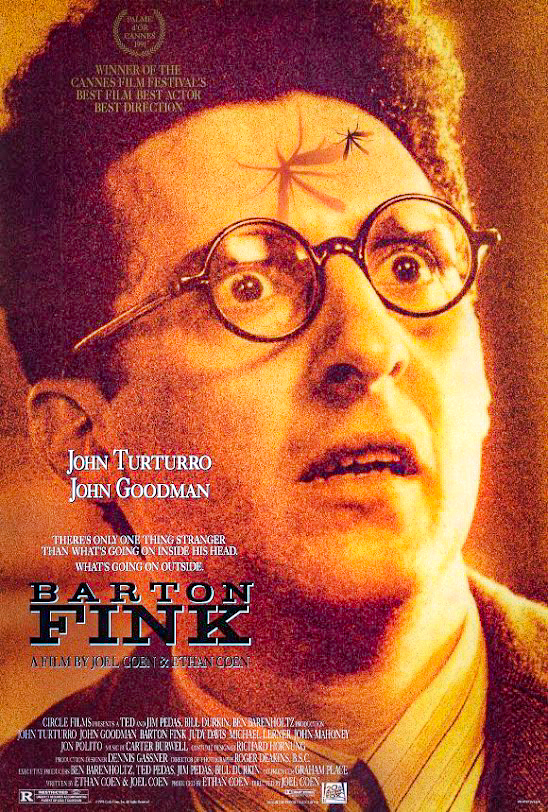
Plot Overview
Set in 1941, the film follows Barton Fink (John Turturro), a socially conscious New York playwright whose latest play about the "common man" is a smash hit. Eager to capitalize on his success, his agent sends him to Hollywood to write B-movie screenplays for Capitol Pictures.
Upon arriving in Los Angeles, Barton checks into the decaying, eerie Hotel Earle. Under pressure from studio head Jack Lipnick (Michael Lerner) to churn out a "wrestling picture" starring Wallace Beery, Barton is instantly struck by a paralyzing case of writer's block. He is constantly distracted by the oppressive heat, peeling wallpaper, and bizarre sounds of the hotel.
Seeking human connection, he befriends his neighbor, a jovial, sweat-drenched insurance salesman named Charlie Meadows (John Goodman). Barton also seeks help from an alcoholic, legendary Southern novelist turned Hollywood hack, W.P. Mayhew (John Mahoney), and Mayhew's long-suffering secretary/muse, Audrey Taylor (Judy Davis).
When Audrey is brutally murdered in Barton's bed after a night of passion, Barton's reality completely disintegrates. Charlie helps him dispose of the body before leaving town, leaving Barton with a mysterious, wrapped cardboard box. Soon after, two detectives arrive, revealing that Charlie is actually Karl "Madman" Mundt, a notorious serial killer who decapitates his victims. The film culminates in a fiery, apocalyptic climax inside the Hotel Earle, leaving Barton shattered, clutching his unread screenplay and the mysterious box on a lonely beach.

The Hotel Earle as Purgatory/Hell
The Hotel Earle is one of the most memorable settings in cinema history. With its endless hallways, oozing wallpaper, oppressive heat, and constant buzzing, it is a living, breathing manifestation of Barton's psychological decay—and perhaps hell itself.
The Wallpaper: The sickly green wallpaper that continuously peels and secretes a sticky paste represents Barton's rotting mind and his inability to escape his own head.
The Mosquito: The single, buzzing mosquito represents the persistent, irritating voice of Barton's conscience and anxiety.
The Picture of the Woman on the Beach
In Barton's room hangs a small picture of a woman sitting on a beach, looking out at the ocean. It represents Barton's desire for escape, peace, and artistic purity. At the end of the film, Barton walks onto a real beach, only to find the exact woman from the picture sitting in the exact same pose. This surreal ending suggests Barton has either escaped into his own mind, entered a purgatory of his own making, or is forever trapped inside his own art.
The Box
What is in the box Charlie leaves with Barton? While many assume it contains Audrey's head, the Coen brothers intentionally leave it unanswered. It functions as a classic "MacGuffin" and a symbol of Barton's guilt, complicity, and the dark secrets of his soul that he refuses to open and look at.

Cinematography (Roger Deakins)
Barton Fink marked the first collaboration between the Coen brothers and legendary cinematographer Roger Deakins. Deakins uses a rich, warm, yet deeply unsettling color palette—heavy in sickly greens, deep ochres, and blood reds.
The camera movements are fluid but intrusive. Deakins frequently uses wide-angle lenses to distort the architecture of the hotel, making the space feel both cavernous and claustrophobically tight.
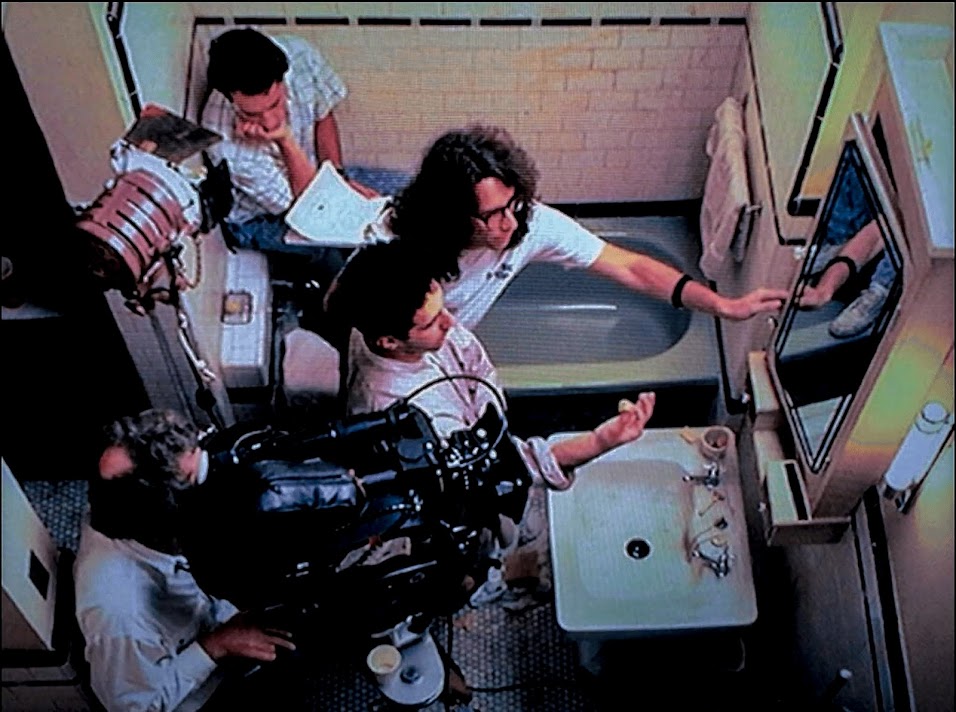
One of the film's most famous shots occurs when the camera dives directly down the drain of Barton's bathroom sink, a visual metaphor for Barton's descent into psychological ruin.
The Coen brothers blend film noir and surrealism in Barton Fink by taking the visual and narrative shell of a 1940s Hollywood crime story and filling it with dream logic, psychological projection, and absurdist horror.
Instead of using noir tropes to solve a mystery, the Coens use them to plunge the protagonist—and the audience—into an unraveling psyche.
1. Noir Shadowcraft vs. Expressionist Architecture
Classic film noir relies on chiaroscuro lighting, rain-slicked streets, and claustrophobic interiors to signal moral corruption. Cinematographer Roger Deakins adopts these low-key lighting techniques, but the Coens push the environment past noir realism into surreal expressionism:
Living Space: The Hotel Earle is not just a dimly lit, seedy setting; it acts as a living organ reflecting Barton's writer's block.
Tactile Decay: The wallpaper oozes thick paste, the walls sweat under unbearable heat, and the plumbing groans with unnatural sounds. The physical environment directly reacts to Barton’s internal state.
2. Subversion of Noir Character Archetypes
The film introduces standard noir archetypes, only to distort them into surreal caricatures:
The Anti-Hero: The classic noir protagonist (like Philip Marlowe) is a cynical, street-smart investigator navigating a corrupt world. Barton is his exact opposite: an idealistic, naive intellectual who is completely passive, oblivious to the clues around him, and incapable of action.
The "Femme Fatale": Audrey Taylor (Judy Davis) enters as the mysterious, alluring woman who holds the secret to a great writer's work. Instead of double-crossing the hero in traditional noir fashion, she is abruptly and inexplicably slaughtered in Barton's bed mid-movie. Her death occurs off-screen while Barton sleeps, turning a noir plot catalyst into an irrational nightmare.
The Detectives: Detectives Mastrionotti and Deutsch arrive in trench coats and fedoras, spewing classic hard-boiled dialogue. However, their hostility, casual antisemitism, and theatrical cruelty feel less like real police work and more like demonic tormentors birthed from Barton's guilty conscience.
3. The Collapse of Cause and Effect
Traditional film noir is driven by investigative logic: a crime is committed, clues are gathered, and a dark truth is unraveled. Barton Fink discards rational cause-and-effect in favor of Lynchian surrealism:
Unexplained Phenomena: Barton hears muffled weeping through the walls, receives a box with mystery contents he never opens, and swats a mosquito that seems to exist only to draw blood at pivotal moments.
The Hallway Inferno: When Charlie Meadows reveals his identity as serial killer Karl "Madman" Mundt, the confrontation doesn't take place in a dark alley, but in a hotel hallway erupting into literal flames while Charlie screams, "Look upon this vessel! I'll show you the life of the mind!" It transitions from a crime story into an apocalyptic fever dream.
By fusing noir's thematic fascination with moral decay and entrapment with surrealism's subversion of reality, the Coens create a world where the line between Hollywood's external sleaze and Barton's internal madness vanishes entirely.
Legacy
Barton Fink remains one of the Coen brothers' most intellectually challenging and artistically rewarding films. It is a brilliant, tragicomic warning about the dangers of artistic ego, the corrupting nature of commercialism, and the horrifying consequences of turning a blind eye to the world around us. Rather than offering easy answers, it invites the audience to get lost in its sticky, burning labyrinth of ideas.


.jpg)




The final beach scene and the framed picture on the hotel wall form the thematic apex of Barton Fink. It is a haunting transition where Barton’s external reality completely collapses into his own psychological interior, trapping him inside the very artwork he used as a mental escape.
The Picture as an Idealized Portal
Throughout his descent in Room 621 of the Hotel Earle, Barton frequently stares at a small framed picture of a woman in a bathing suit sitting on a sunlit beach, gazing out at the ocean.
In a room defined by heat, rotting wallpaper, damp darkness, and screaming neighbors, the picture serves as Barton’s escapist fantasy. It represents an idyllic, serene California ideal—completely untouched by the intellectual angst, commercial compromise, or visceral horror consuming his life. It is static, artificial, and safe.
The Ending: Trapped Inside the Frame
After the catastrophic fire at the hotel and his career's terminal freeze at Capitol Pictures, Barton wanders onto a real ocean shore carrying the heavy, unopened box given to him by Charlie.
When a woman walking along the shore sits down in front of him, the scene mirrors the framed picture step-by-step:
The Encounter: Barton tells her, "You're very beautiful." He asks, "Are you in pictures?" She smiles and responds, "Don't be silly."
The Mirroring: She poses with her back to him, raising her arm to shade her eyes as she looks out at the waves—recreating the exact composition from the wall painting.
The Dead Bird: As Barton stares, a seabird suddenly plummets out of the sky into the water.
Core Interpretations
Complete Loss of Reality: Having utterly failed to connect with the actual "common man" (personified by Charlie) or succeed in Hollywood, Barton has fully retreated into a projection. He hasn't escaped to paradise; he has been absorbed into a synthetic, commercial backdrop.
The "In Pictures" Pun: Barton's question—"Are you in pictures?"—functions as a double entendre. He asks if she works in Hollywood movies, but her physical transformation reveals that she is literally inside the picture from his wall. In the Coens' Hollywood, reality and cinematic artifice are indistinguishable.
Purgatory and Guilt: The beach looks like heaven, but the atmosphere remains deeply eerie. The unopened box sitting beside Barton on the sand—widely assumed to contain Audrey's severed head—symbolizes the moral corruption and guilt he can never leave behind. The dead bird dropping into the water breaks the postcard tranquility, confirming that even Barton's paradise is tainted by death.


.jpg)


.jpg)


