The One Shot:
Ritual and Ruin
"Michael's Cimino's "The Deer Hunter" is a big, crazily ambitious, sometimes breathtaking motion picture that comes as close to being a popular epic as any movie about this country since "The Godfather."
Three Pennsylvania steelworkers, Mikey (Robert De Niro), Nick (Christopher Walken) and Steven (John Savage), obey Uncle Sam's call to fight in Vietnam, leaving behind wives and sweethearts, including shopworker Linda (Streep) who may be in love with more than one of them. Before they leave, they attend Steven's wedding: a ceremony in which, without realising it, they are saying goodbye to their old lives.
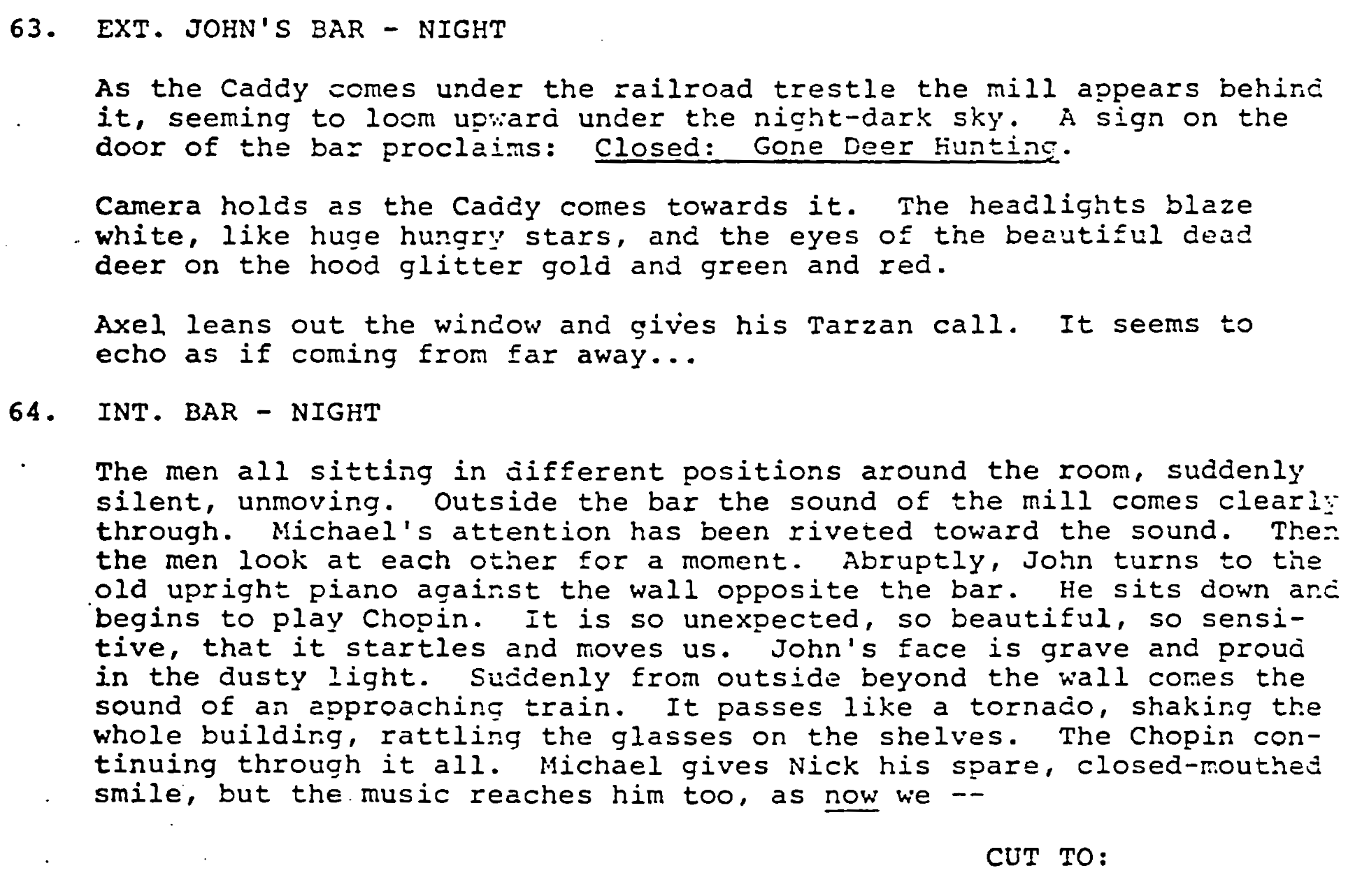
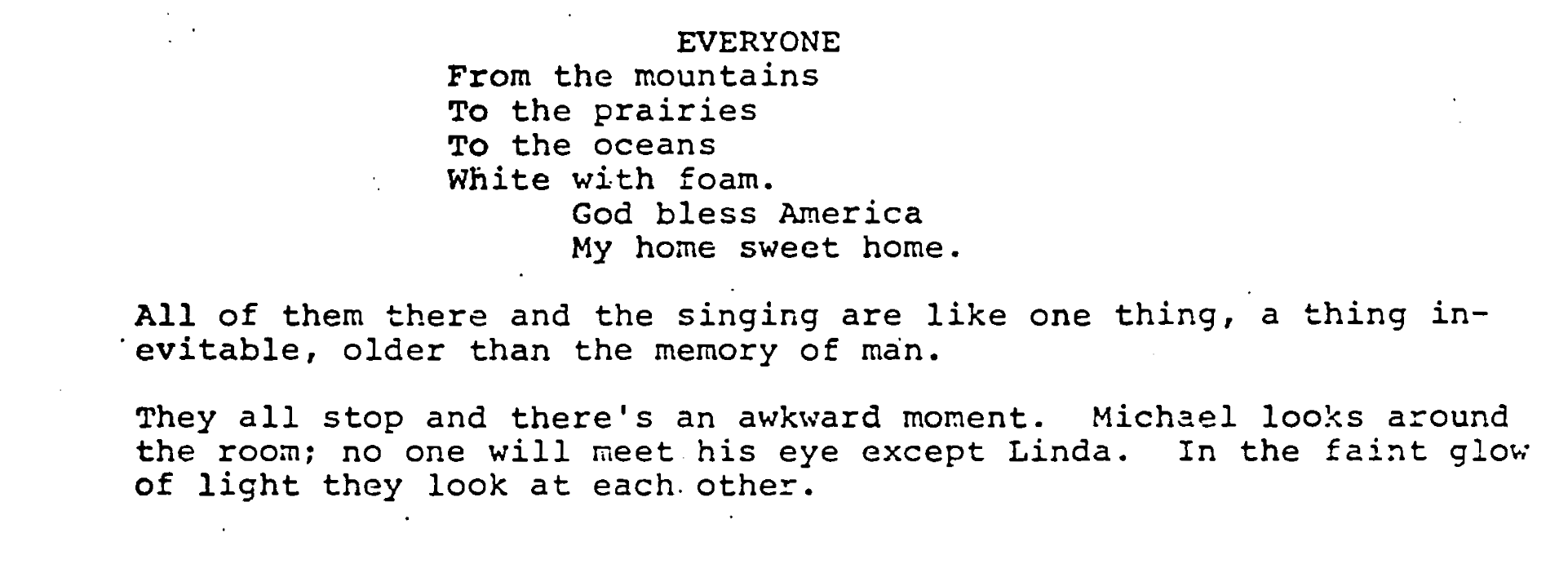
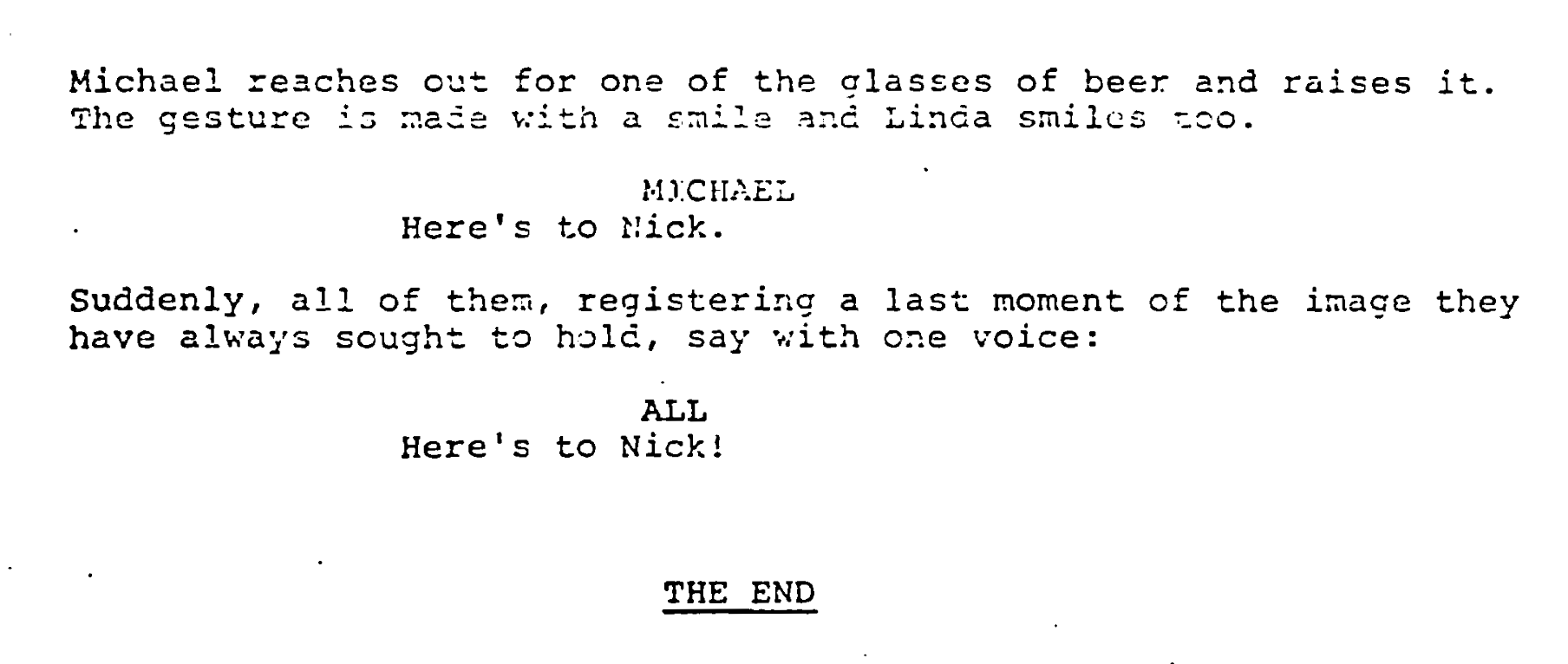
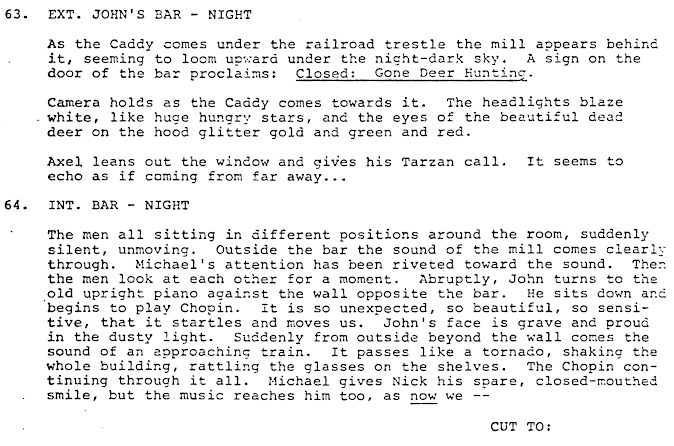
Michael Cimino's "The Deer Hunter" is a three-hour movie in three major movements. It is a progression from a wedding to a funeral. It is the story of a group of friends. It is the record of how the war in Vietnam entered several lives and altered them terribly forever. It is not an anti-war film. It is not a pro-war film. It is one of the most emotionally shattering films ever made. It begins with men at work, in the furnace of the steel mills in a town somewhere in Pennsylvania. The klaxon sounds, the shift is over, the men go down the road to a saloon for a beer. They sing "I Love You Bay-bee" along with the jukebox. It is still morning on the last day of their lives that will belong to them before Vietnam.

The opening movement is lingered over; it's like the wedding celebration in "The Godfather," but celebrated by hard-working people who have come to eat, dance and drink a lot and wish luck to the newlyweds and to say good-by to the three young men who have enlisted in the Army. The party goes on long enough for everyone to get drunk who is ever going to, and then the newlyweds drive off and the rest of the friends go up into the mountains to shoot some deer.
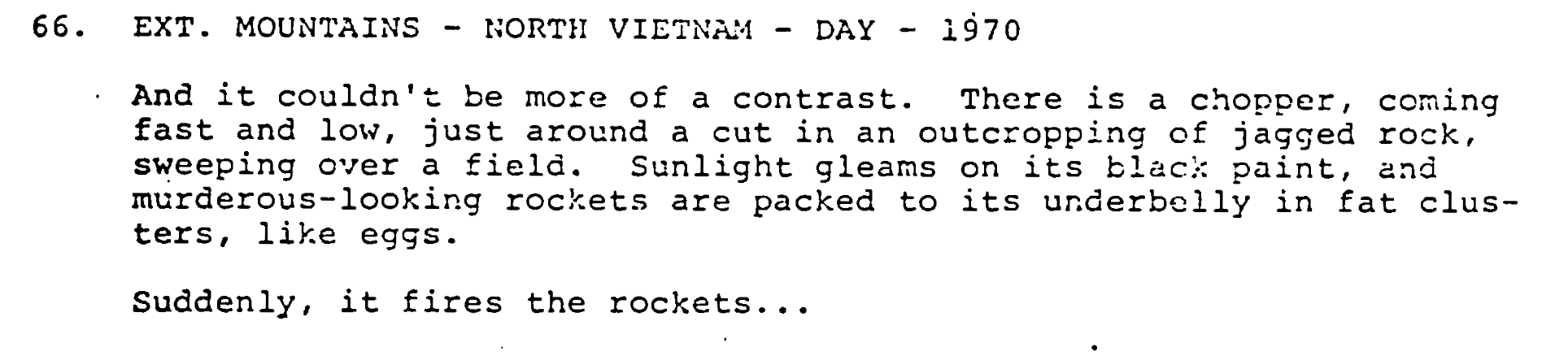
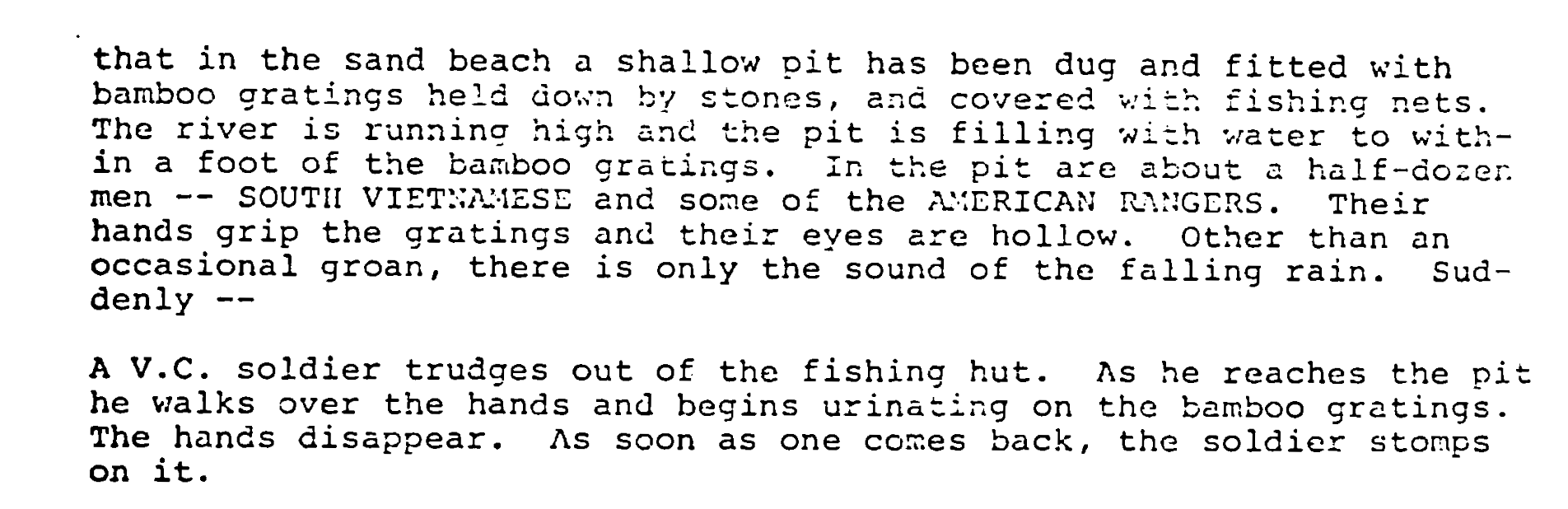
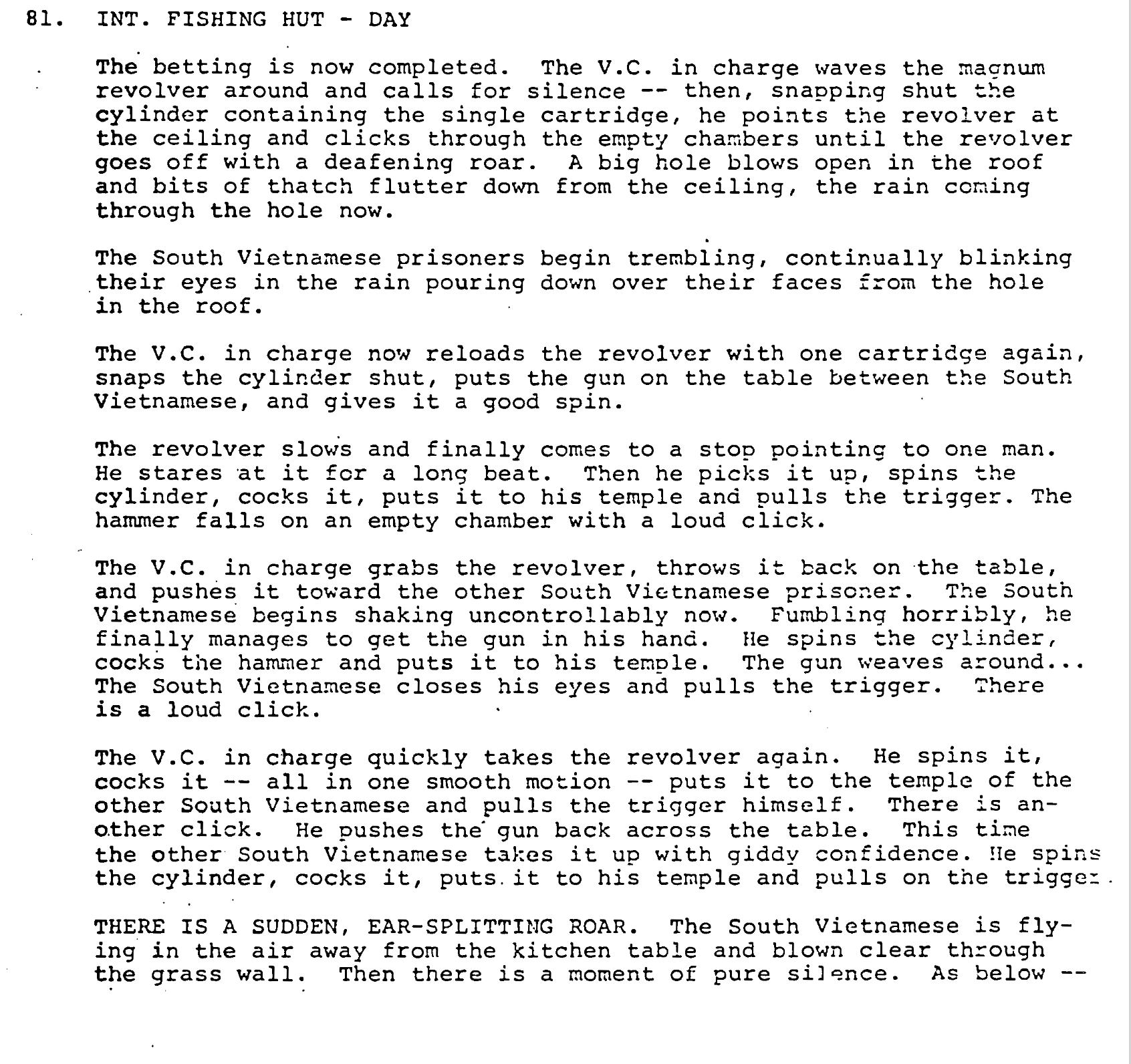
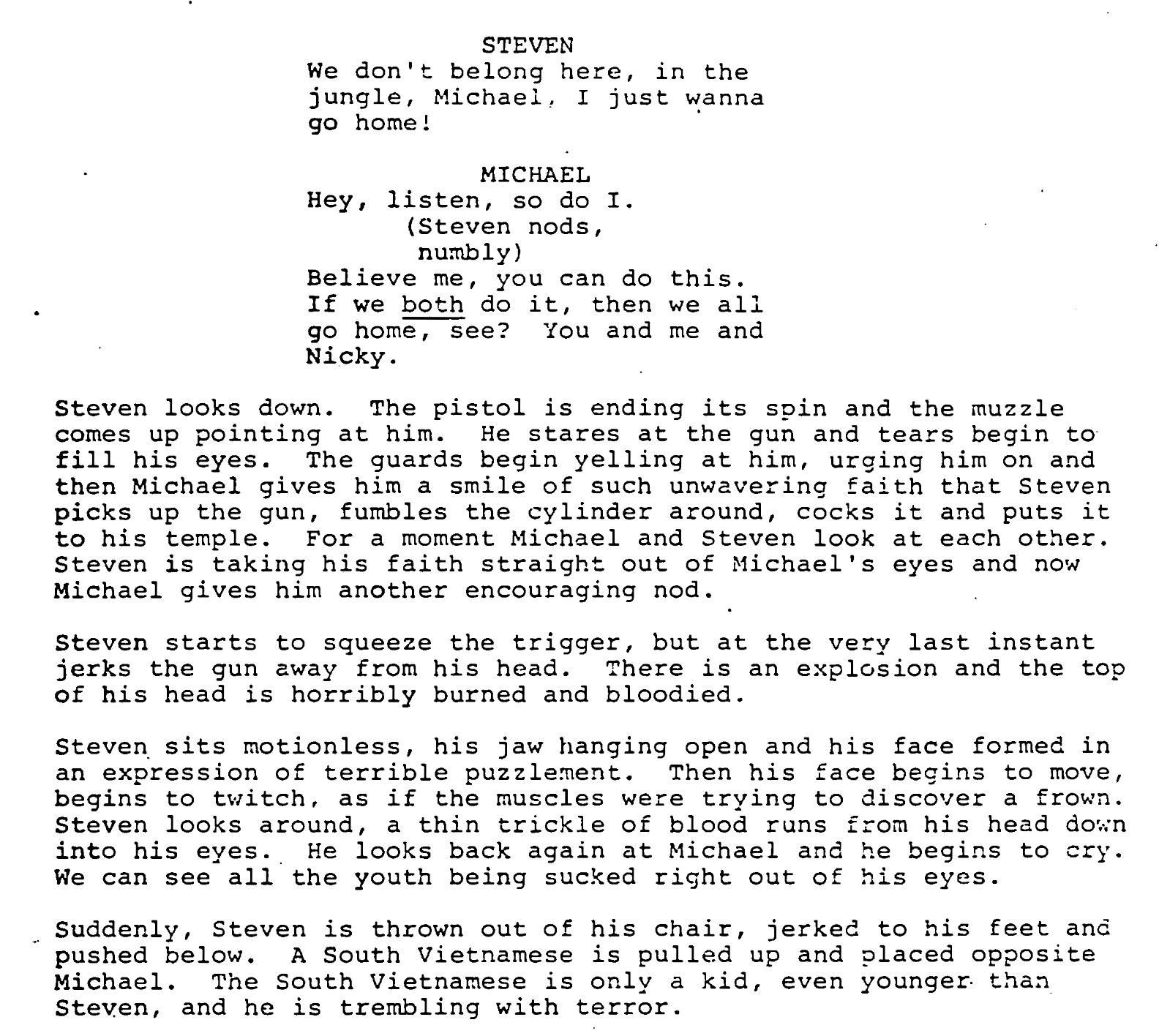
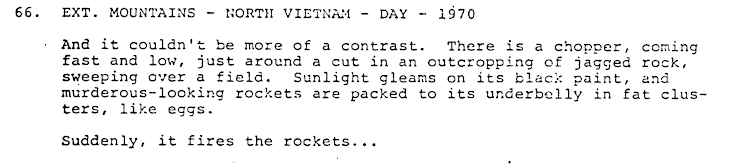
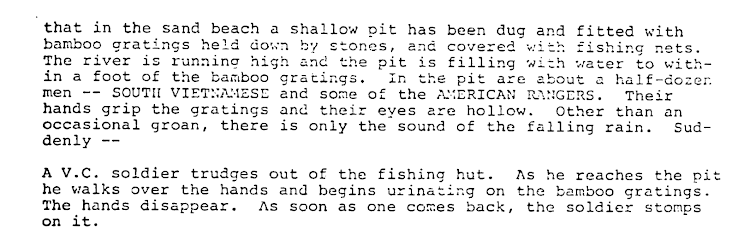
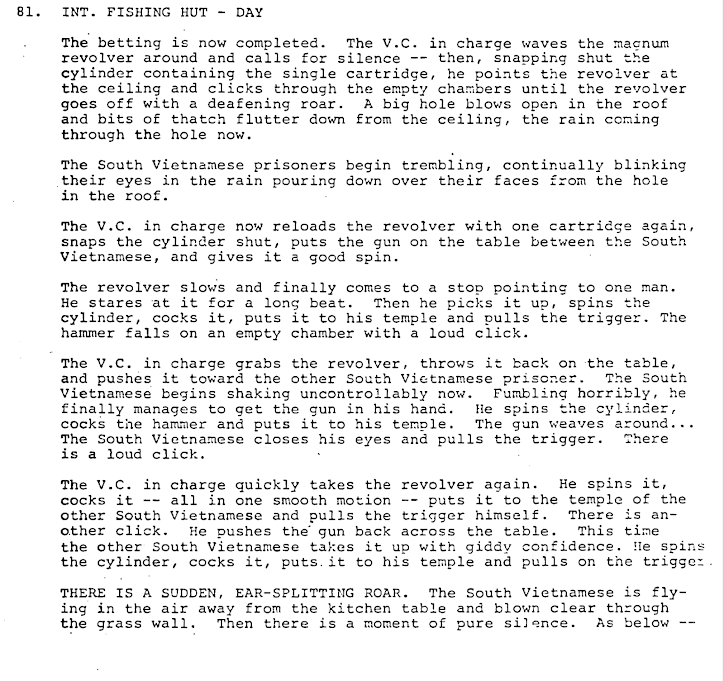
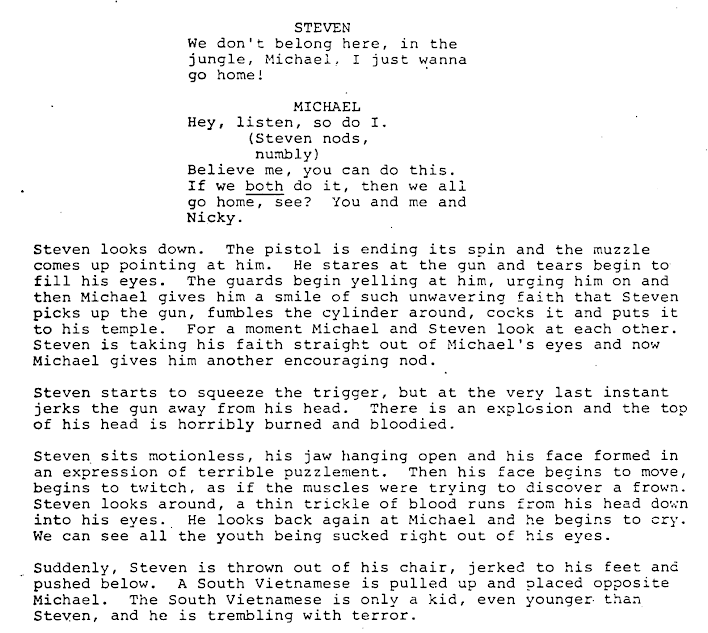
Then Vietnam occupies the screen, suddenly, with a wall of noise, and the second movement of the film is about the experiences that three of the friends have there. At the film's center comes one of the most horrifying sequences ever created in fiction, as the three are taken prisoner and forced to play Russian roulette while their captors gamble on who will, or will not, blow out his brains.
The game of russian roulette becomes the organizing symbol of the film: Anything you can believe about the game, about its deliberately random violence, about how it touches the sanity of men forced to play it, will apply to the war as a whole. It is a brilliant symbol because, in the context of this story, it makes any ideological statement about the war superfluous.
"The Deer Hunter" is said to be about many subjects: About male bonding, about mindless patriotism, about the dehumanizing effects of war, about Nixon's "silent majority." It is about any of those things that you choose, if you choose, but more than anything else, it is a heartbreakingly effective fictional machine that evokes the agony of the Vietnam time.
https://www.rogerebert.com/reviews/the-deer-hunter-1979

Release date: February 23, 1979 (USA) Starring: Robert De Niro; John Cazale; John Savage; Meryl Streep; Christopher Walken

I don't make 'flat' movies. I want to take down the wall of the screen."
Few filmmakers embody the dizzying heights and cataclysmic shifts of 1970s American cinema quite like Michael Cimino. He was a director of immense, uncompromising ambition, whose career famously charts the absolute peak and the sudden, industry-altering conclusion of the New Hollywood "director-driven" era.
Here is a look at the artistic hallmarks, the monumental triumphs, and the complex legacy of his filmography.
The Artistic Vision: Grand Canvas & Broken Myths
Cimino’s cinema is defined by its epic scale and melancholic focus on the American identity. Where his contemporaries like Scorsese focused on urban grit, or Spielberg on suburban wonder, Cimino looked at the sweeping geography of America—its mountains, vast plains, and industrial towns—and the immigrant communities that built their lives within them.
Key thematic and formal signatures include:
The Rituals of Belonging: Cimino had a deep fascination with cultural rituals—weddings, dances, community celebrations, and local clubs. He used these extended, deeply detailed sequences to establish what his characters stood to lose before tearing their worlds apart.
The Disintegration of the American Dream: His finest work strips away the romanticism of American exceptionalism, focusing instead on the psychological trauma of war, class disparity, and the violent displacement of marginalized groups.
Meticulous Visual Composition: Working with legendary cinematographers like Vilmos Zsigmond, Cimino favored wide anamorphic frames, deep focus, and natural light, creating landscapes that felt both breathtakingly beautiful and overwhelmingly indifferent to human suffering.
The Definitive Works
Thunderbolt and Lightfoot (1974)
Cimino’s directorial debut, written by himself and starring Clint Eastwood and Jeff Bridges, is an exceptional, melancholic buddy-heist movie. While deceptively low-key compared to his later epics, it introduces his core interest in intense masculine bonds, tragic destiny, and the vast, open landscapes of the American West.
The Deer Hunter (1978)
A masterpiece of emotional devastation, The Deer Hunter remains one of the definitive cinematic statements on the Vietnam War.
The Structure: Cimino boldly splits the film into three distinct acts: a sprawling, vibrant working-class Russian-Orthodox wedding in Pennsylvania; the surreal, localized horror of the war (symbolized by the infamous Russian Roulette sequences); and the hollow, fragmented aftermath of survival.
Impact: The film swept the Academy Awards, winning five Oscars including Best Picture and Best Director, cementing Cimino as the premier auteur of his generation. It masterfully balances intimate character studies (driven by career-defining performances from Robert De Niro, Christopher Walken, and John Cazale) with an overwhelming national trauma.
Heaven's Gate (1980)
Perhaps no film in Hollywood history carries as much historical baggage. Cimino’s multi-hour epic about the late 19th-century Johnson County War became an infamous box-office disaster, largely due to his obsessive perfectionism, massive budget overruns, and a hostile press campaign.
The Critical Re-evaluation: Strip away the industry lore, and the un-cut director’s cut of Heaven's Gate is a towering, visually astonishing achievement. It is a fiercely political, bleak anti-Western that replaces the mythology of the frontier with a brutal class war between wealthy cattle barons and destitute European immigrants.
The Legacy: Its financial failure led to the collapse of United Artists and effectively ended the era of studios giving young, radical directors blank checks, shifting power back to executives and ushering in the high-concept blockbuster era.
Later Career and Cult Status
Though Heaven's Gate severely fractured his career, Cimino’s subsequent work contains striking stylistic merits that have earned dedicated cult followings:
Year of the Dragon (1985): Co-written with Oliver Stone, this hyper-stylized, deeply controversial crime thriller stars Mickey Rourke as a xenophobic detective waging war on the Triads in New York's Chinatown. It is a breathless, visually explosive, and deeply cynical neo-noir.
The Sicilian (1987) & Desperate Hours (1990): These later projects saw Cimino fighting against studio interference, yet they still retain his signature operatic style and interest in flawed, larger-than-life antiheroes.
Michael Cimino was a director who refused to compromise. Whether capturing the ecstatic joy of a small-town wedding or the dusty, smoke-filled chaos of an American myth fading away, his frames were always vast, deeply felt, and undeniably cinematic.

Production & Cinematic Legacy
Cinematography by Vilmos Zsigmond: Zsigmond utilized desaturated, gritty tones for the steel mill town and high-contrast, oppressive heat imagery for Saigon, earning an Academy Award nomination for his visual storytelling.
John Cazale’s Final Performance: Terminally ill with cancer during filming, Cazale (who played Stan) completed his scenes entirely before his passing, delivering a brilliant final performance alongside his partner, Meryl Streep.
Awards and Impact: The film won 5 Academy Awards, including Best Picture, Best Director (Michael Cimino), and Best Supporting Actor (Christopher Walken for his haunting portrayal of Nick’s psychological descent).
Cinematic Context: Alongside Coming Home (1978) and Apocalypse Now (1979), The Deer Hunter marked a critical turning point where Hollywood stopped looking away from the psychological wounds of the Vietnam War and began examining the wreckage left behind in American communities.
Narrative Structure: The Three Acts
The Deer Hunter is structurally unique, divided into three distinct, elongated acts that contrast the warmth of community life with the psychological disintegration caused by war.
Act I: The Homefront (Clairton, Pennsylvania)
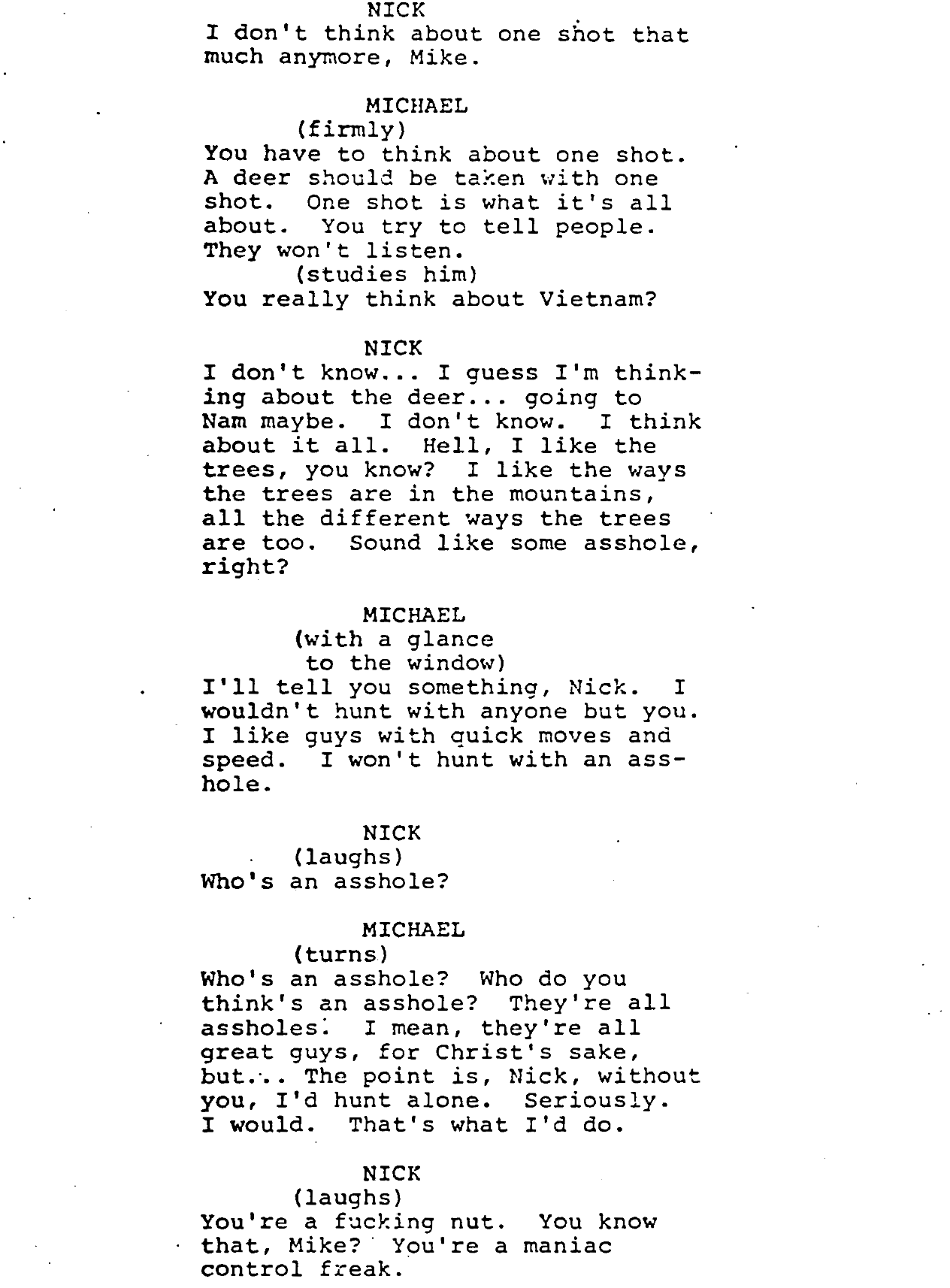
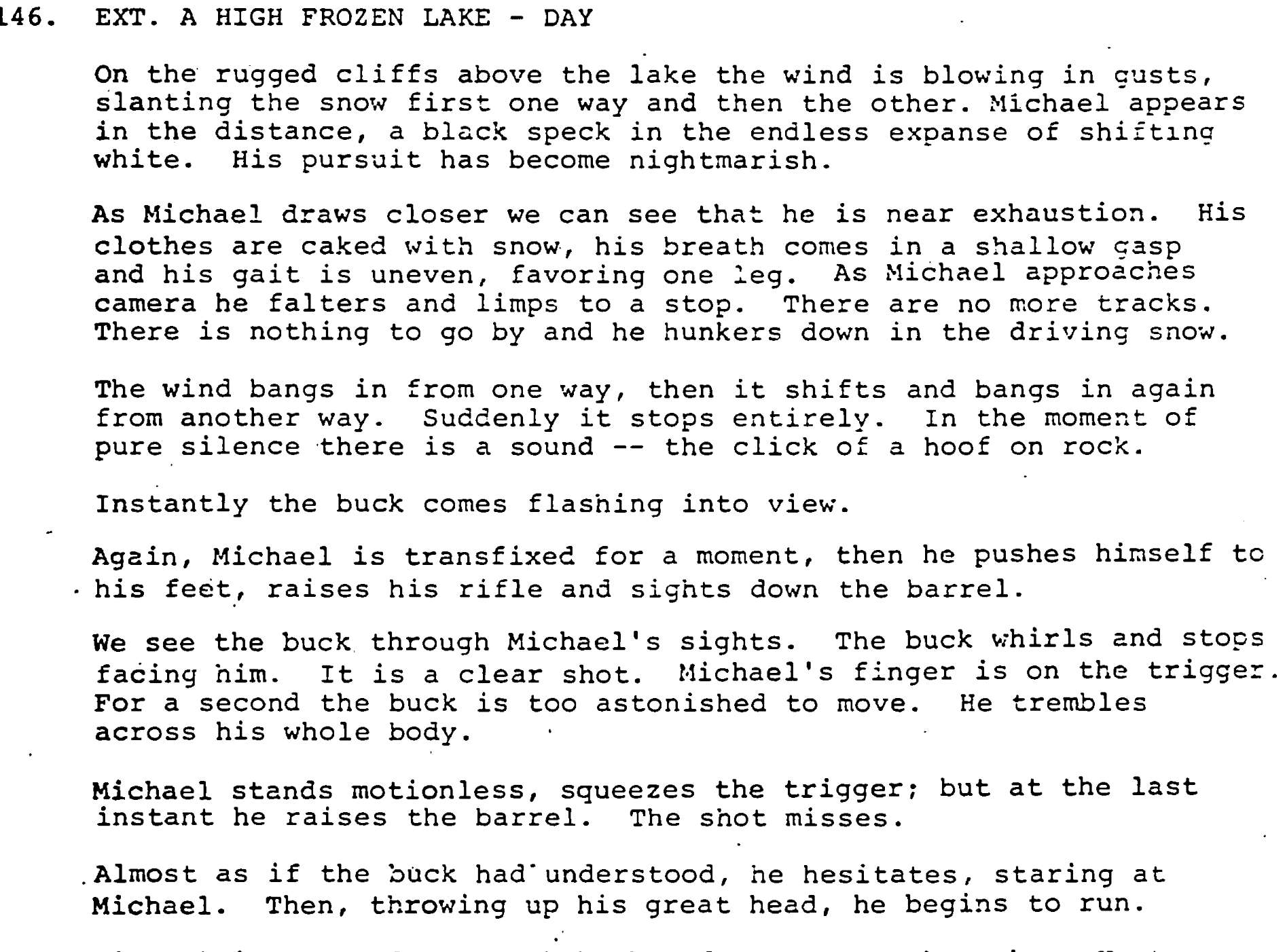
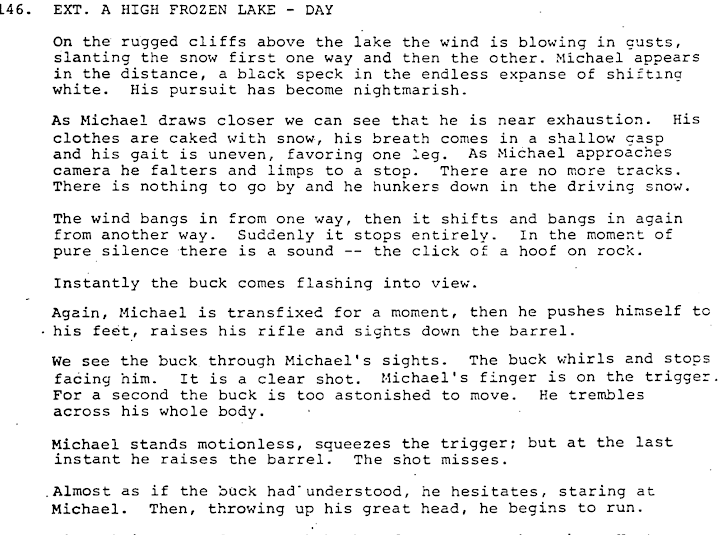
The film opens with a massive, nearly hour-long sequence set in a gritty industrial steel town. We witness the tight-knit bond of the friends, culminating in Steven’s elaborate, traditional Russian Orthodox wedding and a final, spiritual deer hunting trip in the misty Allegheny Mountains. Michael adheres to a strict code: the deer must be killed with "one shot."
Act II: The Crucible (Vietnam)
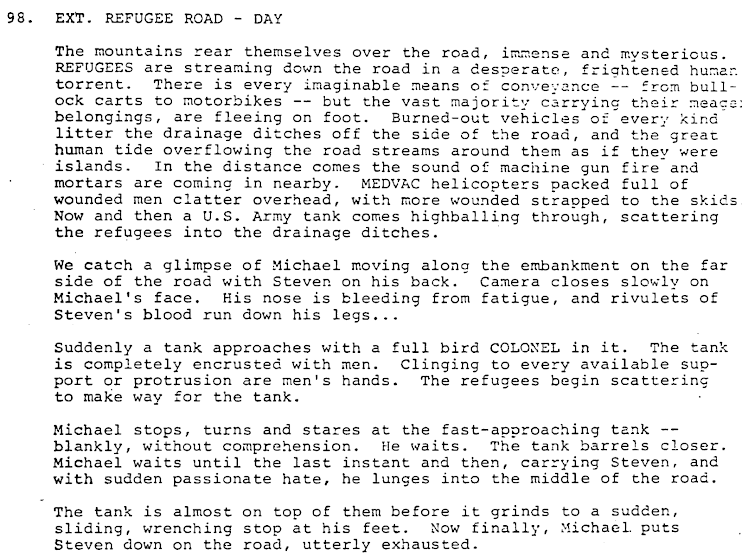
The narrative abruptly cuts from the quiet mountains to the chaotic, fiery hellscape of Vietnam. Michael, Nick, and Steven are captured by the Viet Cong and forced to play Russian roulette for the amusement of their captors. This sequence, packed with unbearable tension, serves as the psychological anchor of the film. Michael engineers a daring escape, but the trio is separated. Steven is severely physically wounded, while Nick is hospitalized in Saigon with severe psychological trauma.
Act III: The Aftermath and Return
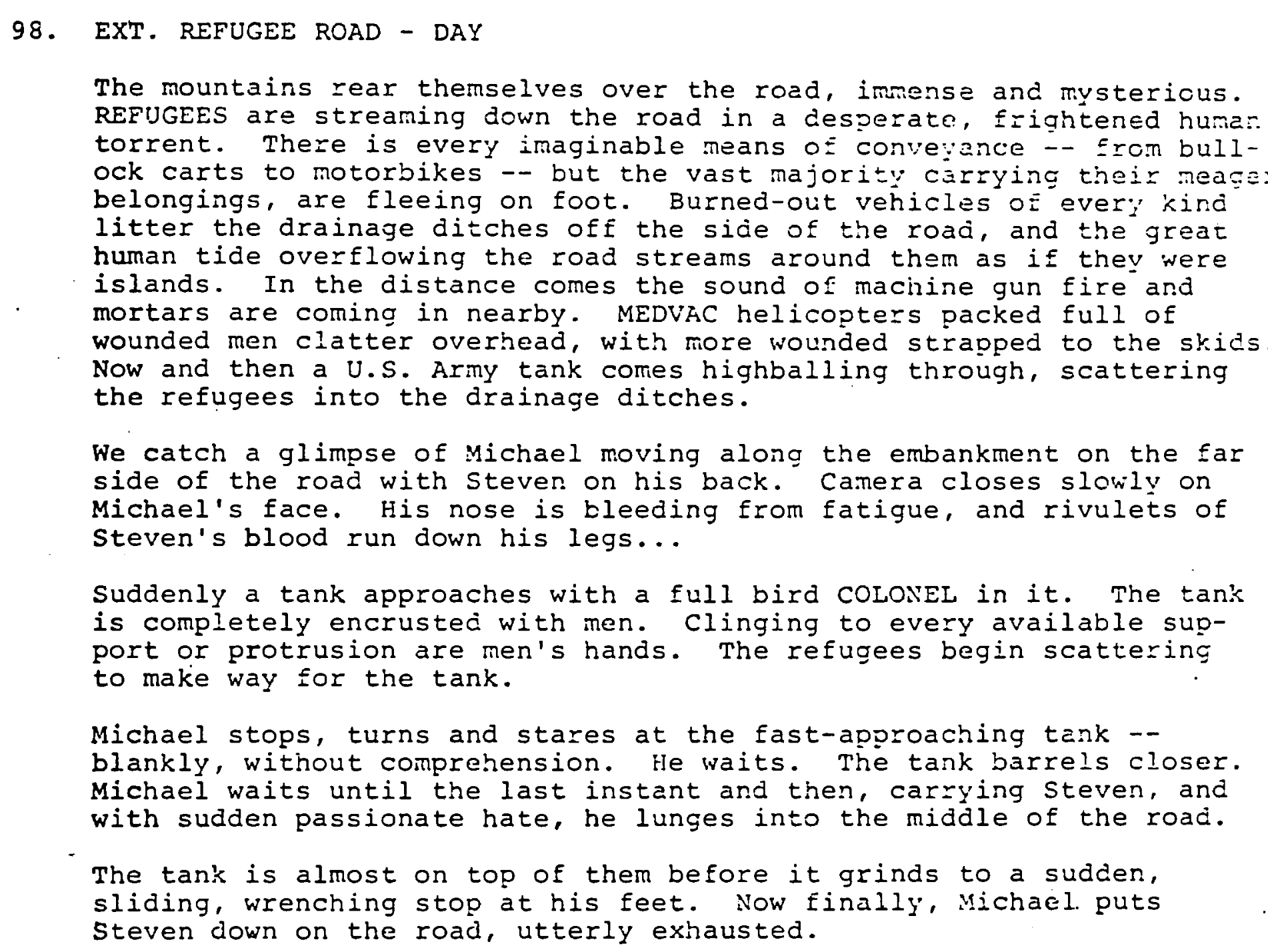
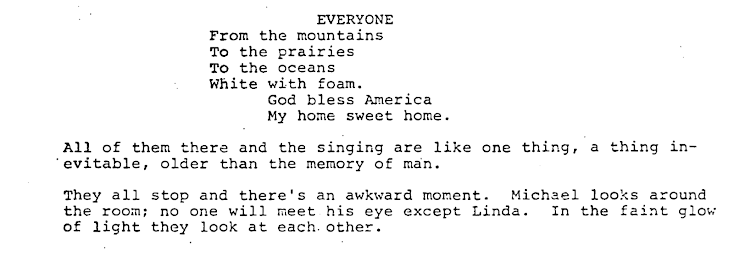
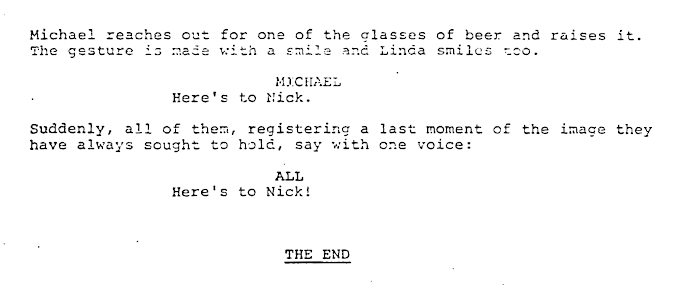
Michael returns to Clairton but finds himself emotionally alienated from his old life and unable to pull the trigger during a subsequent hunt. Learning that Steven is in a veterans' hospital—paralyzed and receiving anonymous cash from Saigon—Michael travels back to a crumbling, chaotic Saigon on the eve of its fall to find Nick. He discovers Nick has become a professional Russian roulette player in the city's underground, completely hollowed out by trauma.

Controversies and Critical Legacy
The Historical Accuracy Debate
Upon its release, the film faced intense backlash from some journalists and anti-war activists for its depiction of the Viet Cong. Critics pointed out that the Russian roulette scenes were completely fabricated. Prominent film critic Roger Ebert, however, defended the film, arguing that it was "not a historical document" but an "artistic recreation of the experience of the war."
Cultural and Artistic Impact
Despite the controversy, the film was a major box-office success and revitalized the careers of its stars.
It cemented Robert De Niro as the leading actor of his generation.
It launched Christopher Walken into stardom.
It showcased Meryl Streep's immense talents early in her career, earning her her first Academy Award nomination.
In 1996, The Deer Hunter was selected for preservation in the United States National Film Registry by the Library of Congress as being "culturally, historically, or aesthetically significant."








.jpeg)