"Everything that happens in real life is either boring or horrible."
Woody Allen's *The Purple Rose of Cairo* is a masterpiece of meta-cinema, set in the bleak winter of 1930s New Jersey. It tells the story of Cecilia, a waitress who finds literal and figurative escape when a movie character steps off the screen.
"The "Purple Rose of Cairo" is audacious and witty and has a lot of good laughs in it, but the best thing about the movie is the way Woody Allen uses it to toy with the very essence of reality and fantasy."
Set during the Great Depression, the main character, a woman (played by Mia Farrow ), is a sweet, rather baffled small-town waitress whose big, shiftless lug of a husband bats her around. She is a good candidate for the magic of the movies. Up on the screen, sophisticated people have cocktails and plan trips down the Nile and are recognized by the doormen in nightclubs. The hero in the movie is played by Jeff Daniels .He is a genial, open-faced smoothie with all the right moves, but he has a problem: He only knows what his character knows in the movie, and his experience is literally limited to what happens to his character in the plot. He’s great at talking sweetly to a woman, and holding hands, and kissing—but just when the crucial moment arrives, the movie fades out, and therefore, alas, so does he."Purple Rose" is delightful from beginning to end, not only because of the clarity and charm with which Daniels and Farrow explore the problems of their characters, but also because the movie is so intelligent. It’s not brainy or intellectual—no one in the whole movie speaks with more complexity than your average 1930s movie hero—but the movie is filled with wit and invention, and Allen trusts us to find the ironies, relish the contradictions, and figure things out for ourselves. While we do that, he makes us laugh and he makes us think, and when you get right down to it, forget about the fantasies; those are two of the most exciting things that could happen to anybody in a movie. The more you think about "The Purple Rose of Cairo", and about the movies, and about why you go to the movies, the deeper the damned thing gets.
https://www.rogerebert.com/reviews/the-purple-rose-of-cairo-1985
It is one of 3 Woody Allen’s own favorite films.
"Beloved by critics if not so much by audiences – not only is it great, it’s the the kind of film that only Woody Allen can make."
Woody Allen stands as one of the most prolific and influential auteurs in American cinema, shaping the landscape of modern comedy and psychological drama over a career spanning more than six decades.
His work is defined by a highly distinct artistic signature: an obsession with existential dread, psychoanalysis, the complexities of human relationships, and a deep-seated reverence for European art-house cinema.
Cinematic Evolution & Themes
Allen’s filmography reflects a distinct transition from pure slapstick and absurdist parody to complex, deeply philosophical narratives. His work can broadly be categorized into three major creative eras:
1. The "Early, Funny Movies" (Late 1960s – Mid 1970s)
Beginning as a stand-up comedian and television comedy writer, Allen's initial directorial efforts were loose, gag-driven comedies heavily influenced by the Marx Brothers and slapstick.
Key Works: Take the Money and Run (1969), Bananas (1971), Sleeper (1973), Love and Death (1975).
The Aesthetic: High-energy, episodic, and intensely self-deprecating, often blending literary or historical parodies with contemporary neuroses.
2. The Golden Age & The European Shift (Late 1970s – 1980s)
With Annie Hall, Allen fundamentally shifted the language of the American romantic comedy, introducing structural fragmentation, fourth-wall breaks, and an adult, melancholic psychological realism. During this period, his reverence for European directors like Ingmar Bergman and Federico Fellini became explicit.
Key Works: Annie Hall (1977), Manhattan (1979), Stardust Memories (1980), Crimes and Misdemeanors (1989).
The Aesthetic: Lush cinematography (frequently collaborating with legendary DP Gordon Willis), extensive use of jazz standards, and narratives that balanced bittersweet romance with heavy theological and moral inquiries.
3. The European Travelogue & Later Work (2000s – Present)
In his later career, Allen shifted his production focus away from his iconic, romanticized New York City to various European cultural capitals, funding his continuous output through international co-productions.
Key Works: Match Point (2005 - London), Vicky Cristina Barcelona (2008 - Spain), Midnight in Paris (2011 - France), Coup de Chance (2023 - France).
The Aesthetic: A mixture of sun-drenched romance, light fantasy, and cynical, Dostoevskian thrillers exploring luck, fate, and morality.
Core Artistic Signatures
The Neurotic Protagonist: A hyper-verbal, anxious intellectual—traditionally played by Allen himself, and later channeled by actors like Owen Wilson, Rebecca Hall, or Timothée Chalamet—who serves as a vehicle for examining existential anxiety, hypochondria, and romantic insecurity.
Moral Ambiguity: Many of his most acclaimed dramas (Crimes and Misdemeanors, Match Point) reject classical Hollywood morality, exploring the unsettling idea that terrible actions can go entirely unpunished in a godless universe.
Structural Playfulness: Frequent use of mockumentary framing, magic realism (characters stepping out of movie screens, time travel), and omniscient narration.
'
Woody Allen’s relationship with the cinema of Ingmar Bergman goes far beyond casual admiration; it represents an intensive, lifelong attempt to translate Scandinavian existential dread into an American idiom.
While Allen initially masked his philosophical anxieties with comedy, the late 1970s marked a period where he actively shed his comedic persona to engage directly with Bergman's visual language and thematic obsessions.
Interiors (1978): The Architectural Prison of the Mind
Following the massive critical and commercial success of Annie Hall, Allen shocked audiences by releasing Interiors, a severe, entirely humorless psychological drama that serves as a direct stylistic homage to Bergman's Cries and Whispers (1972) and Persona (1966).
Thematic Echoes: The Cold Mother and Divine Silence
The Emotional Glacier: The film centers on Eve (Geraldine Page), a cold, pathologically meticulous interior decorator whose obsession with aesthetic perfection masks profound psychological fragility. This mirrors the emotionally detached, deeply repressed matriarchs and sisters that populate Bergman's filmography.
The Sterile Void: Like Bergman, Allen explores the agony of familial silence, the artistic temperament as a form of emotional vampirism, and the absolute absence of spiritual comfort in the face of mortality.
Visual Translation (With Gordon Willis)
To ground these themes visually, Allen and cinematographer Gordon Willis discarded the warm, dynamic New York lighting of Annie Hall in favor of a rigid, clinical aesthetic:
The Desaturated Palette: The film is stripped of primary colors. The sets and costumes are restricted to pale beiges, muted grays, and cold whites, directly visualizing Eve's psychological need to control and deaden her environment.
The Compositional Cage: Characters are frequently shot through windows, trapped behind structural pillars, or arranged in flat, geometric profiles that emphasize their utter isolation from one another.
Symmetry and Stillness: The camera remains static for vast stretches. Allen relies on long, unblinking takes and extreme close-ups of expressive faces, letting the quiet ticking of a clock or the sound of breaking waves stand in for a traditional musical score.
Stardust Memories (1980): The Artist’s Despair and the Circus of Absurdity
If Interiors was Allen’s Cries and Whispers, then Stardust Memories is his 8½ via Bergman’s Persona and The Magician (1958). The film follows Sandy Bates (Allen), a disillusioned director attending a retrospective of his work while being hounded by aggressive fans, pretentious critics, and the memories of his past romances.
Thematic Echoes: Intellectual Parasites and Hidden Horrors
The Hostile Audience: The film tackles the deep ambivalence an artist feels toward their public. Allen channels the opening of Bergman's Persona—where a flood of chaotic, jarring imagery represents the sensory assault of modern existence—by portraying Sandy’s fans and critics as grotesque, surreal caricatures pushing their way into his space.
The Looming Void: Beneath the meta-comedic framework lies a profound existential panic. Sandy is paralyzed by the realization of human suffering (at one point staring at a photograph of a firing squad execution, an explicit nod to the iconic Holocaust photograph scene in Persona) and the ultimate futility of art in a dying universe.
Visual Translation (With Gordon Willis)
For Stardust Memories, Willis used a highly expressive, high-contrast black-and-white film stock that departed sharply from the romantic, velvet tones of Manhattan (1979):
Aggressive Close-Ups: Allen adopts Bergman’s signature framing technique—shoving the camera directly into the faces of secondary characters, often using wide-angle lenses that slightly distort their features to turn the supporting cast into a menacing, claustrophobic wall of humanity.
Surrealist Lighting: The lighting shifts abruptly between harsh, overexposed whites (symbolizing the glaring spotlight of fame and memory) and deep, stygian shadows, mirroring the fragmented, subjective state of Sandy's fracturing psyche.
The Core Distinction: Bergman's Silence vs. Allen's Noise
While the visual cues and thematic blueprints are deeply intertwined, the crucial difference lies in how both directors handle the existential void.
Where Bergman’s characters descend into heavy, agonizing silence or violent spiritual crises, Allen’s protagonists attempt to outrun the void with neurotic talk. Allen uses a hyper-verbal defense mechanism—even in his darkest films—using intellect, art, and philosophical debate as a frantic shield against the very same terrors that Bergman met with quiet resignation.
Plot Summary
The story centers on Cecilia (Mia Farrow), a clumsy, daydreaming waitress trapped in a miserable life. Her husband, Monk (Danny Aiello), is an abusive, unemployed gambler who spends their meager earnings on liquor. Cecilia's only solace is the local movie theater, the Jewel, where she watches Hollywood features to escape her grim surroundings.
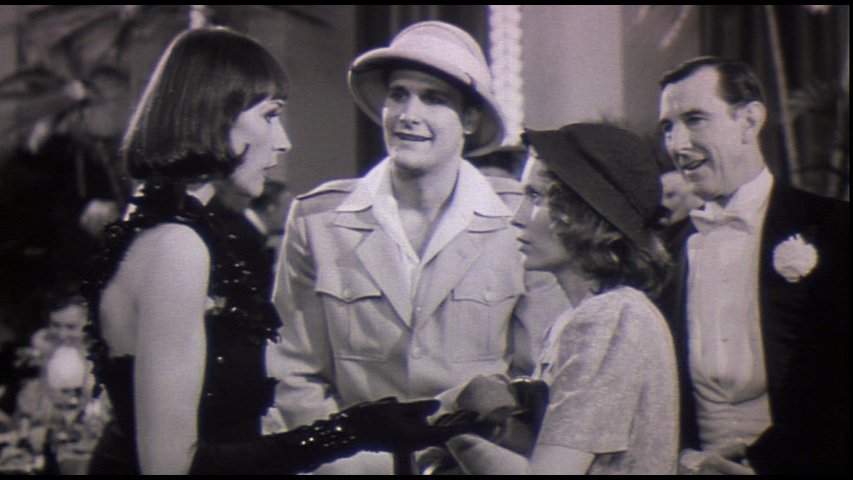
Her obsession focuses on a new RKO release titled The Purple Rose of Cairo. After watching the film multiple times, the handsome, wide-eyed explorer on screen, Tom Baxter (Jeff Daniels), notices her in the audience. Breaking the "fourth wall," Tom addresses Cecilia directly and steps off the silver screen and into the real world to be with her.
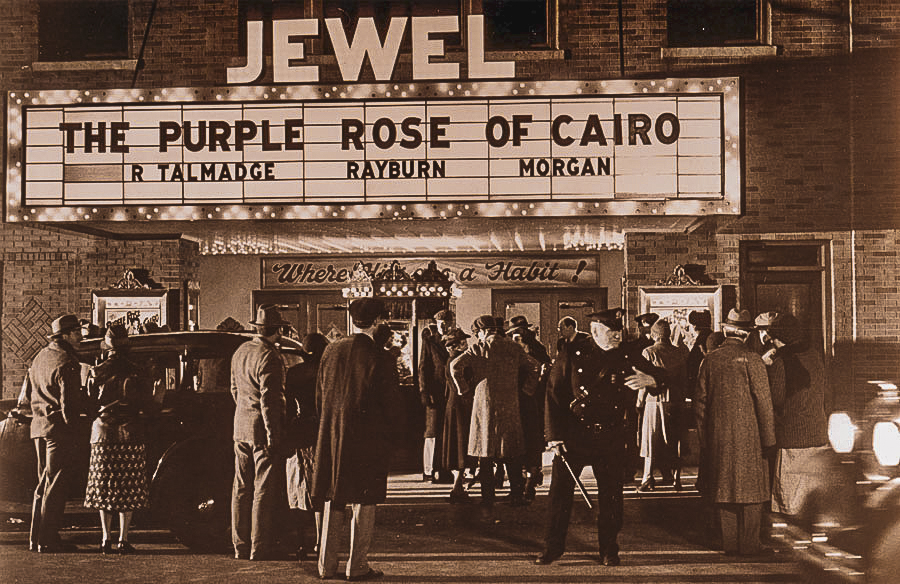
Casting Changes: Michael Keaton was originally cast as Tom/Gil and actually filmed for ten days. Allen realized Keaton was too "modern" and "street-smart" for the role of a 1930s matinee idol, leading to the casting of Jeff Daniels, whose "corn-fed" look fit the era perfectly.
Cinematography: Gordon Willis used distinct color palettes. The real world is shot in muted, sepia-toned colors, while the film-within-a-film is high-contrast, "silvery" black and white, mimicking the orthochromatic look of early sound films.
Special Effects: The "screen crossing" was achieved using a combination of rear-projection and perfectly matched lighting. The actors on the screen had to remain perfectly still or repeat loops while the "real" actors interacted with them.
The "Top Hat" Ending: The use of "Cheek to Cheek" from Top Hat at the end is one of the most famous uses of licensed music in cinema history, providing a hauntingly beautiful counterpoint to Cecilia's tragic situation.
Critical Reception and Legacy
Awards: The film won the BAFTA for Best Film and Best Screenplay, and the Golden Globe for Best Screenplay. It was nominated for the Academy Award for Best Original Screenplay.
Critics: It holds a high rating on Rotten Tomatoes, with critics often citing it as Allen's most "magical" and "coherent" film.
Allen's Personal Rank: Woody Allen consistently ranks this as his best film, alongside Stardust Memories and Match Point, because it successfully realized his philosophical intent regarding the cruelty of reality.
Annie Hall (1977)
Deconstructing the Romantic Comedy
"I would never want to belong to any club that would have someone like me for a member."
“Annie Hall” contains more intellectual wit and cultural references than any other movie ever to win the Oscar for best picture, and in winning the award in 1977 it edged out “Star Wars,” an outcome unthinkable today. The victory marked the beginning of Woody Allen‘s career as an important filmmaker (his earlier work was funny but slight) and it signaled the end of the 1970s golden age of American movies. With “Star Wars,” the age of the blockbuster was upon us, and movies this quirky and idiosyncratic would find themselves shouldered aside by Hollywood’s greed for mega-hits. “Annie Hall” grossed about $40 million–less than any other modern best picture winner, and less than the budgets of many of them.
Alvy Singer, the gag writer and stand-up comic played by Allen in the movie, is the template for many of his other roles–neurotic, wisecracking, kvetching, a romantic who is not insecure about sex so much as dubious about all the trouble it takes. Annie Hall, played by Diane Keaton, sets the form for many of Allen’s onscreen girlfriends: Pretty, smart, scatterbrained, younger, with affection gradually fading into exasperation. Women put up with a lot in Allen’s movies, but at a certain point they draw the line.
Alvy is smarter than the ground rules of Hollywood currently allow. Watching even the more creative recent movies, one becomes aware of a subtle censorship being imposed, in which the characters cannot talk about anything the audience might not be familiar with. This generates characters driven by plot and emotion rather than by ideas; they use catch-phrases rather than witticisms. Consider the famous sequence where Annie and Alvy are standing in line for the movies and the blowhard behind them pontificates loudly about Fellini. When the pest switches over to McLuhan, Alvy loses patience, confronts him, and then triumphantly produces Marshall McLuhan himself from behind a movie poster to inform him, “You know nothing of my work!” This scene would be penciled out today on the presumption that no one in the audience would have heard of Fellini or McLuhan.
The Legacy
Annie Hall won four Academy Awards, including Best Picture, Best Director, and Best Actress for Diane Keaton. Keaton’s portrayal of Annie—and her iconic wardrobe—influenced fashion and cultural perceptions of the "modern woman" for decades.
By humanizing the breakup and acknowledging that some relationships are simply "eggs" (a famous metaphor used at the end of the film), Annie Hall paved the way for the more cynical, realistic, and character-driven comedies that followed in the 1980s and 90s.


