Fassbinder directed his first feature in 1969, and was dead in 1982. Who else has created such a torrent of film, at such a high level of artistry? It's tempting to say he hurried because he knew his time was limited. Not at all. He hurried because his life was in his work, and those who knew him best wrote afterwards that he feared losing his friends and lovers if he did not always keep them around, in a flood of films and plays. If he had lived, and worked at the same rate, he would have made 80 films by now. Perhaps no one could have kept up that pace. He might have kept up the quality, however; it is sobering to think how much we lost when he died alone in that sad locked room.
Rainer Werner Fassbinder emerged in the late sixties to become one of the most prolific and influential filmmakers of what would become known as New German Cinema. Fassbinder was born in 1945 and like other filmmakers of his generation, including Werner Herzog, Volker Schlöndorff and Wim Wenders, he dramatically altered the cinematic landscape by telling stories about postwar Germany that focused on its economic, social and political issues problems faced and the power dynamics between individuals.
Fassbinder, more than any other major European art film director, so consistently privileged the language of theater and transposed it to the cinematic medium– effectively constituting a new film idiom. Moreover, Fassbinder’s specific employment of theatrical language and performance allow for a complex exploration of identity and identification.
Before Fassbinder turned his attention to film, he was involved in Munich’s theater community and later formed his own group called the “Anti-theater.” Thus it is not so surprising that Fassbinder’s passion and involvement with theater informs the basis for his entire stylistic and intellectual approach to filmmaking.

However, the strategic decision to synthesize two distinct representational “languages” must be considered not only as an aesthetic or formal choice but also a political one—one which refuses to affirm the traditional view that designates theater and cinema as rivals.
Like the theater revolutionary writer and theorist Bertolt Brecht, Fassbinder once remarked that even though his films often end on an unhappy note, what film scholar Richard Dyer termed “left-wing melancholy,” his goal was to encourage viewers to reveal the mechanisms of how society works in order to enable them to enact change in their own lives, rather than succumb to intellectual passivity.
He does this through his use of theatrical conventions, for example—stylized poses and gestures, non-naturalistic acting, diction, and utterance—which reveals simultaneously the structure of power that operates within social, political, and interpersonal discourse. Fassbinder merges the illusionist power of film language with a modernist theatrical language. Without stifling identification with the heroines and social outcasts he often represented, he allows audiences the opportunity to think and feel.
As an auteur, Fassbinder created a visually and imaginatively rich film repertoire that melds Hollywood melodrama and Brechtian distanciation to great effect.
1969
Love Is Colder Than Death
His feature debut. A minimalist gangster film heavily influenced by Godard, introducing his cool, detached aesthetic and early theater troupe.
1971
Beware of a Holy Whore
A chaotic, self-reflexive look at the torturous process of filmmaking, serving as a bitter love letter to his own ensemble cast.
1972
The Merchant of Four Seasons
His first major commercial success and the beginning of his melodrama phase, detailing the downfall of a fruit peddler in post-war Munich.
1972
The Bitter Tears of Petra von Kant
A chamber piece focusing entirely on an all-female cast, exploring power dynamics, narcissism, and sadomasochism in the fashion world.
1974
Ali: Fear Eats the Soul
Considered his absolute masterpiece. A heartbreaking romance between an older German cleaning woman and a younger Moroccan immigrant mechanic.
1975
Fox and His Friends
Fassbinder himself stars as a working-class gay man who wins the lottery, only to be financially and emotionally drained by his bourgeois boyfriend.
1978
In a Year of 13 Moons
Created in the wake of his lover's suicide, an intensely personal and tragic depiction of a transgender woman wandering Frankfurt.
1979
The Marriage of Maria Braun
His biggest international hit. An allegory for West Germany's economic miracle, starring Hanna Schygulla as a ruthless survivor.
1980
Berlin Alexanderplatz
A colossal 14-part television adaptation of Alfred Döblin's novel. A monumental achievement in cinematic storytelling exploring the Weimar Republic.
1982
Querelle
His final film, released posthumously. A visually hyper-stylized adaptation of Jean Genet's novel exploring homosexuality, crime, and myth.
Ali: Fear Eats the Soul (1974)
The first shots set up the theme: them against us. An older woman, dumpy and plain, walks into an unfamiliar bar and takes a seat at the table inside the door. The barmaid, an insolent blond in a low-cut dress, strolls over. The woman says she will have a Coke. At the bar, a group of customers turns to stare at her, and the camera exaggerates the distance between them. Back at the bar, the blond tauntingly dares one of her customers to ask the woman to dance. He does. And now the camera groups the man and woman together on the dingy dance floor, while the others stare.
“Ali: Fear Eats the Soul” (1974) tells the story of these two people. Emmi Kurowski (Brigitte Mira) is about 60, a widow who works two shifts as a building cleaner, and whose children avoid her. Ali (El Hedi ben Salem) is about 40, a garage mechanic from Morocco, who lives in a room with five other Arabs and describes his life simply: “Always work, always drunk.” Ali is not even his real name; it’s a generic name for dark-skinned foreign workers in Germany.
Fassbinder said he made the film just to fill the time between bigger pictures, but “Ali” may be the best of his 40 or so films; it certainly belongs on the short list with “The Marriage of Maria Braun” and “Merchant of the Four Seasons.”
The film is powerful but very simple. It is based on a melodrama, but Fassbinder leaves out all of the highs and lows, and keeps only the quiet desperation in the middle. The two characters are separated by race and age, but they have one valuable thing in common: They like one another, and care for one another, in a world that otherwise seems coldly indifferent. When Emmi shyly confesses she is a building cleaner, she says many people look down on her for that. Ali, whose German is limited, expresses his position more directly: “German master, Arab dog.”
“Ali: Fear Eats the Soul” might sound like improbable, contrived soap opera. It doesn’t play that way. The reason it gathers so much power, I think, is that Fassbinder knew exactly what was meant by the title, and made the film so quickly he only had time to tell the truth.
The Marriage of Maria Braun (1979)
Bombs fell as Maria was married to a soldier named Hermann Braun, with the wedding party scrambling for safety. Then came more years of the war. Whatever happened to Maria Braun during those years created a woman who is strong and cruel, sad and indomitable. She is so loyal to her husband of less than a day that she kills for him, and so pitiless to her lover of many years that she drives him to death.
All the time she is keeping score: nylons and cigarettes at first, then a good job, fashionable clothes, a house in the suburbs, expensive restaurants. At the end, her desperate lover, who is also her boss and has made her rich, tries to get a word with her; as he talks, she continues to enter numbers into an adding machine.
"The Marriage of Maria Braun" was made by Rainer Werner Fassbinder in 1979, near the end of a career so short and dazzling that it still seems incredible he did so much and died so young. Fassbinder made at least 30 features, or many more if you count his television productions, including the 15-hour miniseries "Berlin Alexanderplatz," and he did it all between 1969 and his death at age 37 in 1982.
Fassbinder's world was one in which sex, ego and money drove his characters to cruelty, sadism and self-destruction. It is never difficult to discover what they want, or puzzling to see how they go about it. His occasional gentle characters, like the old woman in "Ali -- Fear Eats the Soul" (1974), are eaten alive. The suggestion is that the war years and the postwar years wounded the German psyche so profoundly that the survivors wanted what they wanted, now, on their terms. Fassbinder himself was cruel and distant to those around him, particularly those who loved him, and in Maria Braun, he created an indelible monster who is perversely fascinating because she knows exactly what she is doing and explains it to her victims while it is being done.
THE MARRIAGE OF MARIA BRAUN (1979) >>>
Veronika Voss (1982)
The decay of a great star
Rainer Werner Fassbinder premiered "Veronika Voss" in February 1982, at the Berlin Film Festival. It was hailed as one of the best of his 40 films. Late on the night of June 9, 1982, he made a telephone call from Munich to Paris to tell his best friend he had flushed all his drugs down the toilet — everything except for one last line of cocaine. The next morning, Fassbinder was found dead in his room, a cold cigarette between his fingers, a videotape machine still playing. The most famous, notorious and prolific modern German filmmaker was 36.
Does this film represent a premonition of his own death? It tells the story of a German actress who worked tirelessly and achieved great fame, but began depending on drugs and alcohol and eventually became so addicted that she sold her body and soul for drugs. Her fortune spent, her marriage destroyed, she began to live as an inpatient in the clinic of a sinister Berlin woman who billed herself as a psychiatrist but was also a Dr. Feelgood who strung along her patients on morphine and controlled them by withholding their supply.
The film opens in 1955 with Voss (Rosel Zech) looking at one of her own pre-war classics (that's Fassbinder himself in the audience, leaning on the seat-back behind her). There was a time when she was welcomed in the offices of producers, greeted by hea
dwaiters, recognized on the street. That time has passed, and it is painful to hear her remind people who she is — or was. One night, drinking without funds in a cabaret, she falls into conversation with a soft-faced sportswriter named Robert Krohn (Hilmar Thate), who is old enough to remain under her spell. She grandly says she will pick up the check, then "allows" him to do it, and invites him to come home with her. All the furniture in her villa is covered in white sheets, the electricity is disconnected, and she has them light candles "because they are so much more flattering to a woman." The star struck journalist has without realizing it walked into the last act of Veronika Voss's life.

Weighing in at 930 minutes, Berlin Alexanderplatz is often cited as the longest movie ever made. This is because it was made by the great film director Rainer Werner Fassbinder, but actually his 15-hour odyssey through the underbelly of interwar Berlin began life as a riveting TV series.
Fassbinder, the coke-and-booze-fuelled terror of the 1970s German film industry, loved Alfred Döblin's 1929 novel about Franz Biberkopf, a petty criminal jailed for killing his prostitute girlfriend, then released a few years later into a Berlin in meltdown. Nazis and Communists are fighting on the streets, gangsters are taking over businesses, and everyday people living in fear. Stripped to its bare bones, Biberkopf's story is pretty miserable: he tries one pathetic money-earner after another, works his way through various underworld women, loses his arm after being thrown out of the back of a van, and discovers his one true love, another prostitute, has been murdered by one of his criminal pals.
But it's the murderous intensity with which Fassbinder bears down on Biberkopf's experience that makes Berlin Alexanderplatz so compelling. The episode titles alone give you some idea of its haunting power: A Handful of People in the Depths of Silence; The Serpent in the Soul of the Serpent; About the Eternities Between the Many and the Few. This is a vision of a man hamstrung by forces outwith his control, doomed to a life of angst.
True, Berlin Alexanderplatz isn't especially stylish to look at: much of it is rudimentary, even stagey. This doesn't apply to the final episode, though, which is simply bizarre: Fassbinder wrote his own epilogue, called My Dream of the Dream of Franz Biberkopf by Alfred Döblin. This is a two-hour parade in which Biberkopf, accompanied by two angels in blonde wigs and suspender belts, encounters every character that has passed through the story, dead and alive. As baffling dream sequences go, it's in a league of its own.
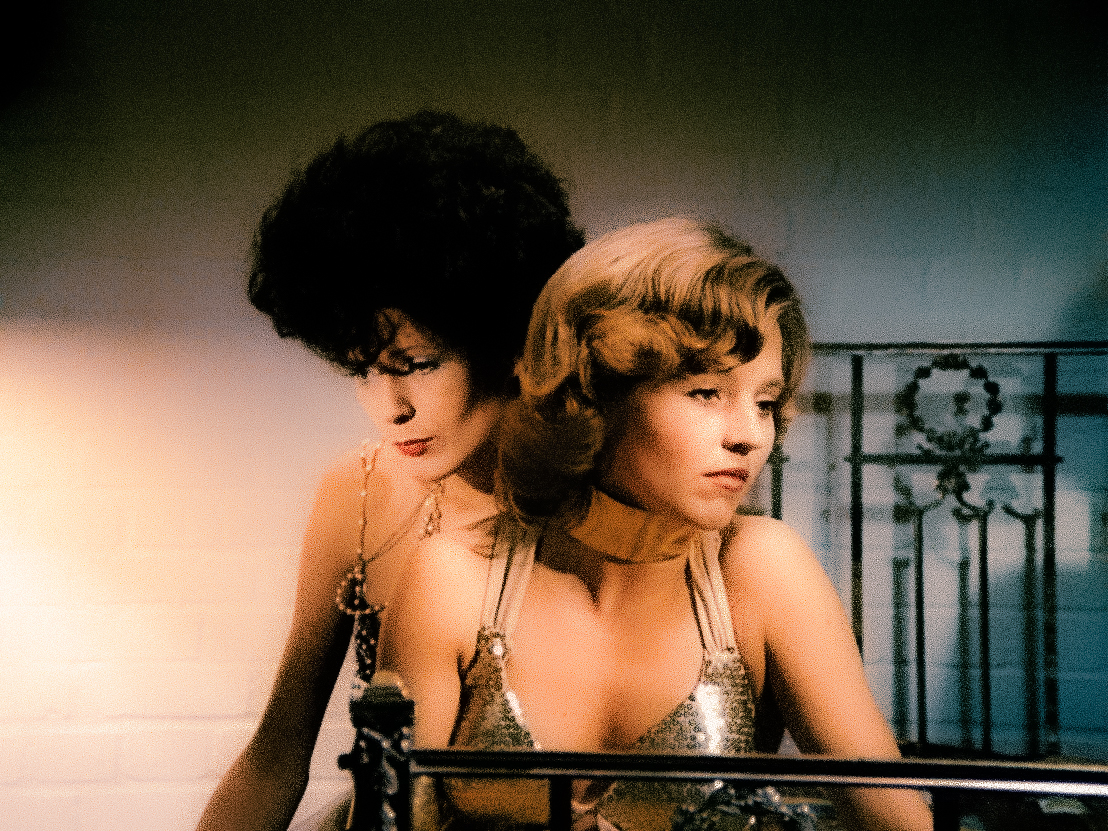
The Bitter Tears of Petra von Kant (1972)
The Bitter Tears of Petra von Kant is one of the director’s more intimate and intensely personal films: Fassbinder said it was his most autobiographical.
Bitter Tears centers on the romance between the title character (Margit Carstensen), a famous fashion designer, and an aspiring model named Karin Thimm (Hanna Schygulla, Fassbinder’s frequent muse). They enter into an affair, with Petra assuming a dominant role in the relationship, but Karin learns to exploit the older woman’s emotional attachment, and the two end up switching roles. As in his earlier films, Fassbinder argues that love is colder than death—it’s a transaction in which one party benefits and the other party loses. At the same time, the writer-director gives the characters greater depth than he did to those in his previous work. Bitter Tears hinges on several extended monologues wherein the characters delve into their pasts and their current beliefs, and these passages give the movie a novelistic texture. One sees the characters as individuals, not just representations of a social order.
Bitter Tears was adapted from a play Fassbinder had staged in Munich not long before, and the film retains the theatrical conventions of its source material. The action is limited to one place, Petra’s home, and each of the scenes plays out in real time. Fassbinder evens heightens the sense of theatricality with opulent costumes, moments of grandly overstated acting, and painted walls that evoke theatrical backdrops. In doing so, he makes theatrical convention seem arbitrary and constricting—much like he presents love as an arbitrary and constricting convention that replicates in miniature the order of capitalist society. Fassbinder ironically appeals to the emotions in conveying this argument—in the movie’s most commanding scenes, Bitter Tears drops the curtain of artifice as characters bare their souls and voice their most primitive emotional needs. Fassbinder elicits more naturalistic performances during these scenes and shoots some of them in close-up. It feels as though the director has broken through his style to achieve something universal and direct.
Beware of a Holy Whore (1971)
Comparisons between Beware of a Holy Whore and Godard’s Contempt and Truffaut’s Day for Night are unavoidable, but even if the film is not quite as successful as those two films it’s infinitely funnier. At once Fassbinder’s most accessible and self-indulgent film, Beware of a Holy Whore catalogs the emotional baggage of actors holed up inside a Spanish seaside hotel during a tedious and under-financed movie shoot. The film is, at first glance, about making movies.
This is how the cinema looked, in 1971, to the twenty-six-year-old director Rainer Werner Fassbinder, who already had ten feature films under his belt. The cast and crew of a politicized costume drama are holed up in a Spanish villa while awaiting their star, their equipment, and their money; meanwhile, they drink joylessly and engage in provocative sexual escapades, subtly Machiavellian manipulations, and cruel displays of power that threaten the film with emotional sabotage. The director, Jeff (Lou Castel), betrayed by his financiers and obliged to complete a doomed production, plays these games as recklessly as his employees do. He risks alienating his star, Eddie Constantine (playing himself), with his allusive script and its violent action. The increasing dissolution of the shoot is captured in the kaleidoscopic fragmentation of the story, which shatters the filmmaking process into a whirl of dispersed moments of latent or blatant conflict—which is the stuff that Jeff’s film is made of. Co-starring Fassbinder himself, as an assistant whose practical wiles don’t prevent his own breakdown.
Fox and His Friends (1975)
At the delicate art of combining the bizarre and the mundane, nobody is more skillful than Rainer Werner Fassbinder. His formula is wickedly simple. He begins, often enough, with elements of lurid sexuality. Then he films against type, looking for deliberately banal characters and locations. And then, in a stylistic double reverse, he photographs his banal subjects with a highly mannered artificiality.
The results are uneven, but then anyone who's made some 33 films and is only 36 years old can be excused for a certain inconsistency. What's important is that when everything's working, Fassbinder produces work that's hauntingly poignant.
And it's especially true of "Fox and His Friends," a 1975 film which won a Gold Hugo in the Chicago Film Festival. Fassbinder himself takes the leading role, playing a naive and slightly dense, young working-class man who wins the state lottery and soon finds himself - and his lottery winnings - embraced in Munich's gay circles.
The movie begins by seeming to be about a homosexual relationship; the slightly dazed young hero is adopted by the superficially charming son of a rich industrialist. But then things grow complicated. The industrialist, we learn, is about to go bankrupt. The son hopes to save the business. One solution might be to swindle the easily flattered lottery winner out of his fortune - using love as a pretext.
Fassbinder is a specialist at scenes in which the unspeakable is spoken, the unthinkable is thought, the undoable is done with a vengeance. All three of those elements come into play in the film's best scenes, including a brilliantly complex dinner scene. The industrialist's son brings his new lover home to meet his parents, and it becomes chillingly clear that sex is not the issue with this family; money is. The relentlessly upper-middle-class parents and their gay son are, in fact, engaging in a form of tacit prostitution, trading the fashionable facade of their lives for the money they desperately need.
Fassbinder films capture a frantic life's desperation
In the 1970s Rainer Werner Fassbinder was a familiar presence at film festivals, invariably clad in black leather, a cigarette always in his hand, a scraggly mustache drooping over lips that seemed curled in constant ironic amusement. He traveled with a pack of friends, lovers and associates, and at Cannes, for example, you expected them all to turn up sometime after midnight at Le Petit Carlton, the little all-night bar where the party spilled out into the street.
He was sublimely uninterested in publicity, in press conferences, in interviews. He wasn't awake during the hours when all of that went on. I had dinner with him once at the Montreal festival, but he was more interested in brandy than conversation. At some festivals he would have two or three films (he made about 40 in 14 years), but until late in his career they were made on small budgets with unknown actors, so he didn't have to play the money game. Yet the screenings for his movies were always packed--critics wanted to see them even if their readers back home didn't--and there was always a feeling of heightened anticipation when the lights went down.
Fassbinder worked quick and loose, but his films weren't sloppy; his visual style was a tight observant mannerism that locked all of those strangely assorted stories into the same world view. His typical films were supercharged melodramas in which the eternal themes of love, jealousy, shame and betrayal were played out in a style that valued them at the same time it mocked them. You felt he had a certain contempt for the formulas of romance and heartbreak, but that he took the subjects very seriously indeed.The Dialectics of Despair: A Comprehensive Analysis of the Life, Work, and Cultural Impact of Rainer Werner Fassbinder
The emergence of Rainer Werner Fassbinder in the late 1960s signaled a seismic shift in the landscape of European cinema, marking the definitive arrival of the New German Cinema as a movement of international consequence. Fassbinder, who lived with a frantic intensity that mirrored the rapid-fire production of his forty-four feature-length projects, remains the most polarizing and prolific figure of his generation. His work functioned as a sustained, clinical autopsy of the West German soul, specifically targeting the "moral hypocrisy" of a society that had rebuilt itself atop the repressed ruins of National Socialism. Born into the immediate aftermath of Germany’s total defeat, Fassbinder’s aesthetic was forged in the tension between the cinematic escapism of his youth and the radical political upheavals of the 1960s. He did not merely make films; he constructed a "house" of dreams and historical inquiry that sought to ennoble the marginalized while exposing the "everyday fascism" inherent in human relationships.
The Crucible of Postwar Identity: 1945–1966
The origins of Fassbinder’s relentless creative drive can be traced to a childhood defined by isolation and the pervasive influence of the American occupation. Born on May 31, 1945, in the Bavarian town of Bad Wörishofen, Fassbinder arrived only three weeks after the unconditional surrender of the Third Reich. This timing was so central to his self-conception that he later claimed, in compliance with his mother's wishes, to have been born in 1946 to more firmly establish his identity as a child of the postwar "zero hour". His father, Helmut Fassbinder, was a physician whose professional life was a secondary pursuit to his passion for poetry, while his mother, Liselotte Pempeit, worked as a translator. The early separation of his parents in 1951 left Fassbinder in a state of chronic neglect; his mother, burdened by her own work and frequent bouts of tuberculosis, used the cinema as a surrogate guardian.
This early immersion—sometimes viewing up to four films a day—provided the young Fassbinder with a proto-cinematic vocabulary that favored the high-gloss artifice of Hollywood. However, this escapism was constantly challenged by the reality of his environment. Living near Munich’s red-light district, Fassbinder was exposed to the fringes of society from a young age, an experience that would later inform his empathy for "social misfits" and "outcasts". His adolescence was marked by delinquency, repeated escapes from boarding school, and an early declaration of his bisexuality at age fifteen. The internal dissonance of this period—a bourgeois background clashing with a deviant lifestyle—became the primary engine of his art, which he famously described as a form of "psychotherapy" to process his lived experience.
Fassbinder’s failure to gain entry into the Berlin Film School—a rejection he shared with other future New German Cinema luminaries like Werner Schroeter—forced him to cultivate an alternative path through the Munich theater scene. At the Fridl-Leonhard Studio, he met Hanna Schygulla, who would become his most enduring muse and the personification of the "Teutonic reserve" and "effortless magic" that anchored his films. The lack of formal training allowed Fassbinder to bypass the "hazy generalities" of academic cinema, opting instead for a direct, emotionally blunt style that prioritized speed and process over traditional polish.
From Action-Theater to Anti-Theater: The Radical Roots
The transition from a theater student to a cultural revolutionary occurred in the late 1960s, a period defined by student protests and the global rise of the New Wave movements. In 1967, Fassbinder joined the Action-Theater, a "cellar theater" group in Munich that sought to dismantle the "bourgeois concept of theater" supported by the state-subsidized Staatstheater. Within eighteen months, Fassbinder had established himself as a creative leader, utilizing a "postdramatic form" that emphasized de-individuated characters and the active role of the audience in the creation of meaning. When the Action-Theater was forcibly closed by the police, the core members reorganized as the antiteater, a title that signaled their rejection of conventional aesthetics and their commitment to "reducing the classics to rubble" (Klassikerzertrümmerung).
The antiteater years (1968–1969) were the crucible for Fassbinder’s stock company, a "hermetic and deeply dysfunctional family" that included Irm Hermann, Kurt Raab, Peer Raben, and Hanna Schygulla. Fassbinder’s methodology in the theater was marked by a "boundless energy" and an authoritarianism that some collaborators described as "sadistic". He learned to manage every phase of production—writing, acting, directing, and management—developing the versatility that would later allow him to produce feature films on extremely low budgets. During this period, he developed a "ritualized syntax" that combined choreographed movement with static poses, taking cues from musicals, cabaret, and the student protest movement. This theatrical background remained a constant throughout his career, manifesting in the "stagey" intensity and claustrophobic framing of his cinematic output.
The Early Cinematic Phase: Gangsters and Alienation (1969–1971)
Fassbinder’s entry into feature filmmaking was marked by a synthesis of his theatrical practice and a deep admiration for the French New Wave, particularly Jean-Luc Godard. His first feature, Love Is Colder Than Death (1969), was a deconstructed gangster film that stripped the genre of its Hollywood glamour and replaced it with a clinical, almost robotic detachment. Dedicated to Claude Chabrol and Eric Rohmer, the film utilized a "fixed camera" to replace the theater audience, emphasizing long takes and a "comic melancholia" that confused many critics at its Berlinale debut. In this early stage, Fassbinder was already preoccupied with themes of "alienation" and "brutality," using the crime genre as an "arthouse Mean Streets" to explore the social rigidity of West Germany.
The most significant work of this period, Katzelmacher (1969), derived its title from Bavarian slang for a "foreign worker". The film focuses on the arrival of a Greek immigrant (played by Fassbinder) in a suburban Munich neighborhood, an intrusion that sparks a wave of "violent xenophobic slackers". The film’s "austere and demanding manner" forces the audience to confront their own social prejudices without the comfort of identification with the characters—a technique inspired by Bertolt Brecht’s "distanciation". Katzelmacher established a recurring theme in Fassbinder's diverse oeuvre: "alienated characters unable to escape the forces of oppression".
Fassbinder’s productivity during this phase was staggering. Between 1970 and 1971, he completed ten feature films, including Gods of the Plague, The American Soldier, and Beware of a Holy Whore. The latter film, Beware of a Holy Whore (1971), is a pivotal work that serves as a "revealing self-portrait" of the director. Shot on location in Spain, it depicts the internal chaos and "emotional power struggles" of a film crew waiting for a director to arrive, mirroring the real-world dynamics of Fassbinder’s own troupe. The film acts as a "watershed," marking the transition from his early experimental phase toward the more structured, "Sirkian" melodramas that would define his international breakthrough.
The Douglas Sirk Turning Point: Melodrama as Social Critique
In 1971, Fassbinder’s cinematic philosophy underwent a radical recalibration after he viewed six films by the German-born Hollywood director Douglas Sirk. Fassbinder’s discovery of Sirk—documented in his seminal 1971 essay "Imitation of Life"—is credited with the critical rehabilitation of Sirk as a subversive master of the "family melodrama". Fassbinder was particularly struck by Sirk’s ability to use "melodramatic excess" and "artifice" to convey profound emotional truths about the "prison" of the middle-class home. He realized that intellectual subject matter worked most effectively when stripped of "self-conscious artiness" and delivered through the "straightforward, uncomplicated narrative style" of Hollywood.
This influence bore immediate fruit in The Merchant of Four Seasons (1971), which tells the story of Hans Epp, a fruit peddler who is slowly crushed by the "silent group pressure" of his family and society. The film is a "luminous, inventive movie" that utilizes "soap opera, social comedy, irony, and farce" to depict the "down-path of a family black sheep". Unlike his previous avant-garde efforts, Merchant was a domestic commercial success, proving that Fassbinder’s "ritualized syntax" could resonate with a wider audience when filtered through the lens of domestic tragedy.
The masterpiece of this period, Ali: Fear Eats the Soul (1974), was a direct "gritty" homage to Sirk’s All That Heaven Allows. By updating Sirk’s story of a wealthy widow’s romance with a gardener to a contemporary setting involving an elderly German washerwoman and a young Moroccan "guest worker," Fassbinder created a "bitter and touching" critique of racial prejudice in West Germany. The film’s "melodramatic directness" was paired with a "clinical political" astuteness, indicating Fassbinder's growth as an artist who could balance "Brechtian distance" with "Sirkian emotion". Ali: Fear Eats the Soul earned him his first major international success, cementing his status as a "catalyst" for the New German Cinema.
The Aesthetics of the Frame: Space, Mirrors, and Power
Fassbinder’s directorial style was defined by a "tender eye" that was paradoxically "devoid of sentimentality". He collaborated closely with cinematographer Michael Ballhaus and production designer Kurt Raab to create a visual language that reflected the internal paralysis of his characters. One of his most recognizable techniques was the use of "tight, slightly crammed frames" and "restricted, fixed framed motionless shots" that suggested a "paralysis of the soul". Characters were frequently seen through "door frames," making the camera an "uncanny consciousness" that observed them like "insects in a science lab".
In World on a Wire (1973), his only work of science fiction, Fassbinder pushed this formal experimentation to its limit. Using banks of mirrors and shimmering decorative panels, he envisioned a research institute as a "maze of reflected images" that mirrored the film's philosophical inquiry into the nature of "subjective reality". The characters become "identity units" trapped within a digital simulation, a metaphor for the "filmmaker-as-programmer" who unknowingly plays out the directives of society. This use of mirrors—inspired by Sirk’s observation that a mirror "does not show yourself as you are; it shows you your own opposite"—became a cornerstone of Fassbinder’s ability to "activate things and feelings" in the viewer while maintaining the possibility for reflection.
The Theme of Exploitation: Power Dynamics in Personal Life
Central to Fassbinder’s entire body of work was a singular, persistent subject: "the exploitability of feelings". He believed that every relationship—whether between partners or between the state and the citizen—involved one party "destroying the other" or exploiting their vulnerabilities. This theme was not merely theoretical; it was the "permanent theme" of his own life. His relationships with his troupe were characterized by a "symbiosis between sadism and masochism," where he acted as the "svengali" who "lovingly crafted" the images of his stars like Hanna Schygulla at the expense of their autonomy.
In The Bitter Tears of Petra von Kant (1972), this "exploitability" is laid bare. The film centers on a fashion designer who subjects her assistant to constant degradation while herself falling into a "treacherous" and "unpredictable" love for a young model. The film explores how "desire plays a major supporting role" but the "will to power is sadly dominant" in human interaction. Fassbinder’s approach suggests that even personal contentment is compromised by "general social resentment" that "works its way into a gut".
This interrogation reached its most painful and personal height in In a Year of 13 Moons (1978). Written and filmed in the immediate aftermath of the suicide of his former lover, Armin Meier, the film is an "autopsy of the layers of hypocrisy" and "moral confusion" that follow such a tragedy. Meier, a "barely literate former butcher," had been with Fassbinder for four years before the director ended the relationship, leading to Meier’s suicide on Fassbinder’s birthday. The film’s protagonist, Elvira, mirrors many details of Meier’s life—raised in an orphanage, working in a slaughterhouse—and occupies an "impossible sexual identity" as a transwoman who underwent a sex change solely because a lover suggested he might love her more as a girl. Fassbinder served as director, writer, cinematographer, and set designer for the project, creating a "suffocating aesthetic" that reflects a world where "all the exits are tightly bolted".

The Political Autopsy: Germany in Autumn and The Third Generation
While many of his contemporaries in the New German Cinema—such as Werner Herzog and Wim Wenders—largely avoided the immediate political crises of the West German state, Fassbinder was a "card-carrying Ironist" who tackled these subjects with "impertinent" ferocity. The height of the "German Autumn" of 1977, marked by the Baader-Meinhof/RAF atrocities and the murder of industrialist Hanns-Martin Schleyer, deeply vexed Fassbinder. In the anthology film Germany in Autumn (1978), Fassbinder provided a "remarkable" and "exhausted" self-portrait, appearing naked and wrestling with "moral confusion" as he argues with his mother about the ethics of the state-versus-terrorist conflict.
His feature film The Third Generation (1979) took this critique further, portraying the RAF warriors as "charlatans," "rapists," and "cosplayers" who play "Monopoly" and drink "champagne" while discussing guerrilla warfare. Fassbinder exposed the situation as a "circus of opportunism" and "foolishness," suggesting that to come down on either side of the conflict was to fall victim to "idealism or power madness". The film was a "full-on siege of hyper-irony," mocking its own "diegetic constructions" and playing with the "loaded gun" of recent German history—a risk his peers were unwilling to take.
The BRD Trilogy: The History of the Economic Miracle
Fassbinder’s most sustained historical project was the BRD Trilogy (The Marriage of Maria Braun, Lola, and Veronika Voss), which examined the "rotten substratum of Nazism" beneath the "flimsy modern foundations" of postwar West Germany. He understood that the "Wirtschaftswunder" (economic miracle) was built on "historical amnesia" and "psychic denial," a "prosaic combination of American fiscal influence and materialist gain".
The Marriage of Maria Braun (1979)
This film was Fassbinder’s "greatest critical and commercial success," establishing him as a director of "national and international renown" and making Hanna Schygulla an international star. The character of Maria Braun, who prostituted her emotions to survive the postwar rubble, serves as a "gorgeous workhorse" and an "allegory" for West Germany itself. The film is noted for its sophisticated use of "overlapping sound," where radio broadcasts of German chancellors from Adenauer to Schmidt and the "obtrusive sound of a sledgehammer" create a narrative of a nation "rising from the rubble" while remaining "oblivious of its past". Despite its "vicious satire," the film was praised for its "linear plot development" and "accessible narrative," proving to be a "major hot-ticket item" that passed a million dollars at the U.S. box office.
Lola (1981)
Representing late-fifties rationalization, Lola utilized an "aggressively bright palette" of reds and blues to achieve a "Technicolor look" inspired by the films of the era. It centers on a "hurricane of movement" (Barbara Sukowa) and a hero who withdraws into "nostalgic denial," portraying the moral compromises of the reconstruction period.
Veronika Voss (1982)
The final installment, shot in "piercing black and white," follows a morphine-addicted former Nazi-era star who has become a "relic of an unwanted past". The film won the Golden Bear at the Berlin International Film Festival, marking the pinnacle of Fassbinder’s critical recognition just months before his death.
Berlin Alexanderplatz: The Monumental Masterpiece
While filming the BRD Trilogy, Fassbinder was simultaneously working on his most "monumental project": a fourteen-part television adaptation of Alfred Döblin’s 1929 novel Berlin Alexanderplatz. Fassbinder had read the novel many times, stating that it saved him from being "completely and utterly sick" as an adolescent. The 894-minute miniseries follows the character Franz Biberkopf, a simple man released from prison who tries to remain decent in a world of rising fascism and urban decay.
The production was a "titanic undertaking," noted for its "nocturnal gloom" and "murderous intensity". The final two-hour epilogue, "My Dream of the Dream of Franz Biberkopf," abandoned the "rudimentary, even stagey" naturalism of the earlier episodes for a "politically and spiritually charged psychosexual dreamscape" featuring music by Lou Reed and Kraftwerk. Despite its length, the series holds a 100% approval rating on Rotten Tomatoes and is frequently cited as a "belated Expressionist masterpiece".
The Final Year and the End of an Era
Fassbinder’s final completed film, Querelle (1982), based on Jean Genet’s novel, evoked an "erotic underworld" of sailors and outcasts, further pushing the boundaries of sexual representation. His health, however, was rapidly deteriorating due to his "nonstop work ethic" and a reliance on cocaine and sleeping pills to sustain his pace—a lifestyle he shared with his troupe members like Harry Baer and Peter Berling. On June 10, 1982, ten days after his thirty-seventh birthday, Fassbinder was found dead in his Munich apartment. He died while in the middle of a project, with the unfinished script for Rosa Luxemburg found by his side.
His death is widely considered the "symbolic end" of the New German Cinema. Fassbinder was the "most flamboyant" and the "solely responsible" figure for the movement's international resurgence during the 1970s. Since his passing, German cinema is often described as having "slipped back into stagnation," lacking a central figure who could combine "avant-garde aesthetics" with "mainstream success".
Legacy and Contemporary Influence
Fassbinder’s influence continues to reverberate through the work of major contemporary auteurs who have adopted his "mercurial and brutally honest" practice. Filmmakers such as Pedro Almodóvar and Todd Haynes have directly cited Fassbinder as an inspiration, particularly in their use of "aesthetic eclecticism" and the serious treatment of "melodramatic feelings". François Ozon, a French filmmaker, has frequently borrowed from Fassbinder’s corpus, adapting his play Water Drops on Burning Rocks and directing the fictionalized biopic Peter von Kant (2022).
The "resurgence of interest" in Fassbinder’s work in the 21st century is driven by the persistence of the "social conditions he railed against," such as xenophobia and the "exploitability of feelings" in capitalistic societies. The Rainer Werner Fassbinder Foundation, established to preserve his legacy, has undertaken massive digital restorations of his work, ensuring that his "hall of mirrors" remains accessible to a new generation of "disturbed viewers". Ultimately, Fassbinder achieved his goal of being for cinema what "Shakespeare was for theatre and Freud for psychology"—a figure who mapped the "psychosexual dreamscape" of a nation and, in doing so, created a universal language of desire, power, and the "tender eye" of the outsider.
The complexity of Fassbinder’s art lies in its refusal to offer the "salvation" of love or the comfort of a "state of grace". Instead, he provided an "awesome intensity" that ennobled the ordinary souls of Maria Braun, Veronika Voss, and Franz Biberkopf, protecting them from "idealization and sentimentality" while exposing the "vicious circles" of their historical moment. His "finished product" remains one of the most significant and "defiant" achievements in film history, a "house" built on ideological sludge that nevertheless stands as a testament to the "immense possibilities of movies made by masters".


-2.jpg)