_
And, indeed, I will ask on my own account here, an idle question: which is better—cheap happiness or exalted sufferings? Well, which is better?---Fyodor Dostoevsky ---Notes from Underground Fyodor Dostoevsky ---Notes from Underground Even now, so many years later, all this is somehow a very evil memory. I have many evil memories now, but ... hadn’t I better end my “Notes” here? I believe I made a mistake in beginning to write them, anyway I have felt ashamed all the time I’ve been writing this story; so it’s hardly literature so much as a corrective punishment. Why, to tell long stories, showing how I have spoiled my life through morally rotting in my corner, through lack of fitting environment, through divorce from real life, and rankling spite in my underground world, would certainly not be interesting; a novel needs a hero, and all the traits for an anti-hero are expressly gathered together here, and what matters most, it all produces an unpleasant impression, for we are...
Hope
To be human is to be a miracle of evolution conscious of its own miraculousness — a consciousness beautiful and bittersweet, for we have paid for it with a parallel awareness not only of our fundamental improbability but of our staggering fragility, of how physiologically precarious our survival is and how psychologically vulnerable our sanity. To make that awareness bearable, we have evolved a singular faculty that might just be the crowning miracle of our consciousness: hope.--
Erich Fromm
EDWARD CURTIS PHOTOGRAPHY
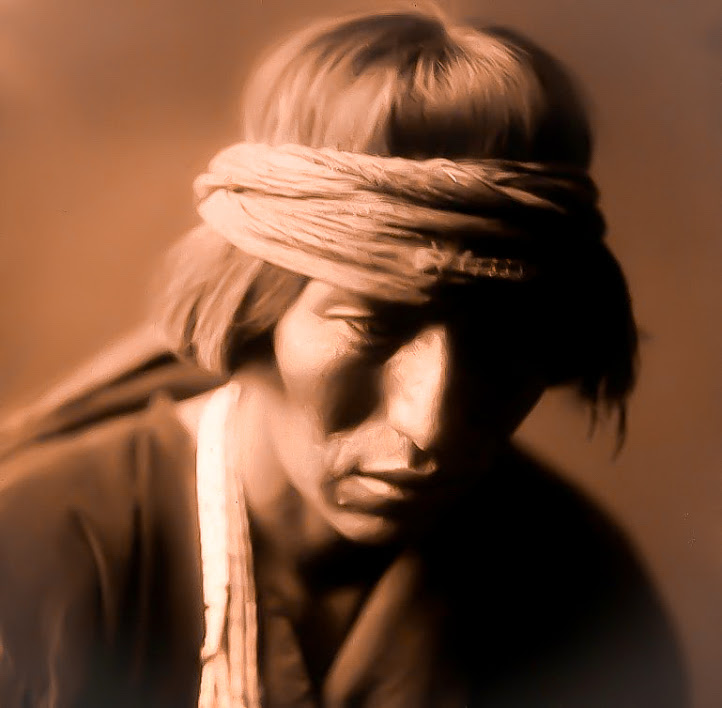
Edward S. Curtis
"It’s such a big order I’m afraid I shall not live to see it through." — Curtis on his quest to document the North American Indian.
Technical & Artistic Mastery
Curtis was more than a record-keeper; he was an innovator of light and chemical processes. His "Pictorialist" approach turned ethnographic documentation into fine art.
P
Photogravure
A high-end printing process using copper plates. This method provided the rich, velvety blacks and soft gradients characteristic of the 20-volume set.
O
Orotone (Goldtone)
The "Curt-tone" process involved printing on glass and backing it with gold leaf and banana oil, creating a luminous, glowing depth that appeared three-dimensional.
R
Rembrandt Lighting
Instead of clinical ethnographic lighting, Curtis used dramatic shadows and single-source light to imbue his subjects with dignity and gravitas.
The "Vanishing Race" & Controversy
Curtis believed he was capturing a culture under threat of extinction. While his goal was preservation, his methods remain a point of intense scholarly debate.
Historical IntentThe Pictorialist Vision
"Preservation through the lens of High Art."
Sought to preserve the dignity and beauty of traditions under active threat from government suppression and forced assimilation.
Used aesthetic mastery to command the attention and significant funding of the world's most powerful people like Morgan and Roosevelt.
Captured 10,000 linguistic and musical wax recordings that are invaluable for modern language revitalization efforts today.
Modern CritiqueModern Critical Lens
"Romanticized fiction vs. Contemporary survival."
Systematically removed 'modern' items (clocks, wagons, umbrellas) to fulfill a pre-conceived idea of the 'pure' Indigenous person.
Reinforced the harmful 'Vanishing Race' myth, suggesting that Indigenous culture had no place in the future of modern America.
Staged ceremonies out of season and mixed tribal clothing, prioritizing his personal artistic vision over strict ethnographic truth.
Vanishing Race
Commissioned by JP Morgan he planned to capture and document what he thought was “The Vanishing Indian”. Guided by this concept, Curtis took over 40,000 images from over 80 tribes and made 10,000 wax cylinder recordings of Indian languages and music. His ethnographies recorded tribal histories as well as described ceremonies, tribal population and customs, foods, clothing and games. In 1930 The North American Indian was published comprising twenty volumes of writing and more than 2,200 sepia toned photographs. After investing decades of his life and his finances in the project, less than 300 copies were sold. Curtis was left bankrupt and divorced and passed away on Oct 19, 1952—his work virtually unknown.
A photo album that took 25 years to make Beginning in 1901 at the age of 33, Edward S. Curtis, a Seattle portrait photographer, spent 25 years documenting Native North American peoples. |
https://www.edwardscurtis.com/
https://edwardcurtis.com/
The Magnum Opus: The North American Indian
Between 1907 and 1930, Curtis published a 20-volume set of books and portfolios.
Scope: He documented over 80 tribes, took more than 40,000 photographs, and made 10,000 wax cylinder recordings of Native languages and music.
Funding: The project was famously bankrolled by financier J.P. Morgan, who provided $75,000 (after being urged by President Theodore Roosevelt).
Physical Format: Each set consisted of 20 volumes of text and small images, plus 20 portfolios of large-scale photogravures. Only about 272 sets were ever finished due to the staggering cost and the onset of the Great Depression.
Artistic Style and Technical Mastery
Curtis was a master of the "Pictorialist" style, which emphasized photography as an art form rather than just a scientific record.
Photogravure: Most of his published work used this high-end printing process, giving the images a soft, rich, and timeless feel.
Orotone (Goldtone): Curtis pioneered the "Curt-tone," a process where an image was printed on glass and backed with gold leaf, creating a luminous, three-dimensional effect.
Lighting: He used dramatic, "Rembrandt-style" lighting to give his subjects a sense of dignity and gravitas, moving away from the cold, stereotypical "mugshot" style of earlier ethnographic photography.


Key Subjects and Discoveries
Curtis photographed some of the most famous figures of the American West, often under difficult conditions:
Princess Angeline: His 1895 portrait of the daughter of Chief Seattle was his first major success.
Geronimo: He photographed the Apache leader shortly before his death.
Chief Joseph: Curtis captured the Nez Perce leader in a series of poignant, dignified portraits.
Ethnographic Detail: He recorded everything from the Hopi Snake Dance to the Kwakwaka’wakw winter ceremonies, preserving rituals that were being actively suppressed by the U.S. government at the time.


Legacy and Rediscovery
The project nearly destroyed Curtis; he suffered a physical and nervous breakdown upon its completion in 1930 and died in relative obscurity in Los Angeles in 1952.
His work was largely forgotten until the 1970s, when a renewed interest in Native American history led to a rediscovery of the original copper plates. Today, his photographs are highly prized by collectors—complete sets of The North American Indian have sold for as much as $2.9 million. Despite the valid criticisms of his methods, many Indigenous communities today use his recordings and photos to help reconstruct lost traditions and linguistic nuances.
US Supreme Court rules half of Oklahoma is Native American land >>>


