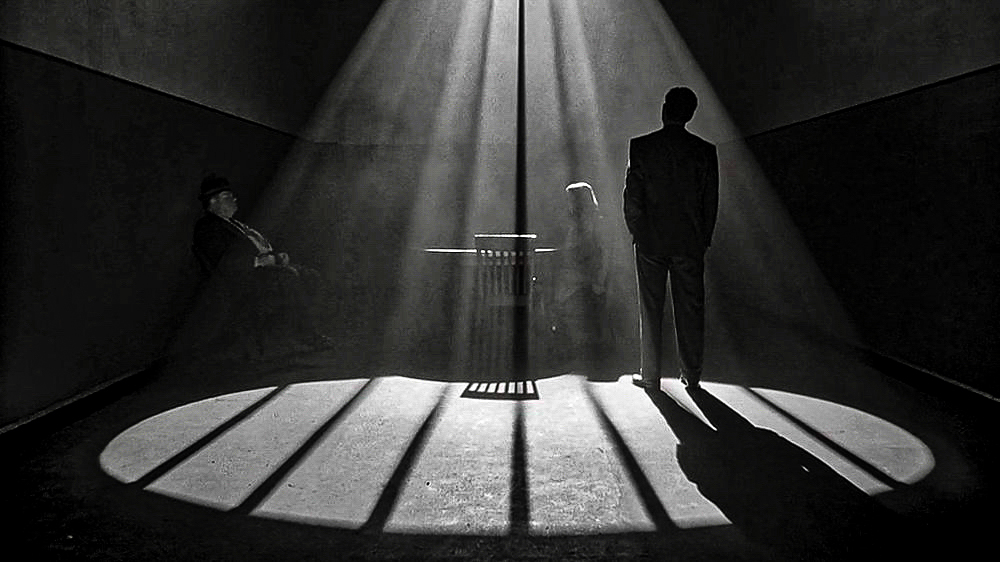
"Billy Bob Thornton plays Ed in a film painstakingly stylized as a film noir of crisp black-and-white photography, enveloped in shadows and an air of impassionate hopelessness."
The Cinematic Universe of the Coen Brothers
Set in a sleepy Northern California town in the 1940s, Joel Coen and Ethan Coen's The Man Who Wasn't There stars Billy Bob Thornton as Ed Crane, a humble barber who suspects his hard-hearted and hard-drinking wife Doris (Frances McDormand) of having an affair with her boss (James Gandolfini). When a jocular stranger (Jon Polito) breezes into town hinting at the fortune to be made investing in an outlandish-sounding new invention called dry cleaning, Ed hatches a blackmail scheme he hopes will make him rich and get him some revenge at the same time.His plan goes horribly awry when he accidentally commits a murder for which Doris ends up being blamed, landing her in the slammer and Ed at the mercy of blowhard big-city lawyer Freddy Riedenschneider (Tony Shalhoub). Filmed in black-and-white by three-time Oscar-nominated cinematographer Roger Deakins, The Man Who Wasn't There was inspired by the seedy crime novels of James M. Cain, putting a distinctly Coen brothers' spin on the film noir tradition.
Perfectly written scenario plus Thornton's ultra low key performance make this film one of my favorite Cohen brother's films

From the opening line:
ED (V.O.)
Yeah, I worked in a barbershop. But
I never considered myself a barber...
till the end
ED (V.O.)
...I don't know what waits for me,
Beyond the earth and sky. But I'm
not afraid to go.
...Maybe the things I don't understand
will be clearer there, like when a
fog blows away...
in this" twisted" example of film noir Cohen brothers one more time showcase why they are one of the best if not the best of what modern American cinema has to offer.
Film noir is rarely about heroes, but about men of small stature, who are lured out of their timid routines by dreams of wealth or romance. Their sin is one of hubris: These little worms dare to dream of themselves as rich or happy. As the title hints, ''The Man Who Wasn't There'' pushes this one step further, into the realm of a man who scarcely exists apart from his transgressions. I kill, therefore I am. And he doesn't even kill who, or how, or when the world thinks he does (although there is a certain justice when he receives his last shave).
Joel and Ethan Coen are above all stylists. The look and feel of their films is more important to them than the plots--which, in a way, is as it should be. Here Michel Ciment is right, and they have devised an efficient, 90-minute story and stretched it out with style. Style didn't used to take extra time in Hollywood; it came with the territory.
But ''The Man Who Wasn't There'' is so assured and perceptive in its style, so loving, so intensely right, that if you can receive on that frequency, the film is like a voluptuous feast. Yes, it might easily have been shorter. But then it would not have been this film, or necessarily a better one. If the Coens have taken two hours to do what hardly anyone else could do at all, isn't it churlish to ask why they didn't take less time to do what everyone can do?
ROGER DEAKINS PHOTOGRAPHY/CINEMATOgraphy >>>
Key Themes and Philosophical Underpinnings
Unlike classic 1940s film noir, which often centers on moral corruption and greed, The Man Who Wasn't There uses the noir framework to explore deeply existentialist questions.
The Existential "Invisible" Man
Ed Crane is the ultimate outsider. He barely speaks, he moves like a ghost, and he is constantly enveloped in a cloud of cigarette smoke. His identity as a barber torments him; he views hair as something dirty and constantly growing, a physical reminder of time passing and useless human output. He is a man who "isn't there" because he lacks agency and connection. When he finally tries to assert himself through blackmail and investment, the universe punishes his attempt at free will, proving that he is merely a passenger to fate.
The Heisenberg Uncertainty Principle
One of the film’s most brilliant thematic motifs is introduced by the fast-talking defense attorney, Freddy Riedenschneider (Tony Shalhoub). He invokes Werner Heisenberg's uncertainty principle to defend Doris:
"The act of looking at something changes it."
This concept serves as a metaphor for the film’s narrative. The more characters try to investigate, analyze, or control their reality, the more elusive the truth becomes. The legal system doesn't care about what actually happened; it only cares about the narrative constructed in the courtroom. Ultimately, truth is subjective and impossible to pin down.
Critical Legacy
Upon its release, The Man Who Wasn't There was highly praised by critics, earning Joel Coen the Best Director award at the 2001 Cannes Film Festival (shared with David Lynch for Mulholland Drive). Roger Deakins also received an Academy Award nomination for Best Cinematography.
While it is occasionally overshadowed by the Coens' more mainstream hits like Fargo or No Country for Old Men, it remains a favorite among cinephiles. It is a slow-burn, atmospheric masterpiece that perfectly captures the tragic, dark comedy of the human condition—where the punishment rarely fits the crime, and the universe remains beautifully, terrifyingly indifferent.
Visual Style and Cinematography
The film is most famous for its stunning black-and-white cinematography by Roger Deakins.
High Contrast: The use of shadows and light (chiaroscuro) evokes the classic noir era of the 1940s.
The "Invisible" Man: The framing often emphasizes Ed's isolation, making him appear as a ghost in his own life—a man who is physically present but emotionally absent.
Existentialist Themes
Unlike traditional noirs where the protagonist is driven by passion or greed, Ed Crane is driven by a vague desire to simply be something else.
The Uncertainty Principle: The film explicitly references Werner Heisenberg’s uncertainty principle, suggesting that the more you look at a situation, the more you change it, and the less you actually know.
Fate vs. Chance: The Coens explore how a single, almost random decision can lead to an inescapable destiny, often punishing characters for the "wrong" crimes.

Billy Bob Thornton’s Performance
Thornton delivers a remarkably restrained performance. Ed Crane rarely speaks, communicating instead through internal monologue and the constant presence of a lit cigarette. His stillness serves as the anchor for the film’s dry humor and pervasive melancholy.
Critical Legacy
While it was a modest success at the box office, the film is highly regarded by critics for its technical precision and narrative depth. It won the Best Director award at the 2001 Cannes Film Festival (shared with David Lynch for Mulholland Drive) and received an Academy Award nomination for Best Cinematography.


%20movie%20script%20-%20Screenplays%20for%20You.png)


%20movie%20script%20-%20Screenplays%20for%20You.png)
.jpg)
%20movie%20script%20-%20Screenplays%20for%20You.png)
%20movie%20script%20-%20Screenplays%20for%20You.png)

%20movie%20script%20-%20Screenplays%20for%20You.png)
.jpg)
%20movie%20script%20-%20Screenplays%20for%20You.png)

%20movie%20script%20-%20Screenplays%20for%20You.png)