Bombs fell as Maria was married to a soldier named Hermann Braun, with the wedding party scrambling for safety. Then came more years of the war. Whatever happened to Maria Braun during those years created a woman who is strong and cruel, sad and indomitable. She is so loyal to her husband of less than a day that she kills for him, and so pitiless to her lover of many years that she drives him to death.
"The Marriage of Maria Braun" was made by Rainer Werner Fassbinder in 1979, near the end of a career so short and dazzling that it still seems incredible he did so much and died so young. Fassbinder made at least 30 features, or many more if you count his television productions, including the 15-hour miniseries "Berlin Alexanderplatz," and he did it all between 1969 and his death at age 37 in 1982.
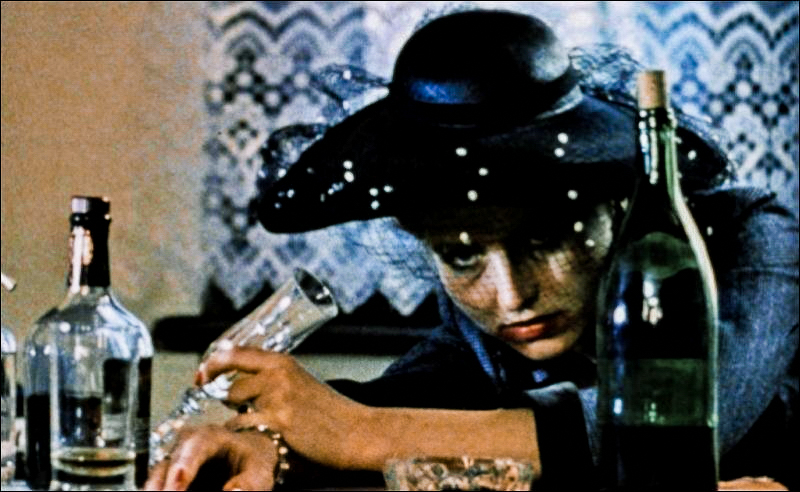
Fassbinder's world was one in which sex, ego and money drove his characters to cruelty, sadism and self-destruction. It is never difficult to discover what they want, or puzzling to see how they go about it. The suggestion is that the war years and the postwar years wounded the German psyche so profoundly that the survivors wanted what they wanted, now, on their terms.
Fassbinder himself was cruel and distant to those around him, particularly those who loved him, and in Maria Braun, he created an indelible monster who is perversely fascinating because she knows exactly what she is doing and explains it to her victims while it is being done.
After the brief opening wedding scene, the story rejoins Maria and her mother immediately after World War II, when they are sharing a flat carved out of a bombed building. She believes her husband, Hermann (Klaus Lowitsch) is dead, although she haunts rail stations with his photograph.
The population is starving and desperate; when an American GI tosses away a cigarette butt, a dozen Germans scramble for it. Maria applies for a job in a nightclub for American soldiers; it's located in a high school gym where she once attended school, and she mounts the parallel bars, which are still in place, and more or less orders the owner to give her the job.
The B-girl joint is the first step on Maria's relentless climb to success. We follow her from about 1946 to the mid-1950s. There is a black American soldier she is fond of (they share the movie's only scene of physical affection), but when her husband unexpectedly returns and finds them in bed, she settles the matter by breaking a bottle over the GI's head. She did not plan to kill him, but he's dead.
Her husband tells the court he did it and is sentenced to prison. Maria remains fiercely loyal to this absent spouse, who is essentially a stranger, for all the rest of the film; perhaps it is her form of loyalty to Germany in its defeat.
The gradual evolution of Maria Braun from a desperate scavenger to a rich beauty; Hanna Schygulla, who met Fassbinder in school and starred in 20 of his films, had an uncanny ability to float just out of range of analysis, as if she were not acting but getting her effects through dreamy murderous impulses -- that despite the fact that every shot was precisely blocked and the dialogue has the precision and brutality of a play by Neil LaBute.
What happens to Maria and her husband in the final scene was the subject of heated discussion after the film played at Cannes in May 1979. It's a surprise, but you must admit it is as plausible an ending as any other. I remember Fassbinder late at night at a back-street bar at Cannes that year, always in his black leather jacket, surrounded by his crowd, often scowling or arguing as they tried to please him. He was Maria Braun and they were all Oswalds. But he was a genius. That much everyone admitted.
ESSENTIAL RAINER WERNER FASSBINDER FILMS >>>
Rainer Werner Fassbinder was the engine room of post-war German film. In a career that lasted barely 15 years, he completed over 40 feature films, revolutionizing the way society looked at its own scars, prejudices, and hidden desires.
Influenced by the lush melodramas of Douglas Sirk and the alienation techniques of Bertolt Brecht, Fassbinder created a unique cinematic language. His films were not just movies; they were surgical dissections of power dynamics, exploitation, and the "exploitability of feelings."
The Marriage of Maria Braun (German: Die Ehe der Maria Braun) is a 1979 West German drama that stands as one of the most significant achievements of the New German Cinema movement. It is the first installment of Fassbinder’s BRD Trilogy (referring to the Bundesrepublik Deutschland), followed by Lola (1981) and Veronika Voss (1982).
.jpg)
Plot Summary
The film follows Maria Berger (Hanna Schygulla) and Hermann Braun (Klaus Löwitsch), who marry during an Allied bombing raid in 1943. After just "half a day and a whole night" together, Hermann is sent to the Eastern Front. At the war's end, Maria is informed that Hermann has died, but she remains steadfastly devoted to his memory.
To survive the post-war devastation, Maria works in a bar for American GIs, eventually beginning a relationship with Bill, a Black American soldier. When a very much alive Hermann unexpectedly returns from a POW camp and finds them in bed, a fight ensues. Maria kills Bill to protect Hermann, but Hermann takes the legal blame and goes to prison in her stead.
Maria then embarks on a ruthless ascent during the West German "Economic Miracle" (Wirtschaftswunder). She becomes the mistress and business partner of a wealthy industrialist, Karl Oswald, all while maintaining her loyalty to the imprisoned Hermann. The film culminates in an ambiguous explosion at the moment West Germany wins the 1954 World Cup, symbolizing the volatile reconciliation of Germany's past and its prosperous, but spiritually hollow, presen

The Final Scene: The Miracle of Bern
The film’s ending is one of the most debated in cinema history. As the radio broadcasts the final moments of the 1954 World Cup (where West Germany beat Hungary), Maria leaves the gas on in her kitchen. Whether the resulting explosion is an accident or a deliberate act of suicide remains ambiguous.
Symbolism: The explosion occurs exactly when Germany wins the Cup—the moment the "New Germany" is officially born on the world stage.
Interpretation: Some critics see it as the "bill coming due" for the moral shortcuts taken during the reconstruction. Others see it as Maria’s realization that the "Hermann" she loved no longer exists, leaving her with nothing but a hollowed-out success.
He tormented his actors, threw drinks at his cameraman, and died of an overdose at 37, leaving behind two dead lovers – and an extraordinary body of work. |
Fassbinder directed his first feature in 1969, and was dead in 1982. Who else has created such a torrent of film, at such a high level of artistry? It's tempting to say he hurried because he knew his time was limited. Not at all. He hurried because his life was in his work, and those who knew him best wrote afterwards that he feared losing his friends and lovers if he did not always keep them around, in a flood of films and plays. If he had lived, and worked at the same rate, he would have made 80 films by now. Perhaps no one could have kept up that pace. He might have kept up the quality, however; it is sobering to think how much we lost when he died alone in that sad locked room.
Fassbinder films capture a frantic life's desperation >>>


.jpg)


.jpeg)


.jpg)

.jpg)



.jpg)