Fassbinder directed his first feature in 1969, and was dead in 1982. Who else has created such a torrent of film, at such a high level of artistry? It's tempting to say he hurried because he knew his time was limited. Not at all. He hurried because his life was in his work, and those who knew him best wrote afterwards that he feared losing his friends and lovers if he did not always keep them around, in a flood of films and plays. If he had lived, and worked at the same rate, he would have made 80 films by now. Perhaps no one could have kept up that pace. He might have kept up the quality, however; it is sobering to think how much we lost when he died alone in that sad locked room.
Rainer Werner Fassbinder emerged in the late sixties to become one of the most prolific and influential filmmakers of what would become known as New German Cinema. Fassbinder was born in 1945 and like other filmmakers of his generation, including Werner Herzog, Volker Schlöndorff and Wim Wenders, he dramatically altered the cinematic landscape by telling stories about postwar Germany that focused on its economic, social and political issues problems faced and the power dynamics between individuals.
Fassbinder, more than any other major European art film director, so consistently privileged the language of theater and transposed it to the cinematic medium– effectively constituting a new film idiom. Moreover, Fassbinder’s specific employment of theatrical language and performance allow for a complex exploration of identity and identification.
Before Fassbinder turned his attention to film, he was involved in Munich’s theater community and later formed his own group called the “Anti-theater.” Thus it is not so surprising that Fassbinder’s passion and involvement with theater informs the basis for his entire stylistic and intellectual approach to filmmaking.

However, the strategic decision to synthesize two distinct representational “languages” must be considered not only as an aesthetic or formal choice but also a political one—one which refuses to affirm the traditional view that designates theater and cinema as rivals.
Like the theater revolutionary writer and theorist Bertolt Brecht, Fassbinder once remarked that even though his films often end on an unhappy note, what film scholar Richard Dyer termed “left-wing melancholy,” his goal was to encourage viewers to reveal the mechanisms of how society works in order to enable them to enact change in their own lives, rather than succumb to intellectual passivity.
He does this through his use of theatrical conventions, for example—stylized poses and gestures, non-naturalistic acting, diction, and utterance—which reveals simultaneously the structure of power that operates within social, political, and interpersonal discourse. Fassbinder merges the illusionist power of film language with a modernist theatrical language. Without stifling identification with the heroines and social outcasts he often represented, he allows audiences the opportunity to think and feel.
As an auteur, Fassbinder created a visually and imaginatively rich film repertoire that melds Hollywood melodrama and Brechtian distanciation to great effect.
Ali: Fear Eats the Soul (1974)
The first shots set up the theme: them against us. An older woman, dumpy and plain, walks into an unfamiliar bar and takes a seat at the table inside the door. The barmaid, an insolent blond in a low-cut dress, strolls over. The woman says she will have a Coke. At the bar, a group of customers turns to stare at her, and the camera exaggerates the distance between them. Back at the bar, the blond tauntingly dares one of her customers to ask the woman to dance. He does. And now the camera groups the man and woman together on the dingy dance floor, while the others stare.
“Ali: Fear Eats the Soul” (1974) tells the story of these two people. Emmi Kurowski (Brigitte Mira) is about 60, a widow who works two shifts as a building cleaner, and whose children avoid her. Ali (El Hedi ben Salem) is about 40, a garage mechanic from Morocco, who lives in a room with five other Arabs and describes his life simply: “Always work, always drunk.” Ali is not even his real name; it’s a generic name for dark-skinned foreign workers in Germany.
Fassbinder said he made the film just to fill the time between bigger pictures, but “Ali” may be the best of his 40 or so films; it certainly belongs on the short list with “The Marriage of Maria Braun” and “Merchant of the Four Seasons.”
The film is powerful but very simple. It is based on a melodrama, but Fassbinder leaves out all of the highs and lows, and keeps only the quiet desperation in the middle. The two characters are separated by race and age, but they have one valuable thing in common: They like one another, and care for one another, in a world that otherwise seems coldly indifferent. When Emmi shyly confesses she is a building cleaner, she says many people look down on her for that. Ali, whose German is limited, expresses his position more directly: “German master, Arab dog.”
“Ali: Fear Eats the Soul” might sound like improbable, contrived soap opera. It doesn’t play that way. The reason it gathers so much power, I think, is that Fassbinder knew exactly what was meant by the title, and made the film so quickly he only had time to tell the truth.
The Marriage of Maria Braun (1979)
Bombs fell as Maria was married to a soldier named Hermann Braun, with the wedding party scrambling for safety. Then came more years of the war. Whatever happened to Maria Braun during those years created a woman who is strong and cruel, sad and indomitable. She is so loyal to her husband of less than a day that she kills for him, and so pitiless to her lover of many years that she drives him to death.
All the time she is keeping score: nylons and cigarettes at first, then a good job, fashionable clothes, a house in the suburbs, expensive restaurants. At the end, her desperate lover, who is also her boss and has made her rich, tries to get a word with her; as he talks, she continues to enter numbers into an adding machine.
"The Marriage of Maria Braun" was made by Rainer Werner Fassbinder in 1979, near the end of a career so short and dazzling that it still seems incredible he did so much and died so young. Fassbinder made at least 30 features, or many more if you count his television productions, including the 15-hour miniseries "Berlin Alexanderplatz," and he did it all between 1969 and his death at age 37 in 1982.
Fassbinder's world was one in which sex, ego and money drove his characters to cruelty, sadism and self-destruction. It is never difficult to discover what they want, or puzzling to see how they go about it. His occasional gentle characters, like the old woman in "Ali -- Fear Eats the Soul" (1974), are eaten alive. The suggestion is that the war years and the postwar years wounded the German psyche so profoundly that the survivors wanted what they wanted, now, on their terms. Fassbinder himself was cruel and distant to those around him, particularly those who loved him, and in Maria Braun, he created an indelible monster who is perversely fascinating because she knows exactly what she is doing and explains it to her victims while it is being done.
THE MARRIAGE OF MARIA BRAUN (1979) >>>
Veronika Voss (1982)
The decay of a great star
Rainer Werner Fassbinder premiered "Veronika Voss" in February 1982, at the Berlin Film Festival. It was hailed as one of the best of his 40 films. Late on the night of June 9, 1982, he made a telephone call from Munich to Paris to tell his best friend he had flushed all his drugs down the toilet — everything except for one last line of cocaine. The next morning, Fassbinder was found dead in his room, a cold cigarette between his fingers, a videotape machine still playing. The most famous, notorious and prolific modern German filmmaker was 36.
Does this film represent a premonition of his own death? It tells the story of a German actress who worked tirelessly and achieved great fame, but began depending on drugs and alcohol and eventually became so addicted that she sold her body and soul for drugs. Her fortune spent, her marriage destroyed, she began to live as an inpatient in the clinic of a sinister Berlin woman who billed herself as a psychiatrist but was also a Dr. Feelgood who strung along her patients on morphine and controlled them by withholding their supply.
The film opens in 1955 with Voss (Rosel Zech) looking at one of her own pre-war classics (that's Fassbinder himself in the audience, leaning on the seat-back behind her). There was a time when she was welcomed in the offices of producers, greeted by hea
dwaiters, recognized on the street. That time has passed, and it is painful to hear her remind people who she is — or was. One night, drinking without funds in a cabaret, she falls into conversation with a soft-faced sportswriter named Robert Krohn (Hilmar Thate), who is old enough to remain under her spell. She grandly says she will pick up the check, then "allows" him to do it, and invites him to come home with her. All the furniture in her villa is covered in white sheets, the electricity is disconnected, and she has them light candles "because they are so much more flattering to a woman." The star struck journalist has without realizing it walked into the last act of Veronika Voss's life.

Weighing in at 930 minutes, Berlin Alexanderplatz is often cited as the longest movie ever made. This is because it was made by the great film director Rainer Werner Fassbinder, but actually his 15-hour odyssey through the underbelly of interwar Berlin began life as a riveting TV series.
Fassbinder, the coke-and-booze-fuelled terror of the 1970s German film industry, loved Alfred Döblin's 1929 novel about Franz Biberkopf, a petty criminal jailed for killing his prostitute girlfriend, then released a few years later into a Berlin in meltdown. Nazis and Communists are fighting on the streets, gangsters are taking over businesses, and everyday people living in fear. Stripped to its bare bones, Biberkopf's story is pretty miserable: he tries one pathetic money-earner after another, works his way through various underworld women, loses his arm after being thrown out of the back of a van, and discovers his one true love, another prostitute, has been murdered by one of his criminal pals.
But it's the murderous intensity with which Fassbinder bears down on Biberkopf's experience that makes Berlin Alexanderplatz so compelling. The episode titles alone give you some idea of its haunting power: A Handful of People in the Depths of Silence; The Serpent in the Soul of the Serpent; About the Eternities Between the Many and the Few. This is a vision of a man hamstrung by forces outwith his control, doomed to a life of angst.
True, Berlin Alexanderplatz isn't especially stylish to look at: much of it is rudimentary, even stagey. This doesn't apply to the final episode, though, which is simply bizarre: Fassbinder wrote his own epilogue, called My Dream of the Dream of Franz Biberkopf by Alfred Döblin. This is a two-hour parade in which Biberkopf, accompanied by two angels in blonde wigs and suspender belts, encounters every character that has passed through the story, dead and alive. As baffling dream sequences go, it's in a league of its own.
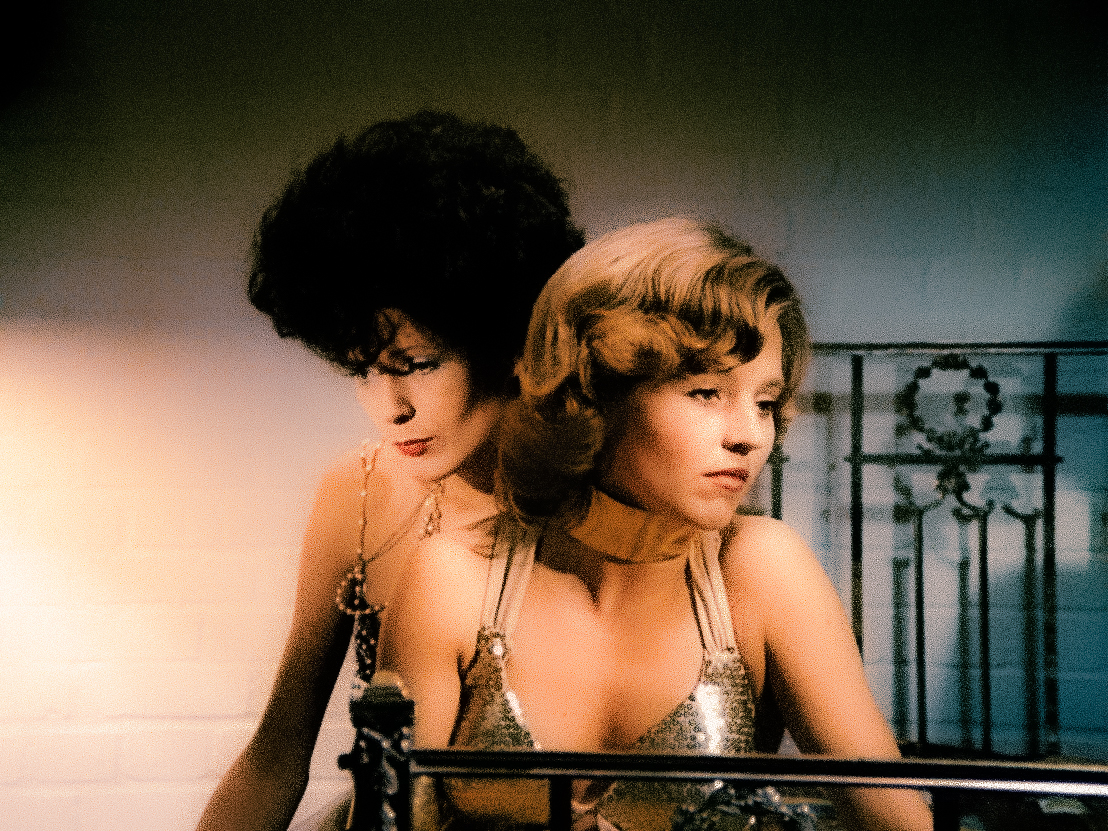
The Bitter Tears of Petra von Kant (1972)
The Bitter Tears of Petra von Kant is one of the director’s more intimate and intensely personal films: Fassbinder said it was his most autobiographical.
Bitter Tears centers on the romance between the title character (Margit Carstensen), a famous fashion designer, and an aspiring model named Karin Thimm (Hanna Schygulla, Fassbinder’s frequent muse). They enter into an affair, with Petra assuming a dominant role in the relationship, but Karin learns to exploit the older woman’s emotional attachment, and the two end up switching roles. As in his earlier films, Fassbinder argues that love is colder than death—it’s a transaction in which one party benefits and the other party loses. At the same time, the writer-director gives the characters greater depth than he did to those in his previous work. Bitter Tears hinges on several extended monologues wherein the characters delve into their pasts and their current beliefs, and these passages give the movie a novelistic texture. One sees the characters as individuals, not just representations of a social order.
Bitter Tears was adapted from a play Fassbinder had staged in Munich not long before, and the film retains the theatrical conventions of its source material. The action is limited to one place, Petra’s home, and each of the scenes plays out in real time. Fassbinder evens heightens the sense of theatricality with opulent costumes, moments of grandly overstated acting, and painted walls that evoke theatrical backdrops. In doing so, he makes theatrical convention seem arbitrary and constricting—much like he presents love as an arbitrary and constricting convention that replicates in miniature the order of capitalist society. Fassbinder ironically appeals to the emotions in conveying this argument—in the movie’s most commanding scenes, Bitter Tears drops the curtain of artifice as characters bare their souls and voice their most primitive emotional needs. Fassbinder elicits more naturalistic performances during these scenes and shoots some of them in close-up. It feels as though the director has broken through his style to achieve something universal and direct.
Beware of a Holy Whore (1971)
Comparisons between Beware of a Holy Whore and Godard’s Contempt and Truffaut’s Day for Night are unavoidable, but even if the film is not quite as successful as those two films it’s infinitely funnier. At once Fassbinder’s most accessible and self-indulgent film, Beware of a Holy Whore catalogs the emotional baggage of actors holed up inside a Spanish seaside hotel during a tedious and under-financed movie shoot. The film is, at first glance, about making movies.
This is how the cinema looked, in 1971, to the twenty-six-year-old director Rainer Werner Fassbinder, who already had ten feature films under his belt. The cast and crew of a politicized costume drama are holed up in a Spanish villa while awaiting their star, their equipment, and their money; meanwhile, they drink joylessly and engage in provocative sexual escapades, subtly Machiavellian manipulations, and cruel displays of power that threaten the film with emotional sabotage. The director, Jeff (Lou Castel), betrayed by his financiers and obliged to complete a doomed production, plays these games as recklessly as his employees do. He risks alienating his star, Eddie Constantine (playing himself), with his allusive script and its violent action. The increasing dissolution of the shoot is captured in the kaleidoscopic fragmentation of the story, which shatters the filmmaking process into a whirl of dispersed moments of latent or blatant conflict—which is the stuff that Jeff’s film is made of. Co-starring Fassbinder himself, as an assistant whose practical wiles don’t prevent his own breakdown.
Fox and His Friends (1975)
At the delicate art of combining the bizarre and the mundane, nobody is more skillful than Rainer Werner Fassbinder. His formula is wickedly simple. He begins, often enough, with elements of lurid sexuality. Then he films against type, looking for deliberately banal characters and locations. And then, in a stylistic double reverse, he photographs his banal subjects with a highly mannered artificiality.
The results are uneven, but then anyone who's made some 33 films and is only 36 years old can be excused for a certain inconsistency. What's important is that when everything's working, Fassbinder produces work that's hauntingly poignant.
And it's especially true of "Fox and His Friends," a 1975 film which won a Gold Hugo in the Chicago Film Festival. Fassbinder himself takes the leading role, playing a naive and slightly dense, young working-class man who wins the state lottery and soon finds himself - and his lottery winnings - embraced in Munich's gay circles.
The movie begins by seeming to be about a homosexual relationship; the slightly dazed young hero is adopted by the superficially charming son of a rich industrialist. But then things grow complicated. The industrialist, we learn, is about to go bankrupt. The son hopes to save the business. One solution might be to swindle the easily flattered lottery winner out of his fortune - using love as a pretext.
Fassbinder is a specialist at scenes in which the unspeakable is spoken, the unthinkable is thought, the undoable is done with a vengeance. All three of those elements come into play in the film's best scenes, including a brilliantly complex dinner scene. The industrialist's son brings his new lover home to meet his parents, and it becomes chillingly clear that sex is not the issue with this family; money is. The relentlessly upper-middle-class parents and their gay son are, in fact, engaging in a form of tacit prostitution, trading the fashionable facade of their lives for the money they desperately need.
Fassbinder films capture a frantic life's desperation
In the 1970s Rainer Werner Fassbinder was a familiar presence at film festivals, invariably clad in black leather, a cigarette always in his hand, a scraggly mustache drooping over lips that seemed curled in constant ironic amusement. He traveled with a pack of friends, lovers and associates, and at Cannes, for example, you expected them all to turn up sometime after midnight at Le Petit Carlton, the little all-night bar where the party spilled out into the street.
He was sublimely uninterested in publicity, in press conferences, in interviews. He wasn't awake during the hours when all of that went on. I had dinner with him once at the Montreal festival, but he was more interested in brandy than conversation. At some festivals he would have two or three films (he made about 40 in 14 years), but until late in his career they were made on small budgets with unknown actors, so he didn't have to play the money game. Yet the screenings for his movies were always packed--critics wanted to see them even if their readers back home didn't--and there was always a feeling of heightened anticipation when the lights went down.
Fassbinder worked quick and loose, but his films weren't sloppy; his visual style was a tight observant mannerism that locked all of those strangely assorted stories into the same world view. His typical films were supercharged melodramas in which the eternal themes of love, jealousy, shame and betrayal were played out in a style that valued them at the same time it mocked them. You felt he had a certain contempt for the formulas of romance and heartbreak, but that he took the subjects very seriously indeed.

-2.jpg)





.jpg)